Six in ten Britons not confident any major political party has a good plan for changing Britain
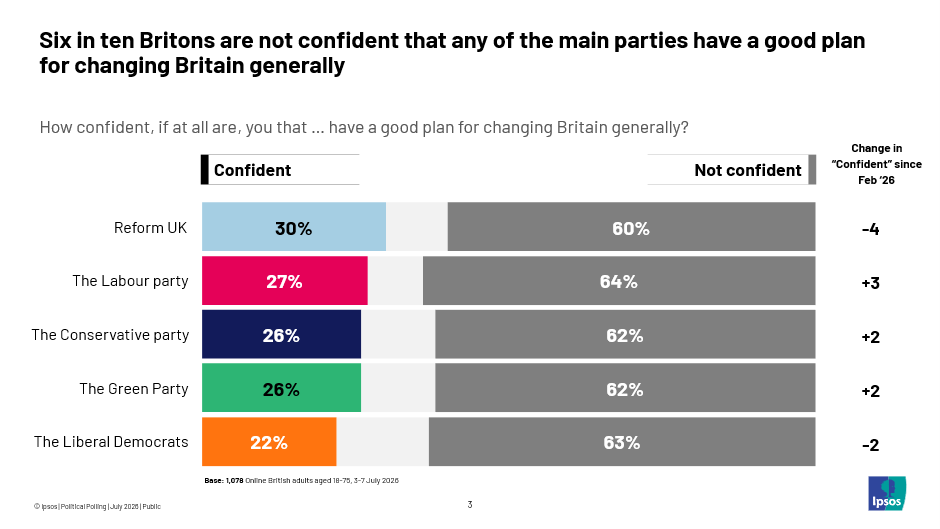
- 6 in 10 British adults express a lack of confidence in all the major national parties’ plans to change the nation generally.
- 30% feel confident in Andy Burnham's plan for changing Britain generally, placing him marginally ahead of other national party leaders, though 54% still remain not confident in him.
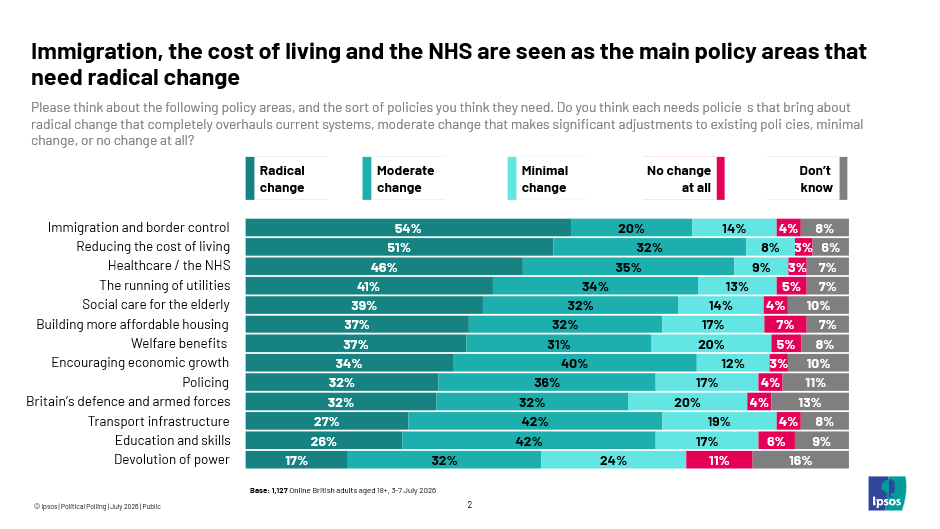
- 54% support radical change to overhaul immigration and border control systems, closely followed by 51% who say the same for reducing the cost of living.
- However deeper questioning reveals Britons do not always agree on exactly what sort of change they would like to see
Widespread public appetite for radical policy reform
The research underscores a strong public consensus that major national systems require a complete overhaul rather than minor or moderate updates. Headline areas traditional to household stability lead the public demand for sweeping policy shifts.
- 3 in 4 (74%) would like to see significant change regarding immigration and border control, with 54% wanting to see radical change and a further 1 in 5 (20%) seeking moderate but still significant change. This is highlighted by qualitative feedback, with one respondent saying that they feel "illegal immigration is becoming unsustainable & putting strain on health care". Though as with other policy areas, there is a range of views on the exact nature of change that people want to see, with others stressing the importance of “sensible control” and some the need for better relations with immigrants.
- Just over 8 in 10 (83%) say they’d like to see significant change to the cost of living, with the majority of this group saying it needs radical change (51%) relative to moderate change (32%). A member of The Beat qualitative community elaborated that they see this as a structural, systemic issue, noting that "things don’t seem broken because of one big decision – they’ve slowly become harder."
- A similar share (81%) feel healthcare and the NHS are in need of significant change, with slightly more in favour of radical change here (46%) relative to moderate change (35%). This aligns with qualitative insights from Ipsos’ online community, The Beat, where members noted that "the NHS needs a massive, radical shake up" because simple tasks like getting a GP appointment "feels like a lottery". Again, though, other Ipsos data suggests Britons are more focused on a need for reform within the current model rather than no longer supporting the founding principles on which the NHS is based, and instead are most looking for improvements to delivery and access.
- Indeed, while there is an agreement on the need for change there is a broader debate on the exact nature of the change needed – some qualitative participants argue that “gradual tinkering has failed….. we need radical change now” while others believe “a lot of our existing systems can work well if they’re properly managed” or worry that “radical change sounds exciting, but it often brings unintended consequences”.
- The qualitative data also highlights other areas where opinions diverge, such as over the definition of fairness. For some, it means wealth redistribution ("make the rich pay more, spread the wealth"), while for others, the focus shifts toward contribution and more efficient public expenditure ("benefits should be a safety net, not a pay cheque").
- Britons are more split on the amount of change needed on devolution, where half (49%) would like to see significant change, of which 17% say they want radical change and 32% more moderate.
Scepticism towards national parties and leadership plans
The polling further shows generalised lack of public confidence regarding whether any mainstream political group holds a viable blueprint for long-term improvement.
- 6 in 10 Britons (60%) are not confident that Reform UK has a good plan for changing Britain generally, despite the party holding a slight edge over others with 30% saying they are confident.
- 64% are not confident in the governing Labour party's plans, though the party has seen a modest increase of +3 percentage points in confidence since February 2026 to 27%.
- A further 62% report a lack of confidence in the plans of both the Conservative party and the Green Party, while 63% feel not confident in the Liberal Democrats.
- 3 in 10 Britons (30%) express confidence that Andy Burnham has a good plan for changing Britain, compared with 27% for Nigel Farage, 26% for Kemi Badenoch, 23% for Zack Polanski, and 22% for Ed Davey. However the majority lack confidence in each of the leaders.
- 3 in 10 Britons (30%) express confidence that Andy Burnham has a good plan for changing Britain generally, compared with 27% for Nigel Farage, 26% for Kemi Badenoch, 23% for Zack Polanski, and 22% for Ed Davey.
- Qualitative data indicates that the definition of fairness remains contested. For some, it means systemic wealth redistribution ("make the rich pay more, spread the wealth"), while for others, the focus shifts toward contribution and restricted public expenditure ("benefits should be a safety net, not a pay cheque").
Commenting on the findings, Gideon Skinner, Senior Director of Politics at Ipsos in the UK said:
The public’s priorities for change are pretty clear – reducing the cost of living, improving the NHS, and taking a better grip of immigration and border control. However, there is a distinct lack of confidence in any of the major national parties’ ability to deliver the change that Britons want to see. This also extends to the Prime Minister in waiting, Andy Burnham, who still needs to persuade a public currently reserving judgement that he has the answers.
The task facing politicians, however, is not made any easier by the fact that ‘change’ itself will mean different things to different people, which reinforces the importance of digging beneath the general demand for change to understand the public’s specific priorities in each policy area. What is most likely to unite Britons are tangible improvements that make a difference to the pressures that they feel in their daily lives, backed up by a viable roadmap for the future that makes them feel optimistic that the country’s economy and public services will be fit for purpose again.
Notes:
- Ipsos interviewed a representative sample of 1,127 online British adults aged 18+ (and 1,078 online British adults aged 18-75 for party/leader confidence questions). Polling was conducted online between 3–7 July 2026.
- Data are weighted to match the profile of the population. All polls are subject to a wide range of potential sources of error.
- Qualitative community insights were sourced from 204 participants via The Beat online community between 6–7 June 2026.