Manifesto Championship

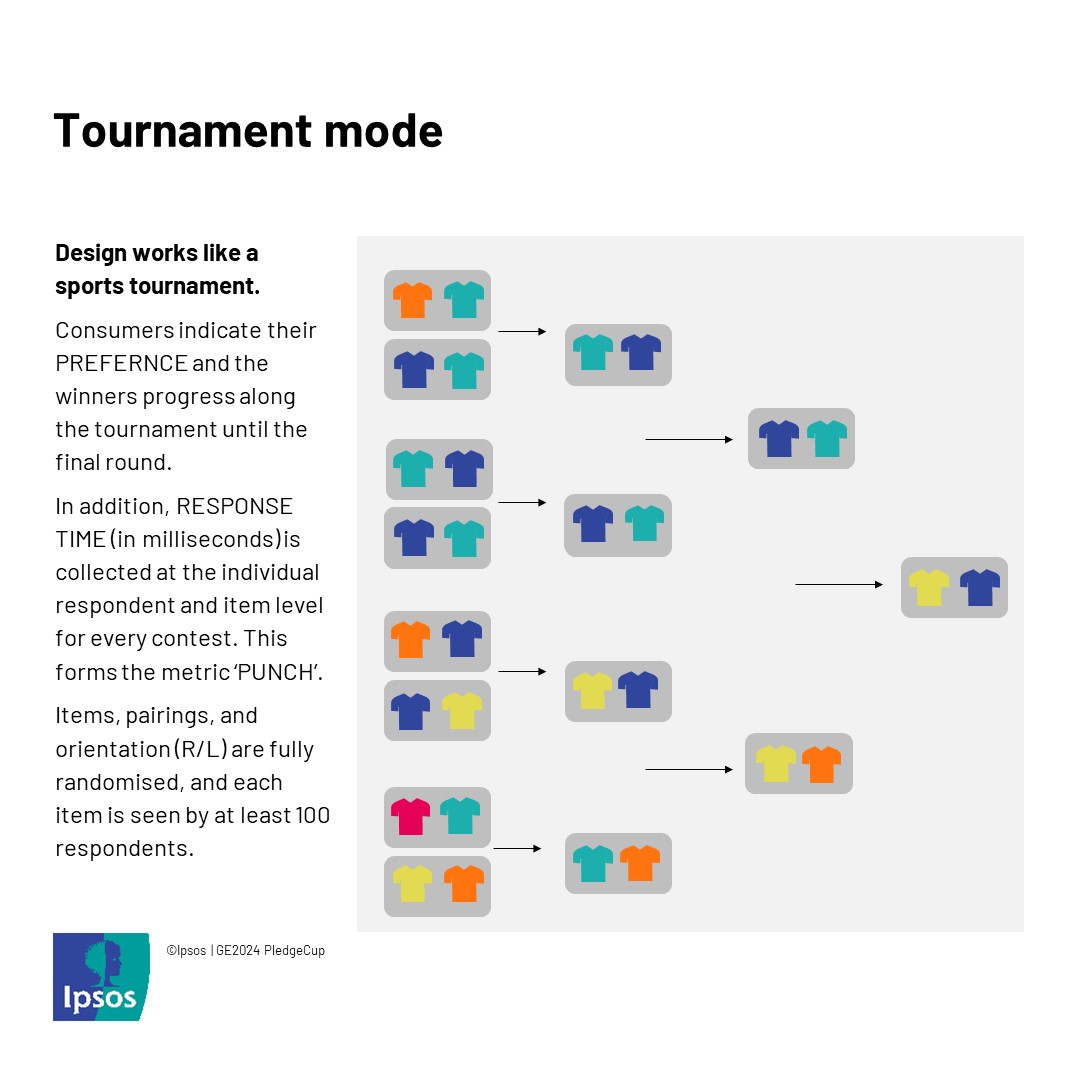
Our Manifesto Championship tested 56 of the key policies announced in party manifestos with the public. It used a message testing approach called Ipsos DUEL to compare policy pledges in a series of ‘matches’. Each participant was shown a random selection of 16 pledges in their own mini-tournament, knocking out the worst performing to select an overall winner.
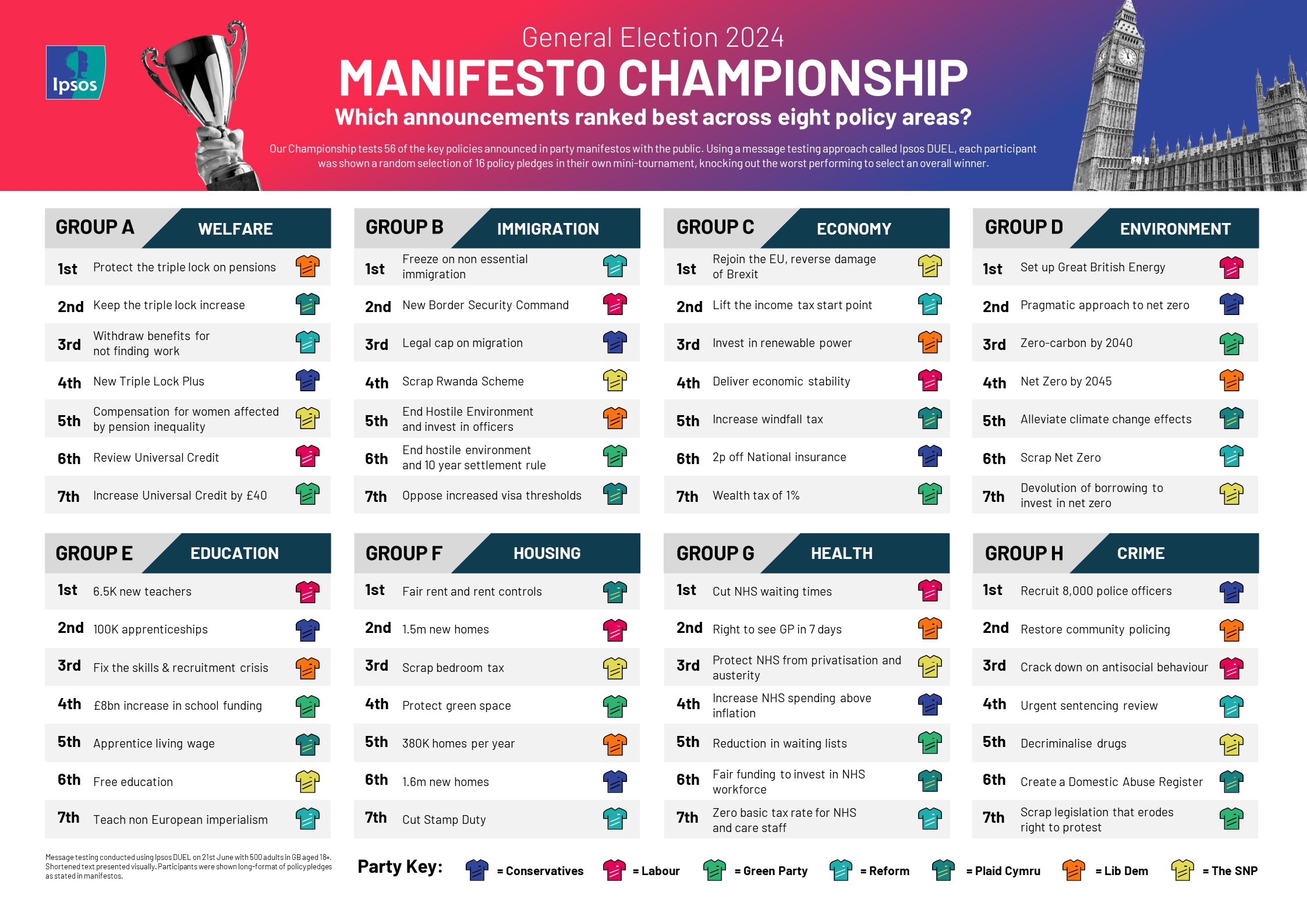
Ipsos identified 8 broad groups of policy announcements, selected based on the issues identified as being most important in helping voters decide who to vote for. These included, Health, Economy, Welfare and Housing. Within each group, Ipsos selected one leading policy announcement from each of the seven main parties contesting the election.
Policy pledges were shown ‘blind’ so that they could be judged on their own merit, without knowing which party had made the announcement. The Preference Score combines the results from over 7,500 ‘matches’ as selected by our 500 participants. This provides an opportunity to see which pledges landed best with voters.
GROUP STAGES: ranking all pledges within their policy 'group'
KNOCKOUT STAGE: the top 16 performing pledges in a route to the final
DREAM TEAM: the best 11 performing policy pledges over all
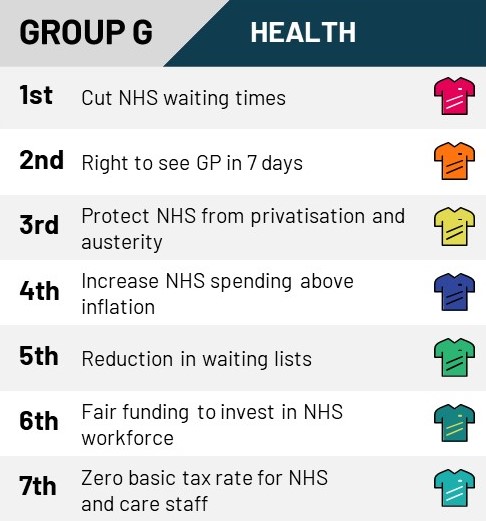
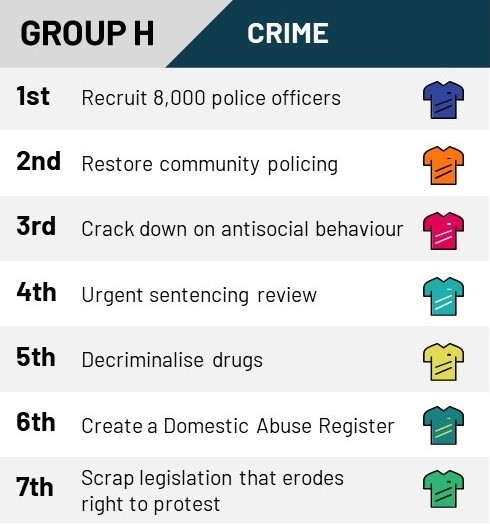
GROUP STAGES
Key findings
- All but the Green Party can claim victory in one of our 8 groups; with the winning pledges representing policies from across the political spectrum
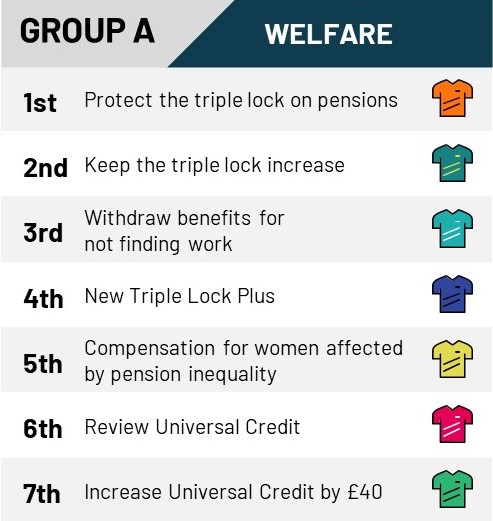
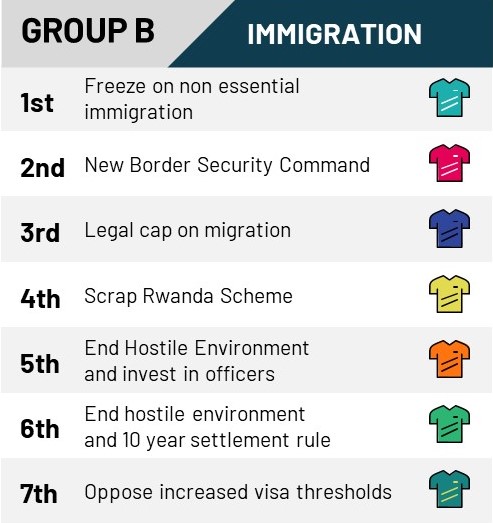
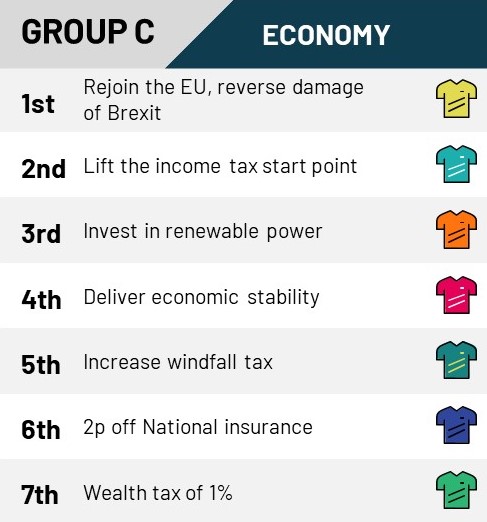
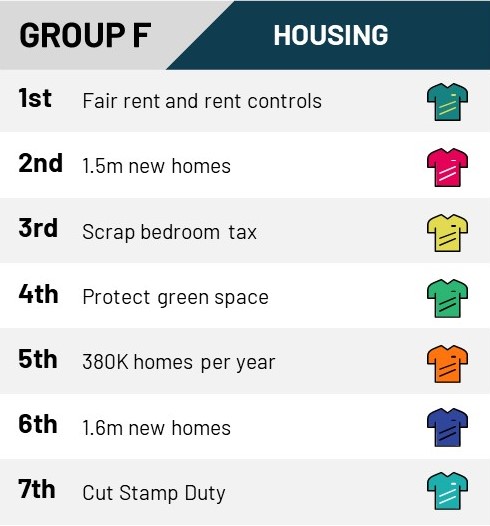
- Plaid Cymru pledge on Fair rent and rent controls is the most preferred housing policy, Reform’s pledge to Freeze non-essential immigration tops the ‘group’ on Immigration, and SNP’s pledge to Rejoin the EU, reverse the damage of Brexit, is the top performing economic pledge we tested
- Labour only just come out on top as the best performing party overall: they achieve an average score of 109 across their 8 policies, winning 3 of the 8 groups (on Health, Environment and Education)
Groups
 |  |
 |  |
 |  |
 |  |
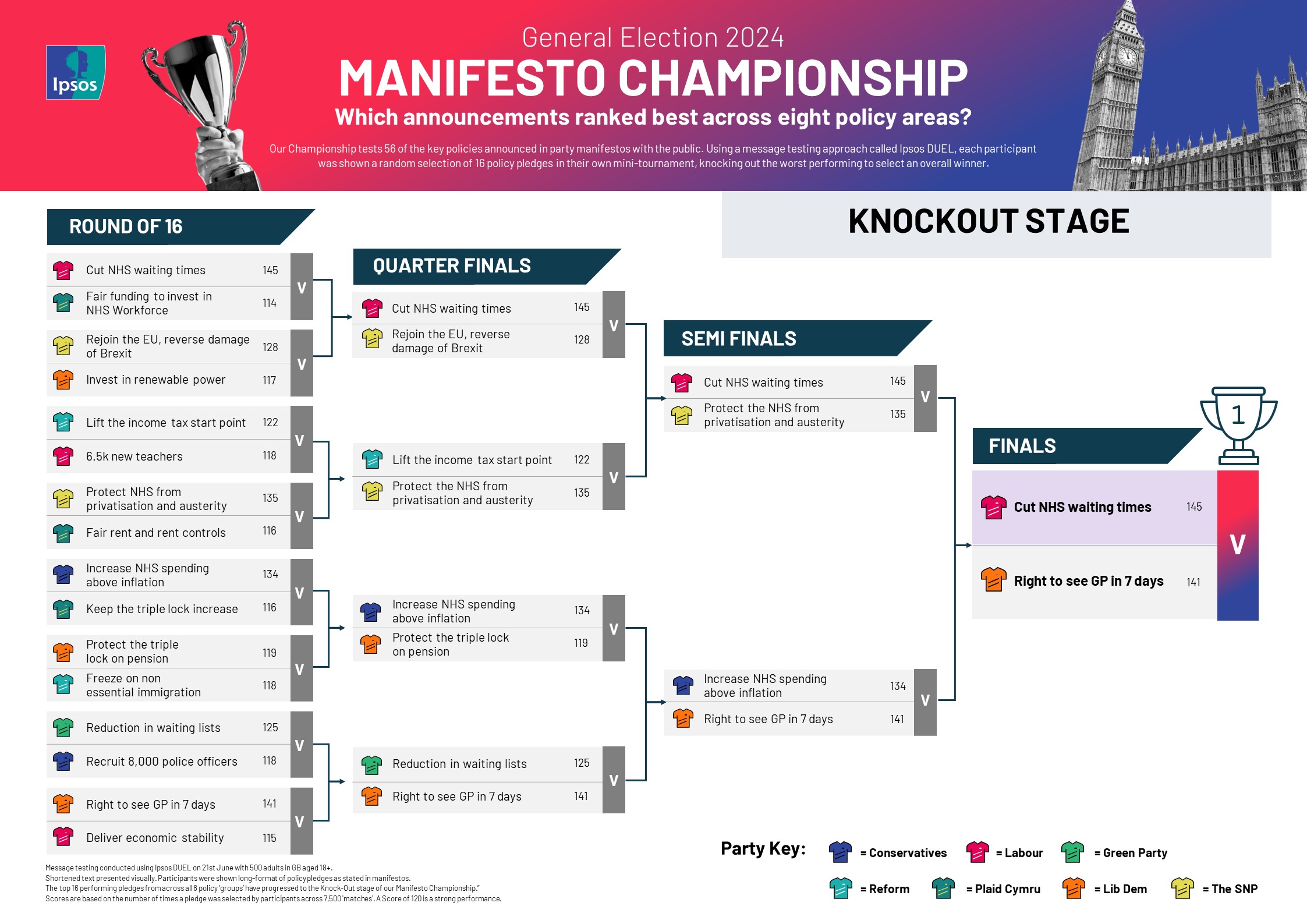
KNOCKOUT STAGE
Key findings
- Labour's pledge to Cut NHS Waiting Times is the top performing pledge, with a Preference score of 145
- The top 4 pledges are all related to Health, dominating the semi-finals, which aligns with wider polling showing health as a key issue for voters
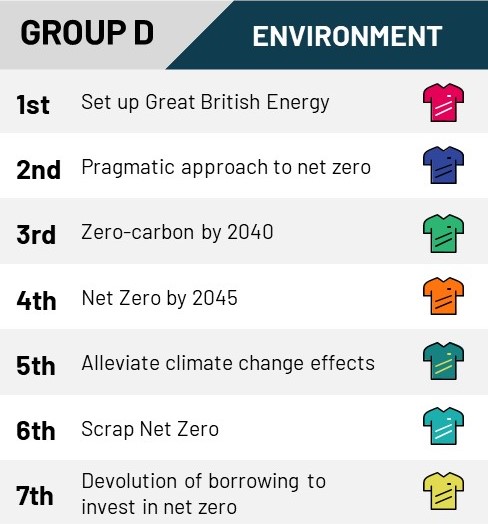
- In contrast, pledges relating to the Environment are the least preferred, receiving an average score of 81 compared to 127 for Health. Environment pledges don't make it through to the Knockout Stages, the highest ranked Environmental Pledge is ranked 24th. This challenges the sincerity of voters' green credentials
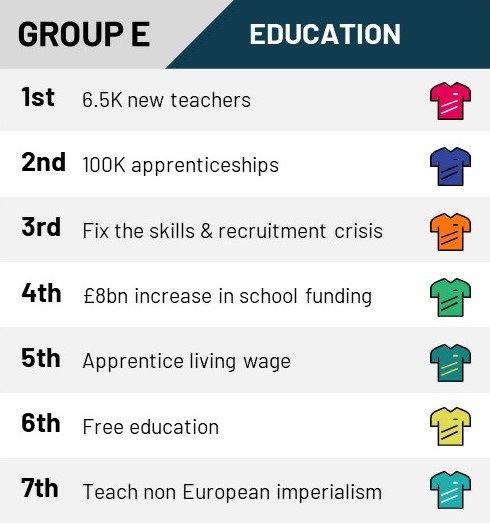
- Once the top 16 performing pledges qualified for the Knock Out stages, flagship pledges on recruiting teaches and police offices get knocked out at the first round of 16
- Welfare and economic pledges such as protect the triple lock (119), lifting income tax (122), and rejoin EU to reverse damage of Brexit (128) are the best of the rest, but are comfortably beaten by pledges to health
- The final is a close shootout between two pledges to invest in the NHS. Cutting NHS waiting lists (Lab score of 145) is marginally seen as a greater priority than 7 day access to GPs (Lib Dem score of 141)
DREAM TEAM
Our Dream Team of pledges is representative of the challenge facing a new Labour Government: a selection of bold requests from voters that are difficult to reconcile without additional money.
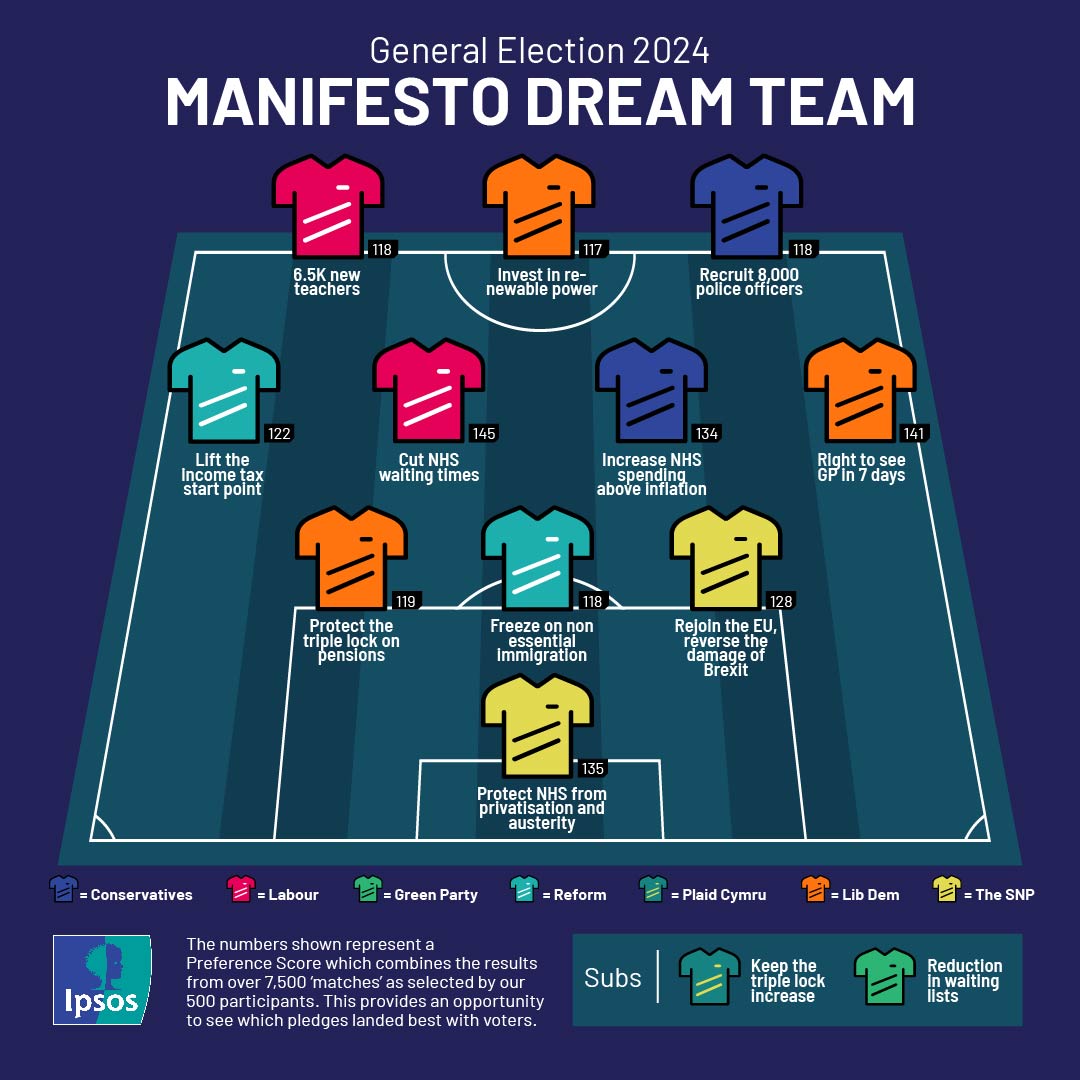
Our team of the best performing 11 unique pledges from across all 8 groups include defensive pledges to protect (Tripple Lock) and reverse (Rejoin the EU), as well as more attack minded aspirations to invest (new teachers and police officers) and give (Right to see GP).
The Dream Team includes pledges from 5 different parties, 3 x Lib Dem, 2 x Lab, 2 x Con, 2 x SNP, 2 x Reform. The Green Party and Plaid Cymru still make the squad but just miss out on being represented in the starting eleven, with similar policies that score less well on Protecting the Triple Lock and Reduction in Waiting Lists.
The 56 policy pledges tested reflect a range of different offers and sentiment to voters, including: investment, protection, change, reversing, reducing, giving, improving and speeding up. The most common of which were to increase invest (17) or reverse existing policies (11).
Overall, pledges that offer to reverse existing policies perform least well (83 vs 101 to invest). However, as show in the Championship Dream Team, voters request a mix of these things.
THE ART OF POLICY MAKING
Strength of conviction is greatest when selecting a preference to Rejoin the EU, reversing the damage of Brexit (SNP). This has the highest 'punch' score (126), measuring the speed at which voters make a selection. The link to 'damage' of Brexit is particularly emotive within the messaging, connecting with voter concerns about the cost of living.
On average, only 26% think the 56 policy pledges tested are believable. The most 'believable' pledge is Scrapping Rwanda Scheme (SNP, 40% say this is believable), perhaps not surprising given this is not yet in action.
There is huge variation in extent to which pledges are seen as relevant to individual voters. The proportion who say each pledge 'meets their needs' varies from 72% (Protecting NHS from privatisation and austerity, SNP) to 14% (Decriminalise drugs, SNP).
Parties have also been keen to ensure that their policy pledges cut through as being memorable and unique. Pledges have mixed performance here too, with Plaid Cymru and Lib Dem seen as having the most unique package over all (both average of 35% 'unique' across their 8 selected pledges.
- Setting up GB energy (47%) and Protecting NHS from Privatisation (48%) are seen as the most unique overall
- Reform land 3 of the top 10 most unique policies
Mis-attribution is a problem that benefits Labour . Of the 56 policy pledges tested, voters can recall only a small number correctly, including :
- Conservative pledge to cut 2p on National Insurance
- Labour pledges to build GB Energy and invest in teachers
- Labour benefit the most, getting the credit for most policies that pledge an investment, including Conservative pledges to build houses and recruit more police offices
Despite the strong performance of some pledges from minor parties they rarely get credit for them
- The exceptions being Reform's pledge to Freeze non-essential immigration (43% attributing this correctly) and Green's pledge to Push ahead with Zero-Carbon (44%)
Technical note
- Each participant is shown a random selection of 16 pledges across 4 knockout rounds, a total of 15 ‘matches’ per participant. Preference Scores are calculated by combining participant preference across all 7,500 ‘matches’.
- Scores of over 120 show a strong performance. Each Pledge is also judged on whether it is believable, unique and meets the needs of voters. DUEL also monitors the speed of decision making (‘Punch’), identifying the conviction with which voters decide between pledges. After they select a preference, respondents are also asked which Party they think announced the policy – helping identify any misattribution.
- Message testing was conducting on 20th June with 500 adults in GB aged 18+. Quotas were set on age, gender and region to ensure participants reflect voters across England, Scotland and Wales.