Overall U.S. consumer sentiment continues to remain muted
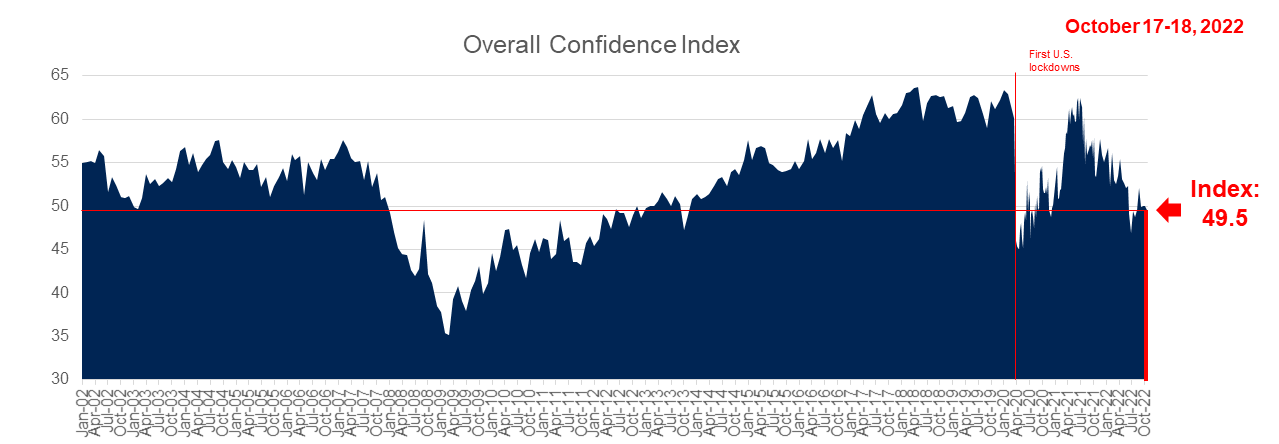
Washington, DC, October 20, 2022 – Americans’ economic sentiment continues to remain muted, as the Ipsos-Forbes Advisor U.S. Consumer Confidence Tracker shows its main index at 49.5, a drop of 0.5 points from its previous reading two weeks ago. The index continues to sit at levels seen over the past three months and remains significantly lower than it did at the start the year – seven points lower than in early January.
The Current and Investment sub-indices both declined by more than one point from two weeks ago, while the Expectations index is virtually unchanged. Similar to the Overall index, these sub-indices all sit significantly lower than they did at the beginning of the year.
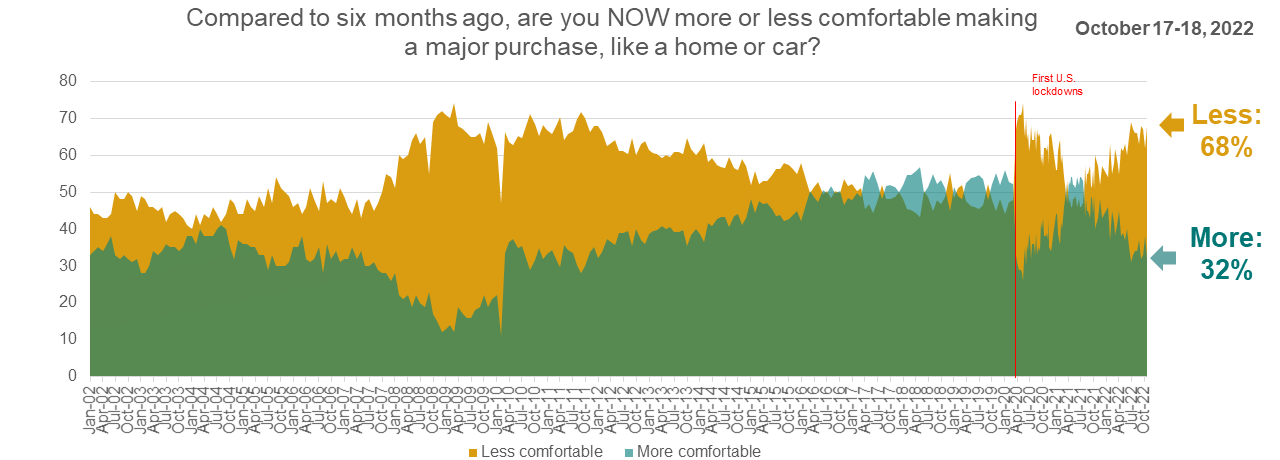
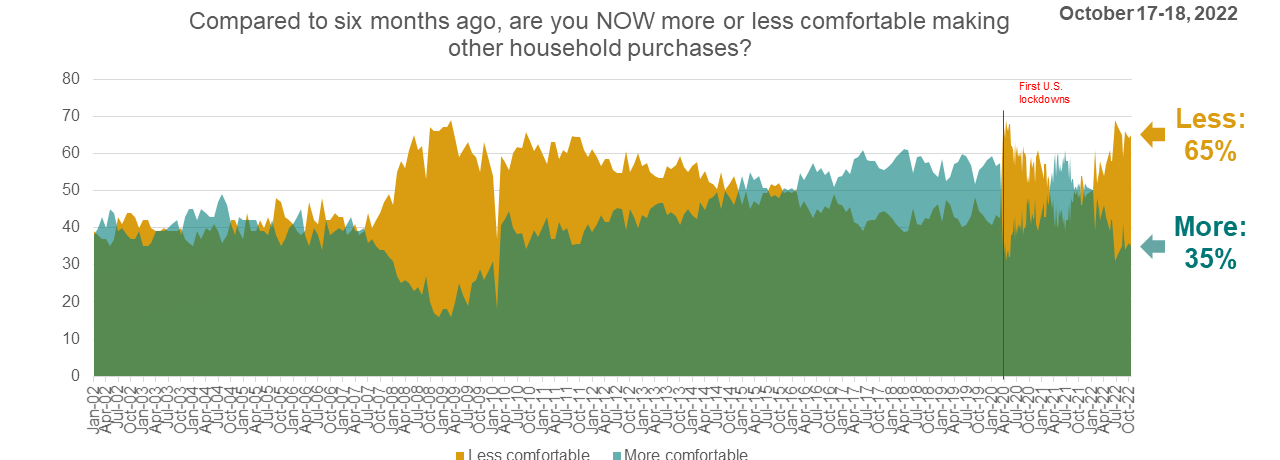
The Jobs sub-index gained more than two points, reversing losses sustained two weeks ago. However, Americans’ purchasing confidence declined sharply, as two in three report being less comfortable making both major and other household purchases than they were six months ago.
Lastly, sentiment continues to differ widely among demographic groups. Democrats, the college educated, those earning $100K+, and those living in urban areas show scores significantly higher than the total population. In contrast, Republicans, the unemployed, rural Americans, and those earning less than $50K continue to have significantly lower index scores. Less than three weeks before the 2022 midterm elections, it is noteworthy that sentiment among Republicans has fallen to a pandemic low.
Read the full story from Forbes Advisor here.
Learn more about the Ipsos Global Consumer Confidence Index and sub-indices via the interactive portal, Ipsos Consolidated Economic Indicators (IpsosGlobalIndicators.com) including graphic comparisons, trended data and all the questions on which they are based.
Detailed Findings
1. Reading at 49.5, the latest Overall Consumer Confidence index is down 0.5 point from two weeks ago.
- The Overall Confidence Index is currently 3.9 points below the pandemic average and 10.6 points below where it stood in early March 2020, prior to the first lockdowns (60.1). The index now sits 3.4 points lower than its 20-year historical average.
2. The Expectations sub-index remained stable this week, gaining 0.2 point from two weeks ago. The index continues to sit below its pandemic and historical averages, as well as its pre-pandemic reading. Lastly, the Expectations index sits below the 60-point mark for the thirteenth consecutive two-week period, a threshold it never crossed in 2021.
3. The Current and Investment sub-indices both declined by at least one point.
- The Current Index and Investment Index continue to remain significantly lower than they were pre-pandemic, now by 14.9 points and 14.6 points, respectively. The Current Index now sits around six points lower than both its pandemic and 20-year historical averages, while the Investment Index is around eight points lower than these respective averages.
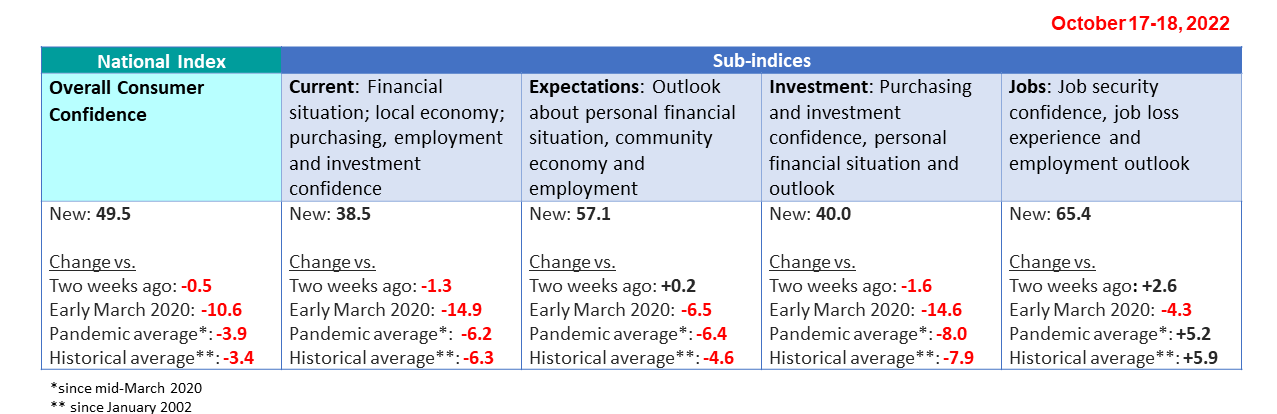
4. The Jobs sub-index gained more than two points this week, rebounding from a decline two weeks ago that resulted in the index falling to its lowest point since early August 2021. The index continues to exceed both its pandemic and historical averages (by 5.2 and 5.9 points, respectively), and it now sits around four points below its pre-pandemic reading.
- The proportion of Americans who say they are more confident in their job security now compared to six months ago is at 48%, up 2 points from two weeks ago.
- The proportion of Americans reporting they, a family member, or a personal acquaintance lost their job in the past six months due to economic conditions is at 25%, down 2 points from two weeks ago.
- In addition, 39% say it’s at least somewhat likely that they, a family member, or a personal acquaintance will lose their job in the next six months due to economic conditions, down 4 points from two weeks ago.
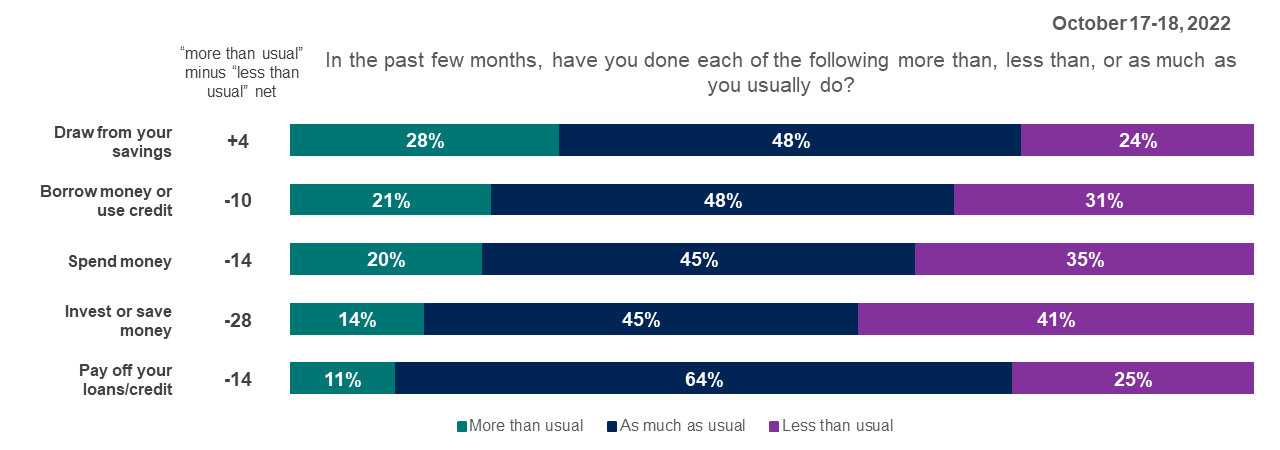
5. As inflation continues its historic rise, nearly half of Americans report drawing from their savings as much as usual, while a similar percentage report the same in their investing and spending habits.
Americans who do report a change are continuing to exercise caution. Those who say they spend money, borrow money/use credit, invest/save money, or pay off their loans/credit more than usual are outnumbered by those who say they do these things less than usual.
However, the amount that draw from their savings more than usual continues to outnumber those who do so less than usual.
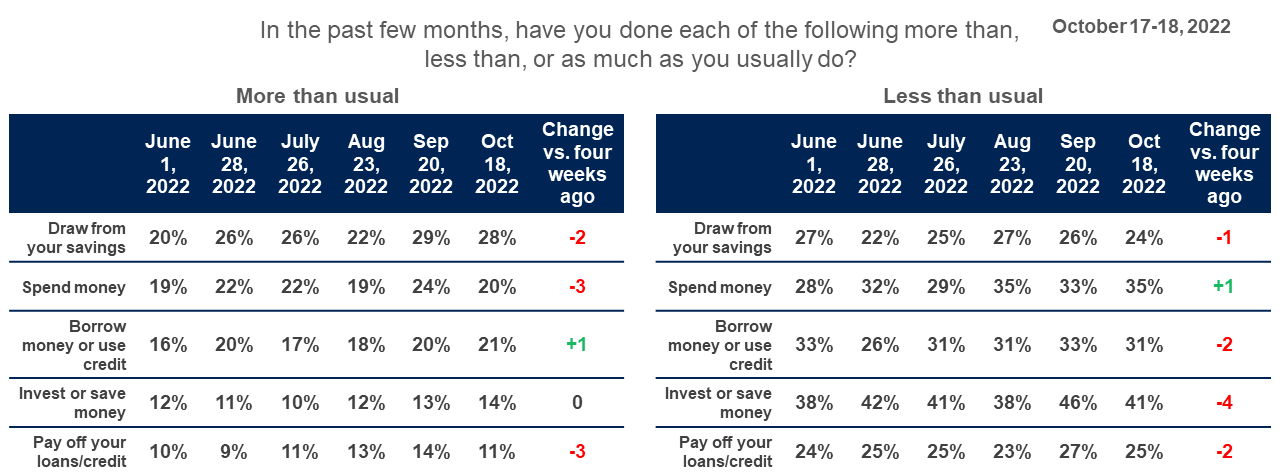
6. There are no notable changes this week as Americans’ habits remained stable.
7. Purchasing confidence declined sharply this week, and just one in three are now more comfortable making both major and other household purchases.
- 32% say they are more comfortable making major household purchases compared to six months ago, down 6 points from the previous reading.
- 35% say they are more comfortable making other household purchases compared to six months ago, down 2 points from the previous reading.
Questions
The data used for the Consumer Confidence index and sub-indices is based on the following questions:
- 1. Now, thinking about our economic situation, how would you describe the current economic situation in the US? Is it… very good, somewhat good, somewhat bad or very bad?
- Rate the current state of the economy in your local area using a scale from 1 to 7, where 7 means a very strong economy today and 1 means a very weak economy.
- Looking ahead six months from now, do you expect the economy in your local area to be much stronger, somewhat stronger, about the same, somewhat weaker, or much weaker than it is now?
- Rate your current financial situation, using a scale from 1 to 7, where 7 means your personal financial situation is very strong today and 1 means it is very weak
- Looking ahead six months from now, do you expect your personal financial situation to be much stronger, somewhat stronger, about the same, somewhat weaker, or much weaker than it is now?
- Compared to 6 months ago, are you NOW more or less comfortable making a major purchase, like a home or car?
- Compared to 6 months ago, are you NOW more or less comfortable making other household purchases?
- Compared to 6 months ago, are you NOW more or less confident about job security for yourself, your family and other people you know personally?
- Compared to 6 months ago, are you NOW more or less confident of your ability to invest in the future, including your ability to save money for your retirement or your children’s education?
- Thinking of the last 6 months, have you, someone in your family or someone else you know personally lost their job as a result of economic conditions?
- Now look ahead at the next six months. How likely is it that you, someone in your family or someone else you know personally will lose their job in the next six months as a result of economic conditions?
Additional question:
Q. In the past few months, have you done each of the following more than, less than, or as much as you usually do?
- Draw from your savings
- Spend money
- Invest or save money
- Borrow money or use credit
- Pay off your loans/credit
About the Study
These findings are based on data from an Ipsos survey conducted October 17 – 18, 2022 with a sample of 915 adults aged 18-74 from the continental U.S., Alaska, and Hawaii who were interviewed online in English.
The sample was randomly drawn from Ipsos’ online panel, partner online panel sources, and “river” sampling and does not rely on a population frame in the traditional sense. Ipsos uses fixed sample targets, unique to each study, in drawing a sample. After a sample has been obtained from the Ipsos panel, Ipsos calibrates respondent characteristics to be representative of the U.S. Population using standard procedures such as raking-ratio adjustments. The source of these population targets is U.S. Census 2019 American Community Survey data. The sample drawn for this study reflects fixed sample targets on demographics. Post-hoc weights were made to the population characteristics on gender, age, race/ethnicity, region, education, and party identification. Party ID benchmarks are from recent ABC News/Washington Post telephone polls.
Statistical margins of error are not applicable to online non-probability polls. All sample surveys and polls may be subject to other sources of error, including, but not limited to coverage error and measurement error. Where figures do not sum to 100, this is due to the effects of rounding. The precision of Ipsos online polls is measured using a credibility interval. In this case, the poll has a credibility interval of plus or minus 4.0 percentage points for all respondents. Ipsos calculates a design effect (DEFF) for each study based on the variation of the weights, following the formula of Kish (1965). This study had a credibility interval adjusted for design effect. For n=915, DEFF=1.5 and adjusted Confidence Interval=+/-5.5 percentage points.
Findings from March 2010 to early March 2020 are based on data from Refinitiv /Ipsos’ Primary Consumer Sentiment Index (PCSI) collected in a monthly survey on Ipsos’ Global Advisor online survey platform with the same questions. For the PCSI survey, Ipsos interviews a total of 1,000+ U.S. adults aged 18-74. The Refinitiv/Ipsos Primary Consumer Sentiment Index (PCSI), ongoing since 2010, is a monthly survey of consumer attitudes on the current and future state of local economies, personal finance situations, savings, and confidence to make large investments. The PCSI metrics reported each month consist of a “Primary Index” based on 10 questions available upon request and of several “sub-indices” each based on a subset of these 10 questions. Those sub-indices include a Current Index, an Expectations Index, an Investment Index, and a Jobs Index.
Findings for January 2002- February 2011 are based on data from the RBC CASH Index, a monthly telephone survey of 1,000 U.S. adults aged 18 and older conducted by Ipsos with a margin of error of +/- 3.1 percentage points.
For more information on this news release, please contact:
Chris Jackson
Senior Vice President, US
Public Affairs
+1 202 420 2025
About Ipsos
Ipsos is one of the largest market research and polling companies globally, operating in 90 markets and employing over 18,000 people.
Our passionately curious research professionals, analysts and scientists have built unique multi-specialist capabilities that provide true understanding and powerful insights into the actions, opinions and motivations of citizens, consumers, patients, customers or employees. We serve more than 5000 clients across the world with 75 business solutions.
Founded in France in 1975, Ipsos is listed on the Euronext Paris since July 1st, 1999. The company is part of the SBF 120 and the Mid-60 index and is eligible for the Deferred Settlement Service (SRD).
ISIN code FR0000073298, Reuters ISOS.PA, Bloomberg IPS:FP www.ipsos.com