E-Business Set To Double In Importance Over The Next Two Years - US Only Slightly Ahead Of Europe
These are some of the main findings of the research programme carried out among 702* companies in Europe and the USA by MORI for Intentia, the enterprise applications global software group. It is the first annual comparative tracking study of tier two companies to establish a picture of how quickly e-business is being adopted, and intentions for the future.
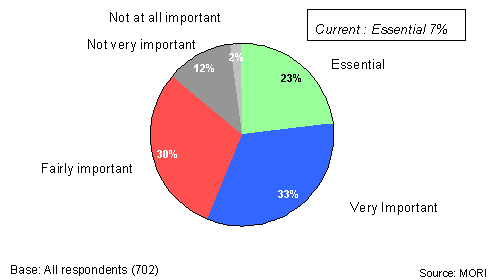
The research has demonstrated that tier 2 companies cannot afford to ignore e-business. Across the manufacturing, retail and wholesale industry sectors 56% consider e-business will be essential or very important in 1 - 2 years' time for the sector in which they operate compared to 13% who consider it will be unimportant. Around two-thirds perceive it can give them a competitive advantage.
Importance Of E-Business In 1 - 2 Years' Time
Contrary to general perception, the US is only slightly ahead of Europe in terms of implementation, with Sweden taking a lead. The US and Europe are equally focused on the development of e-business for their organisation going forward.
Implementation to date has centred on downstream activities such as communicating with customers, marketing over the internet, delivery of products and services. This appears to be stage 1 in the adoption of e-business by companies, driven by sales and marketing professionals in conjunction with the IT department. Few associate back end processes with the term e-business.
Businesses that have already adopted a range of internet-based business services to manage customer relationships are now looking towards the next stage; using the internet to manage supply side relationships and integrate business processes.
The findings suggest that there is a threshold beyond which e-business will become a key component in the way businesses operate. As a barrier to further development, security (a technology issue) is now less important than the requirement for customers and suppliers to take up the technology. Barriers also exist internally, with one in five stating that a lack of understanding of the benefits among key decision makers is a major barrier and a similar proportion a lack of an incumbent skill base.
Although many companies operating in these sectors are holding out for further developments, most are already able to predict bottom line benefits for their organisation, with an expectation that e-business will be generating 13% of their sales in 1 - 2 years' time. The business case appears inexorable, with a 22% return on investment the industry benchmark (though one in five is unable to estimate what the return on investment might be).
There are differences by sector, with retail giving a higher priority to e-business although expecting an average contribution to sales revenue generation. The wholesale sector is taking a lead, with a contribution of 16% expected in 1 - 2 years' time.
Finally, businesses in the UK, USA and Sweden are likely to have higher expectations for the realisation of the benefits of e-business and are investing more heavily than their equivalents in Spain and France. The much talked about Atlantic divide does not appear to exist; there is now a divide between Northern and Southern Europe. Are these countries being left behind ?
 Download E-business research programme among tier 2 businesses in the USA and Europe [pdf format - 80k]
Technical details
* Research sample - 702 Board level directors responsible for e-business or business development strategy. Representative sample in each country of companies operating in the manufacturing, wholesale and retail sectors, with annual turnover of $50m-$1,000m. In the US 200 interviews, and 100 in each of UK, France, Germany, Sweden and Spain. The fieldwork was conducted by telephone using native language interviewers between August 26 and October 13 1999.