Highest percentage of Britons now think the UK Government is doing a bad job of negotiating with trade unions to prevent strikes, amidst potential BMA strikes next week
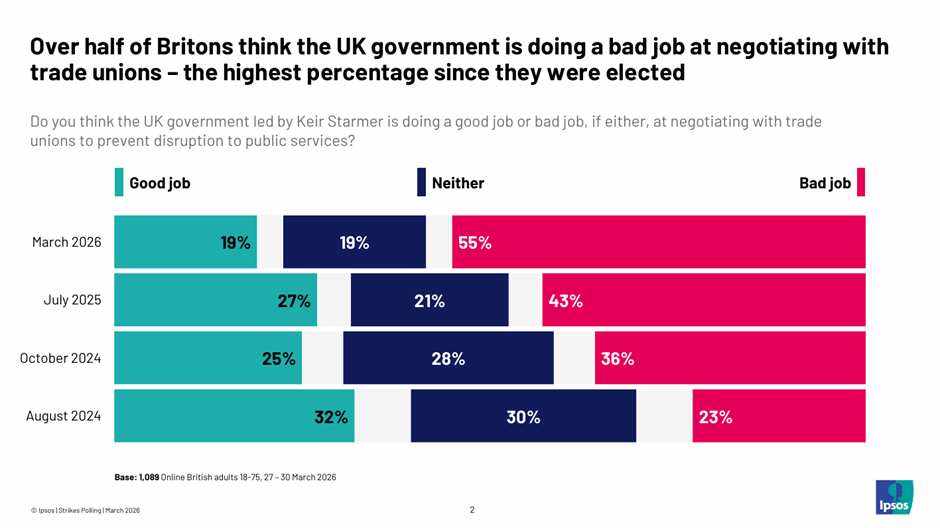
- 55% of Britons now say the UK Government, led by Keir Starmer, are doing a ‘bad job in negotiating with unions to prevent public service disruption’ (up from 43% in July 2025 and 23% in October 2024)
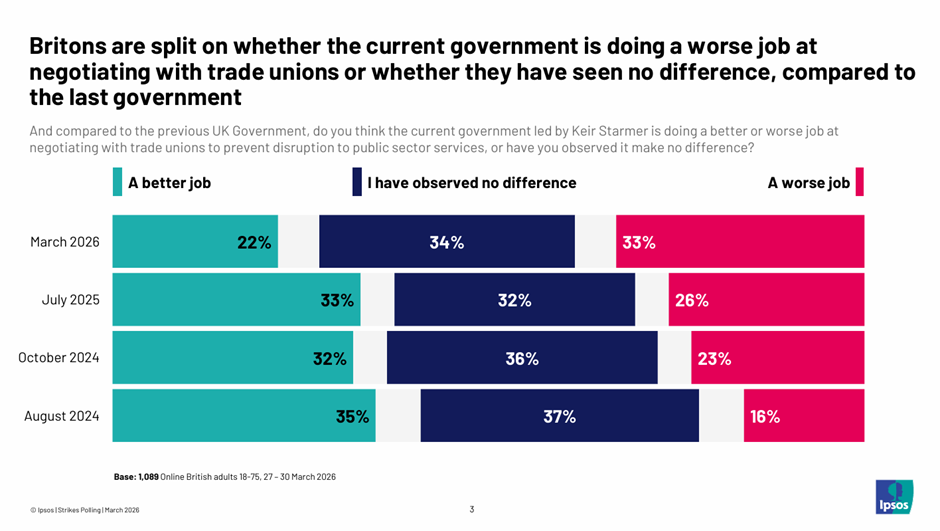
- Less than one in four now say the current Government is ‘doing a better job’ than the previous government at negotiating with trade unions (22% in March 2026 compared to 33% July 2025)
New polling from Ipsos in the UK finds that a significant portion of the British public is dissatisfied with the current government’s handling of negotiations with trade unions. With the highest dissatisfaction rating since this government took office, public sentiment reflects mounting concerns over worker power and public service disruptions.
Key findings:
- Government negotiation effectiveness: 55% of Britons now say the UK Government, led by Keir Starmer, are doing a ‘bad job in negotiating with unions to prevent public service disruption’ (up from 43% in July 2025 and 23% in October 2024)
- Comparison with previous government: Less than one in four now say the current Government is ‘doing a better job’ than the previous government at negotiating with trade unions (22% in March 2026 compared to 33% July 2025).
- Perceived worker power: The survey also highlights that half of Britons feel workers have too little power today (51%)
- Public sympathy: While there’s a notable opposition to resident doctors’ strikes, public sympathy largely remains with NHS patients affected by these disruptions, with more than 8 in 10 (83%) expressing sympathy for patients.
- Dispute blame: More respondents (36%) place the blame for the long-standing dispute on the government rather than on resident doctors (21%). A further 3 in 10 (30%) say they are equally at fault.
Commenting on the findings, Kate Duxbury, Research Director in Public Affairs at Ipsos in the UK said:
With a stand-off between the BMA and the Government remaining this week, our latest trend poll finds a growing perception amongst the public that the Government is doing a bad job when it comes to negotiating with the unions - the highest proportion saying so since they came to office.
That comes alongside an increase in those perceiving the Government to be at fault for the dispute lasting this long, and a stable third thinking both residents’ doctors and the Government share the responsibility. This does not mean that the public are firmly with the BMA though – the public are more likely to oppose than support the latest strikes, and they are less likely to think the Government is at fault than they were in 2024.
What is consistently clear is that the public’s sympathies remain firmly with those patients potentially impacted by the dispute.
Notes:
- Ipsos interviewed a representative sample of 1,089 adults aged 18-75 across Great Britain. Polling was conducted online between the 27th-31st March 2026.
- Data are weighted to match the profile of the population. All polls are subject to a wide range of potential sources of error.