Ipsos Research Highlights - 3 April 2020
More people staying at home as concern about coronavirus increases
Our latest tracker of public opinions surrounding the coronavirus finds that the British public are growing more cautious. Not only are there more people staying at home, but the number of people wearing surgical or face masks has doubled to 12%. The sudden change in behaviour of may be the result of increased concern that COVID-19 threatens the public personally, up to 78% from 61% last week. Despite the rise in concern, the public are confident in the ability of the NHS to deal with the crisis.

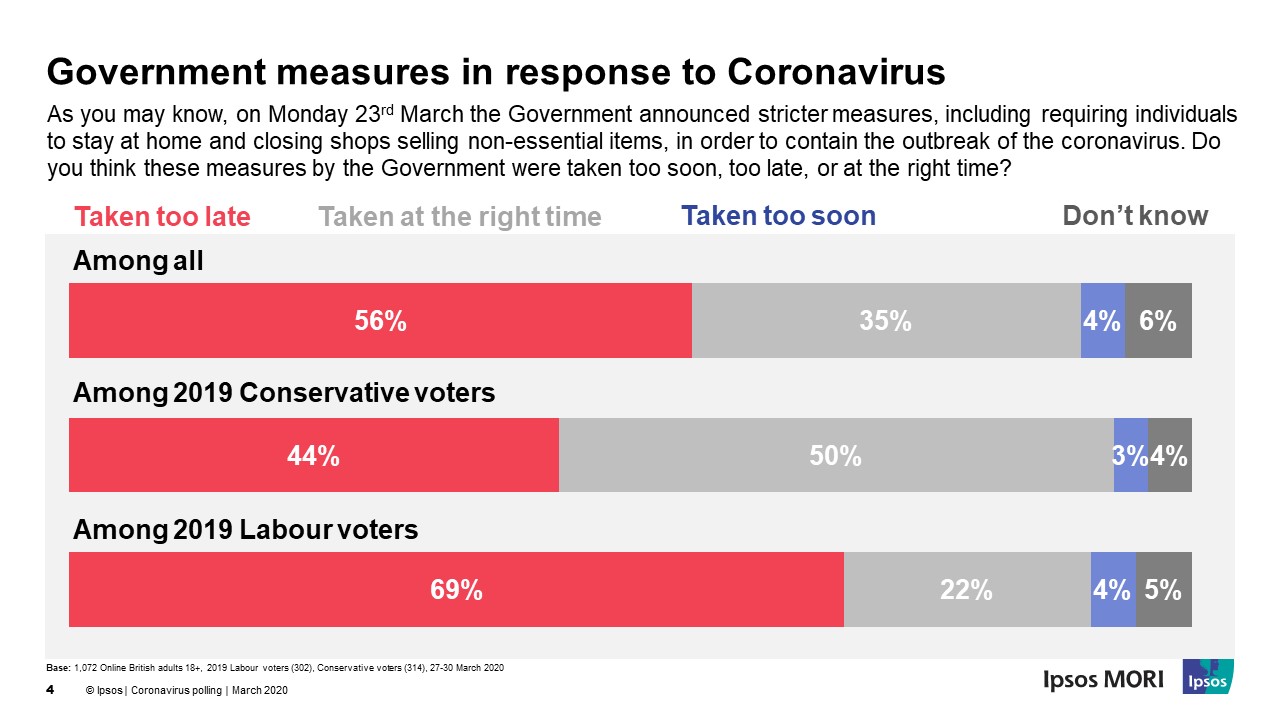
Over half of Britons believe the Government was too slow to enforce lockdown
Britons seem to be responding to the Government's recent social distancing measures as we see nearly four out five (79%) people choosing to stay home. However, 56% of people believe that the Government's social distancing measures were taken too late, whilst only 4% of people felt that they were taken too soon.
One in five Britons think it likely they have already had COVID-19, though perceptions uncertain
However, the majority of Britons (57%) think it is unlikely they have contracted the virus, while say they don’t know (21%). As testing is still not readily available, this is all based on the perceptions of the public. While most feel fairly confident they could tell whether or not they have had the coronavirus, only 17% feel very confident.
Majority concerned for those more vulnerable to COVID-19 than for their own health
As social distancing measures become the 'new normal' the majority of people in the countries surveyed agree it’s likely the pandemic will bring them closer to their family and friends (57%), with countries such as India (72%) and China (67%) agreeing the most. Most people globally are more concerned for those more vulnerable to the virus than they are about their own health. Elsewhere, two in five (44%) of people across the world are optimistic they will likely learn a new skill as a result of the outbreak.
Global Trends 2020 and COVID-19
While we're keeping track of the changes in behaviour as a result of the crisis, our Ipsos Global Trends and Futures team are looking at the bigger picture. As COVID-19 has already changed our everyday habits, it appears that it may take longer to shift underlying trends before a ‘new normal’ is created. We’ve identified a tsunami of new signals as a result of the crisis and will continue to monitor these in the weeks to come. Visit Ipsos Global Trends 2020 for more information.
We have also launched a syndicated qualitative study – CovidWatch – which will monitor consumer response. We will aim to answer questions such as - will family matter more now many families are closer together? And will offices, traditionally the primary workplace of millions, diminish and shrink? Please contact Oliver Sweet for more information.
In other news
With a large portion of people's behaviour changing, Ipsos's Creative Excellence team explore how companies and brands can communicate in this uncertain time, highlighting the dangers for brands that ‘go dark’. It is crucial that brands can adapt in order to survive this pandemic, and this paper shows how brands can use the right measures to develop.
We have recently launched our Digital Doctor study showing how digital tools and virtual care are playing a key role in the handling of COVID-19. Do listen to the launch webinar recording or contact Reena Sooch for more information.
As ever, please do let us know what you think and I hope you find something to interest you.
Ben Page
Chief Executive, Ipsos
[email protected]