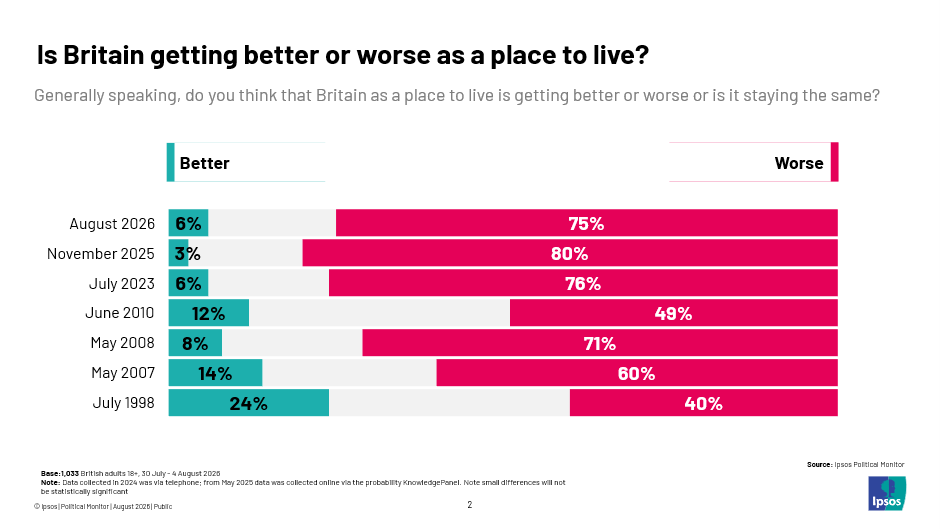
Three quarters of Britons say Britain is getting worse as a place to live
- 75% of Britons say that Britain as a place to live is getting worse, maintaining near-record levels of public pessimism.
- Over 7 in 10 (73%) say the overall quality of public services has declined over the past five years.
- 52% of the public disagree that the government’s policies will improve the economy in the long term, while 49% doubt they will improve public services.
Persistent pessimism about the state of the nation and public services
Public sentiment remains deeply negative, with the majority seeing widespread decline of public services and Britain as a place to live.
- 3 in 4 Britons (75%) think Britain as a place to live is getting worse (down slightly from 80% in November 2025, but far higher than 49% in June 2010), while only 6% believe it is getting better.
- 52% disagree with the statement "In the long term, this government's policies will improve the state of Britain's economy" (down 14ppts since November 2025), with 24% agreeing (up 7ppts), while 49% disagree that government policies will improve public services in the long term (down 16ppts since November 2025) , against 27% who agree (up 9ppts).
Deepening anxiety across key public sectors
When evaluating the outlook over the next few years across specific policy areas, negative expectations outweigh positive ones in every measured category, led by acute worries over the cost of living.
- 3 in 4 (76%) expect the cost of living in Britain to get worse over the next few years (with only 9% expecting it to get better, a net score of -67), making it the single largest area of public concern among the areas asked about in this survey.
- 58% of Britons expect the NHS to worsen over the next few years, while 14% expect it to get better, yielding a net rating of -44.
- 60% anticipate the management of Britain's immigration system will deteriorate (net -46), while 59% expect opportunities for young people to decline (net -43).
- 55% foresee a decline in the quality of the environment, 47% expect workforce skills to worsen, and 43% anticipate local policing will get worse.

Commenting on the findings, Alex Bogdan, Research Director at Ipsos in the UK said:
While these findings hint at some modest improvements in public confidence, the overall picture continues to be one of deep public pessimism about the country's direction and the state of its public services. The long-term trends show that dissatisfaction with core services, from the NHS to local policing, remains high, reflecting deep-seated anxieties around the economy and the state of public services.
As the cost of living continues to dominate Britons’ concerns, the public will be looking to Andy Burnham’s government to show it can deliver improvements people can feel in their everyday lives.
Technical note
- For media queries, please contact the Ipsos in the UK Press Office at [email protected]
- For the full findings, please visit the Ipsos website.
Ipsos interviewed a representative sample of 1,033 British adults aged 18+ via the Ipsos UK Knowledge Panel. Polling was conducted online between 30 July – 4 August 2026. Panel members are recruited via random probability sampling, by sending letters to randomly selected addresses, which invites them to join an online panel. This approach means every household in the UK had a known and non-zero chance of being selected to join the KnowledgePanel. Those who are digitally excluded are provided with a tablet and free, restricted data connection. A sample of 2,207 adults aged 18+ were invited to take part in the survey. The sample was stratified by nation, age, qualifications and vote at the 2024 general election (as collected immediately after the election). The achieved sample was weighted in two stages: - Design weights were applied to correct for the unequal probabilities of a person being selected for a survey, notably residents in smaller households have a higher chance of being selected.
- Calibration weights were applied through rim weighting to correct for differential non-response. Data was weighted to the adult population profile on age and gender, Government Office region, ethnicity, qualifications, work status and work sector (public sector/other), social grade (office coded), number of cars in household, constituency type, and newspaper readership (print and digital). Population targets were obtained from the 2021/22 Census, ONS population estimates and other large-scale probability surveys.
- All polls are subject to a wide range of potential sources of error. On the basis of the historical record of the polls at recent general elections, there is a 9 in 10 chance that the true value of a party’s support lies within 4 points of the estimates provided by this poll, and a 2 in 3 chance that they lie within 2 points. This is especially important to keep in mind when calculating party lead figures.
- Note that this is a new methodology implemented since June 2025. It involves a new form of data collection (online random probability panel instead of quota telephone survey), an updated voting intention (which involves prompting for Reform UK), and an updated weighting scheme. This is based on our learnings during and since the 2024 General Election. This means that comparisons with previous waves need to be made with caution.