Despite rising support for increasing defence spending, half of Britons say there are no circumstances under which they would take up arms for Britain
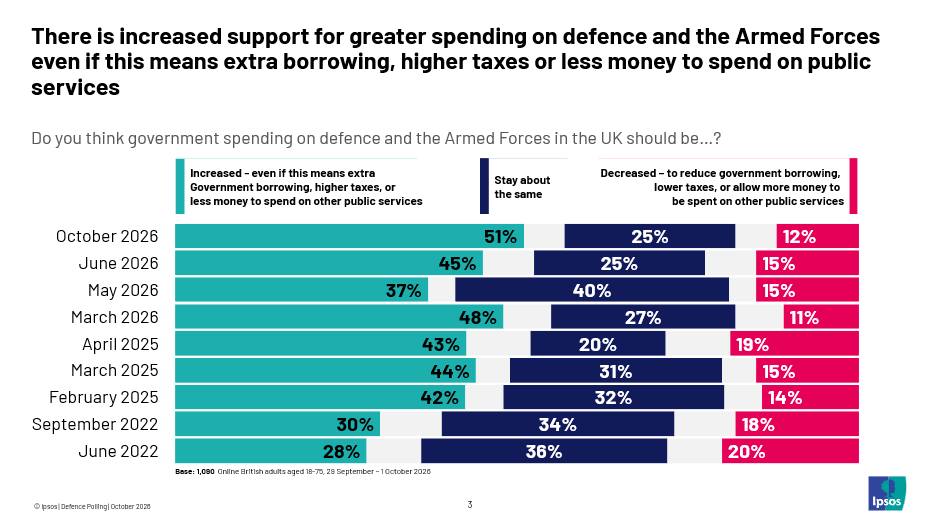
• 1 in 2 Britons (51%) believe government spending on defence and the Armed Forces should be increased, even if this means extra borrowing, higher taxes, or cuts to public services. By contrast, just 1 in 10 (12%) think it should be decreased.
• 3 in 4 (75%) support higher defence spending if it generates jobs and apprenticeships, but more than 4 in 10 (44%) each oppose it if it leads to higher personal taxes or a decrease in spending on public services.
• If public services spending were to be cut in order to fund increased defence spending, 3 in 10 (30%) would prefer to see reductions to welfare, including Universal Credit and pensions. 4 in 10 (41%) would not want to see any public services have their spending reduced.
• 1 in 2 (48%) say there are no circumstances where they would be willing to take up arms and go to war for Britain
London, UK. New polling data from Ipsos in the UK, conducted between 29 September and 1 October 2026 among 1,090 British adults, reveals that public appetite for military investment remains strong amidst global instability, though Britons remain divided over how to fund additional defence spending.
Attitudes to defence spending and personal trade-offs
While half favour expanding the UK's defence budget, support depends heavily on the associated economic consequences.
- 51% of British adults think defence spending should be increased (even with borrowing, tax, or public service trade-offs), an increase of 6 points since June 2026. 25% believe it should stay about the same and 12% think it should be decreased.
• Britons are slightly more likely to describe the state of the UK's Armed Forces as bad (36%) than good (29%), up from 29% who described it as bad in April 2025.
• Support for higher defence spending is highest when tied to civilian benefits: 75% support spending increases that generate jobs including apprenticeships for young people, 68% support spending increases that invest in critical civilian infrastructure (energy, transport), and 65% support spending increases that would help grow Britain's technology industry.
• However, resistance emerges when trade-offs affect personal finances or core services: 44% oppose increased defence spending if it means an increase in the taxes they personally pay, 44% oppose it if it means reduced spending on public services, and 37% oppose increased government borrowing.
Funding mechanisms, tax preferences, and War Bonds
Among those who support increasing defence spending, opinion is split on the primary mechanism to achieve it.
- Among supporters of higher defence spending, 37% favour spending less on other public services (up 4 points since May 2026), 36% think higher taxes should be the main funding method (+1), and 18% prefer extra government borrowing (up 3 points).
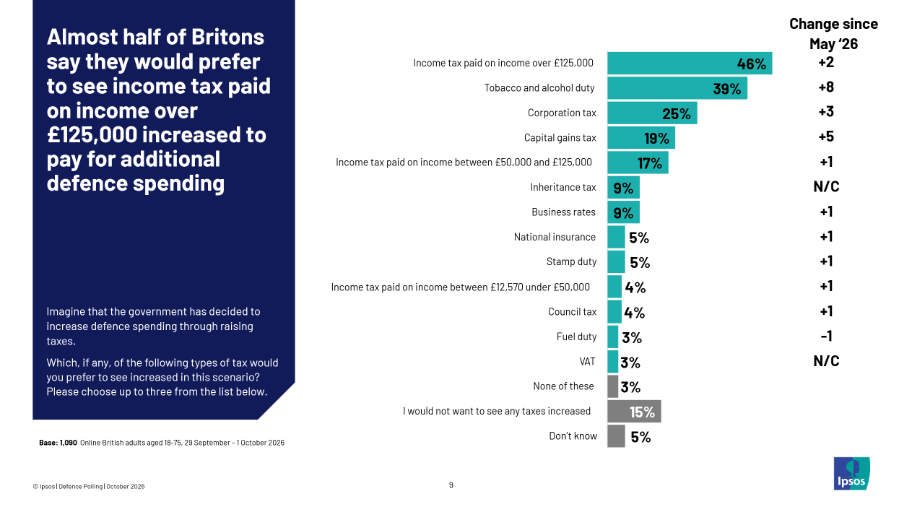
- If taxes were to rise, 46% of British adults would prefer to see income tax paid on earnings over £125,000 increased, followed by tobacco and alcohol duty (39%, +8 points since May) and corporation tax (25%, +3 points since May).
- If public service budgets were to be reduced, 41% of Britons state they would not want to see any public services cut, an increase of 3 points since May 2026. Among those willing to select areas for cuts, welfare (30%, +3ppts) and housing (19%) are the most common choices.
- When asked about alternative financing, Britons are split on purchasing war bonds to facilitate higher defence spending, with 28% likely and 35% unlikely to do so.
Strategic priorities and international alliances
Britons continue to prioritise modern capabilities and domestic support operations within the defence budget, while increasingly looking toward European and transatlantic alliances.
- Cybersecurity remains the top priority for defence budget allocation, with 45% selecting it among their top three choices (up 9 points since May 2026), followed by intelligence and surveillance (36%, -1ppts) and air forces e.g. aircraft, drones (28%, +6ppts).
- Confidence in the Armed Forces remains high for usefully assisting civil domestic operations (73% confident) and humanitarian operations abroad (70% confident), but lower regarding mental health support for service personnel and ex-personnel (35% confident) or providing support for ex-personnel (37%).
- 50% of Britons believe the UK should prioritise building a close defence relationship with the EU (up 9 points since April 2025), and 49% say the same for NATO (up 10 points).
- Nearly 1 in 2 Britons (48%) state there are no circumstances where they would be willing to take up arms and go to war for Britain, compared to 36% who say there are circumstances where they would, in line with what was seen in April 2025.
Commenting on the findings, Caroline Paskell, Research Director at Ipsos in the UK, said:
Our latest polling underscores the continued public recognition of the demands facing Britain's Armed Forces, with half of Britons backing an increase in defence spending despite wider economic pressures. However, the public mood remains finely balanced when faced with the direct trade-offs required to fund this expansion.
While there is strong enthusiasm for military investment that delivers broader economic dividends, such as job creation and civilian infrastructure, resistance grows sharply when funding mechanisms touch personal taxation or cuts to cherished public services.
The key challenge for Ministers will be navigating these competing fiscal priorities, communicating clearly how increased security investment can coexist with public service protection and broader economic growth.
Notes to Editors:
- For media queries, please contact the Ipsos in the UK Press Office at [email protected]
- For the full findings, please visit the Ipsos website.
- Ipsos interviewed a representative sample of 1,090 online British adults aged 18–75. Polling was conducted online between 29 September and 1 October 2026.
- Data are weighted to match the profile of the population. All polls are subject to a wide range of potential sources of error.