As pressure on Starmer continues, Andy Burnham continues to be the most popular alternative
- Almost half of Britons (47%) think Keir Starmer should stand down as Prime Minister and leader of the Labour party, though there is no consensus as to exactly when.
- Andy Burnham remains the most popular alternative (including among 2024 Labour voters), and the only one of several candidates to have a clear lead over Starmer as best PM. However, half the public say they don’t know or “none of the above” when asked who they would prefer to next lead Labour.
- Only 1 in 4 Britons (25%) think the policies outlined in the King’s Speech will deliver positive change for the country, and it has made little difference to which party is trusted most on key polices, with confidence in Labour still down compared to the 2024 General Election.
The question of Labour leadership
Speculation surrounding a potential Labour leadership contest has captured national attention, with three in five Britons (61%) following the story closely (similar to those following the conflict the Middle East, 64%). Currently, 47% of the British public believe Keir Starmer should stand down as Prime Minister and leader of the Labour party, compared to 36% who feel he should continue. While this indicates a slight softening of opposition from its peak of 52% in February of this year, doubts about his leadership remain high.
When considering the future:
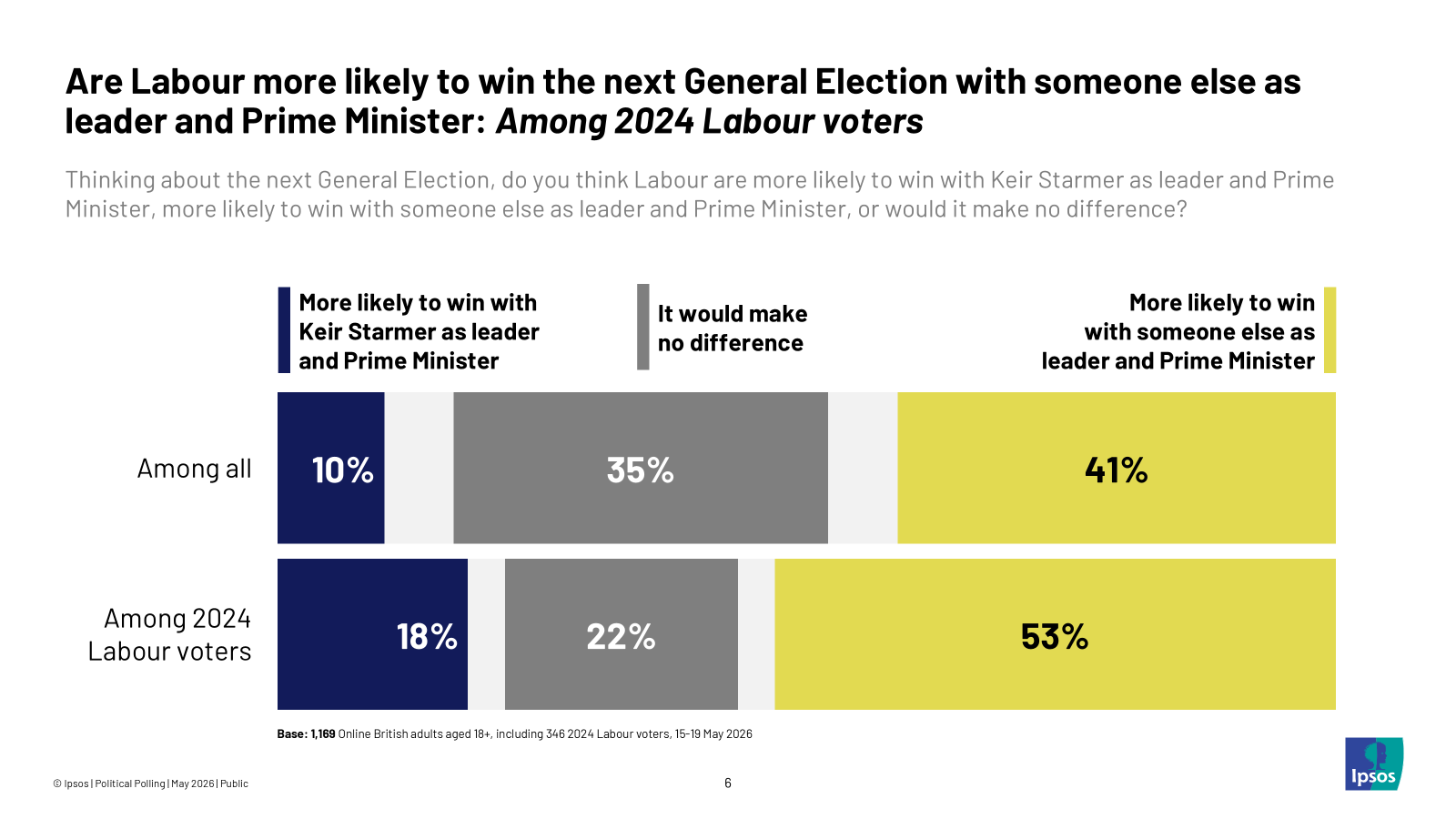
- 41% of Britons believe Labour is more likely to win the next General Election with a different leader, rising to half (53%) of 2024 Labour voters. 35% of Britons state it would make no difference, and just 10% believe Starmer offers the best path to victory.
- When asked what should happen ahead of the next General Election, 59% of the general public think Starmer should not lead Labour into the election (34% wanting immediate resignation, 25% saying now is not the right time). Among 2024 Labour voters, a combined 54% feel he should not lead them into the next election (22% wanting immediate resignation, 32% citing wrong timing). Conversely, 32% of 2024 Labour voters believe he should lead the party into the next election, compared to just 17% of the wider public.
- The public remains divided on how to proceed if there is a new PM: 22% of all Britons (and 39% of 2024 Labour voters) want a leadership contest without a General Election until the current parliament ends, with around 1 in 5 (20% of the public, 17% of 2024 Labour voters) who think that a leadership contest should be called, with a General Election following should a new Prime Minister be chosen. 15% of Britons and 28% of 2024 Labour voters think there should not be a Labour leadership contest at all, while 15% of the public and just 3% of Labour voters think there should be an early election regardless.
- Despite the doubts around Starmer’s political viability, in hypothetical forced choice head-to-heads, he is considered the better Prime Minister compared to Ed Milband (by 20% to 11%), Angela Rayner (20% to 12%), and Wes Streeting (19% vs 12%). Andy Burnham is the only potential Labour leader who outperforms Starmer, with Burnham +12ppts ahead of the current Prime Minister (27% to 15%). However in each case between 4 and 5 in 10 say neither or it would make no difference.
- Keir Starmer does though remain, alongside Nigel Farage, the most well-known politician, with 3 in 4 Britons saying they are familiar with each. Around 6 in 10 say they are familiar with Rachel Reeves, Ed Miliband, Angela Raynor and Kemi Badenoch, and around half with West Streeting, Andy Burnham, Zack Polanksi and Ed Davey.
The Burnham factor: Public and party attitudes
Should a vacancy arise, Greater Manchester Mayor Andy Burnham emerges as the public and party favourite to succeed Keir Starmer.
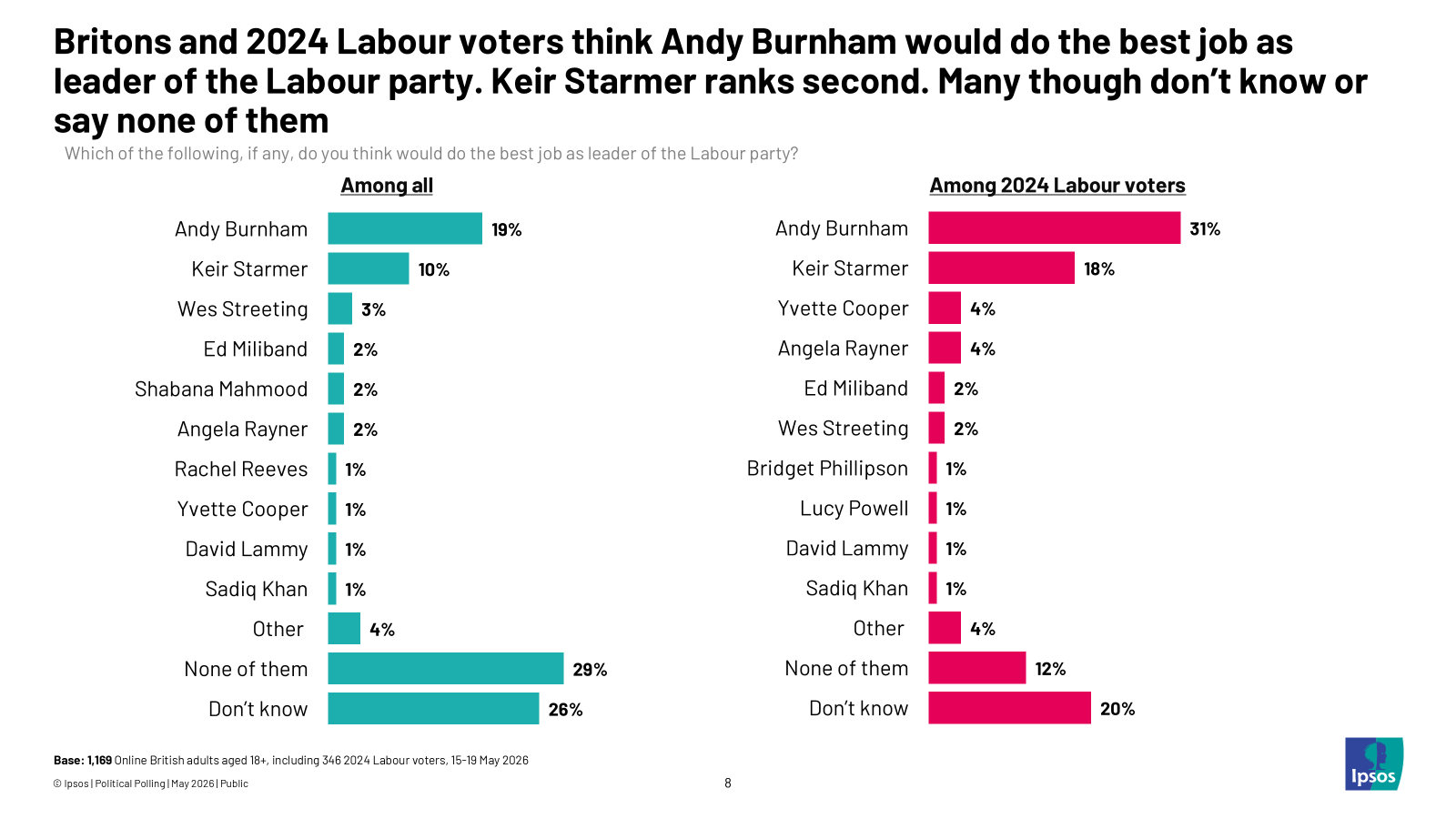
- Burnham leads the pack as the person perceived to do the best job as leader of the Labour Party, both amongst the general public (19%) and 2024 Labour voters (31%). The next most popular candidate for both groups is Keir Starmer (10% amongst the public, 18% amongst 2024 Labour voters).
- When asked for their most preferred next leader of the Labour party if Starmer were to stand down, Burnham again leads, receiving 20% of mentions amongst the general public and rising to 38% amongst 2024 Labour voters. This far exceeds the popularity of other senior figures amongst 2024 Labour voters, including Angela Rayner (7%), Wes Streeting (4%), and Ed Miliband (3%).
- However, in both cases around half the public say either they don’t know who would be best, or choose none of them.
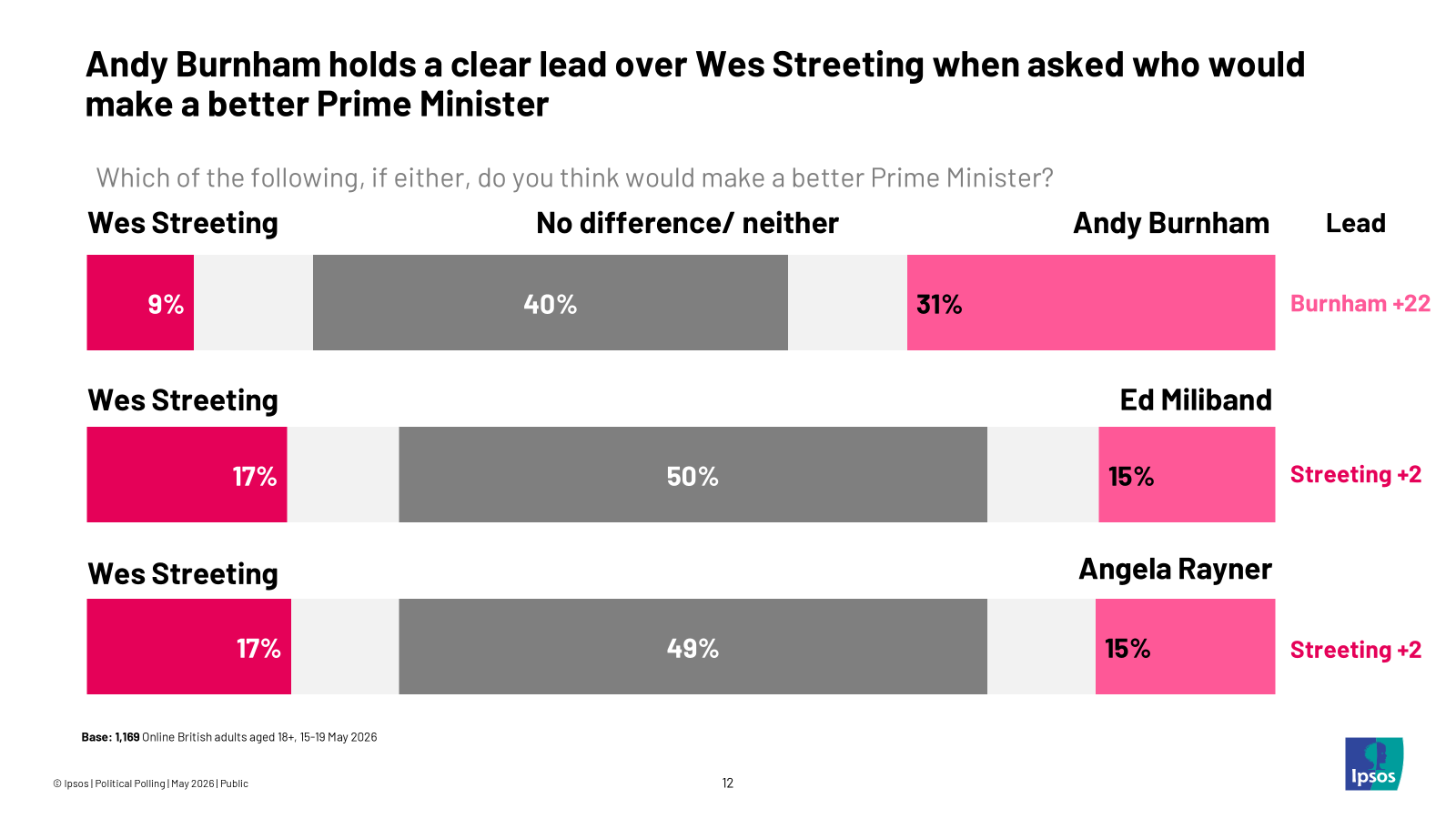
- When presented with a hypothetical forced choice head-to-head between Burnham and Wes Streeting, Burnham commands a clear +22 point lead over the former Health Secretary, with 31% backing Burnham compared to just 9% for Streeting.
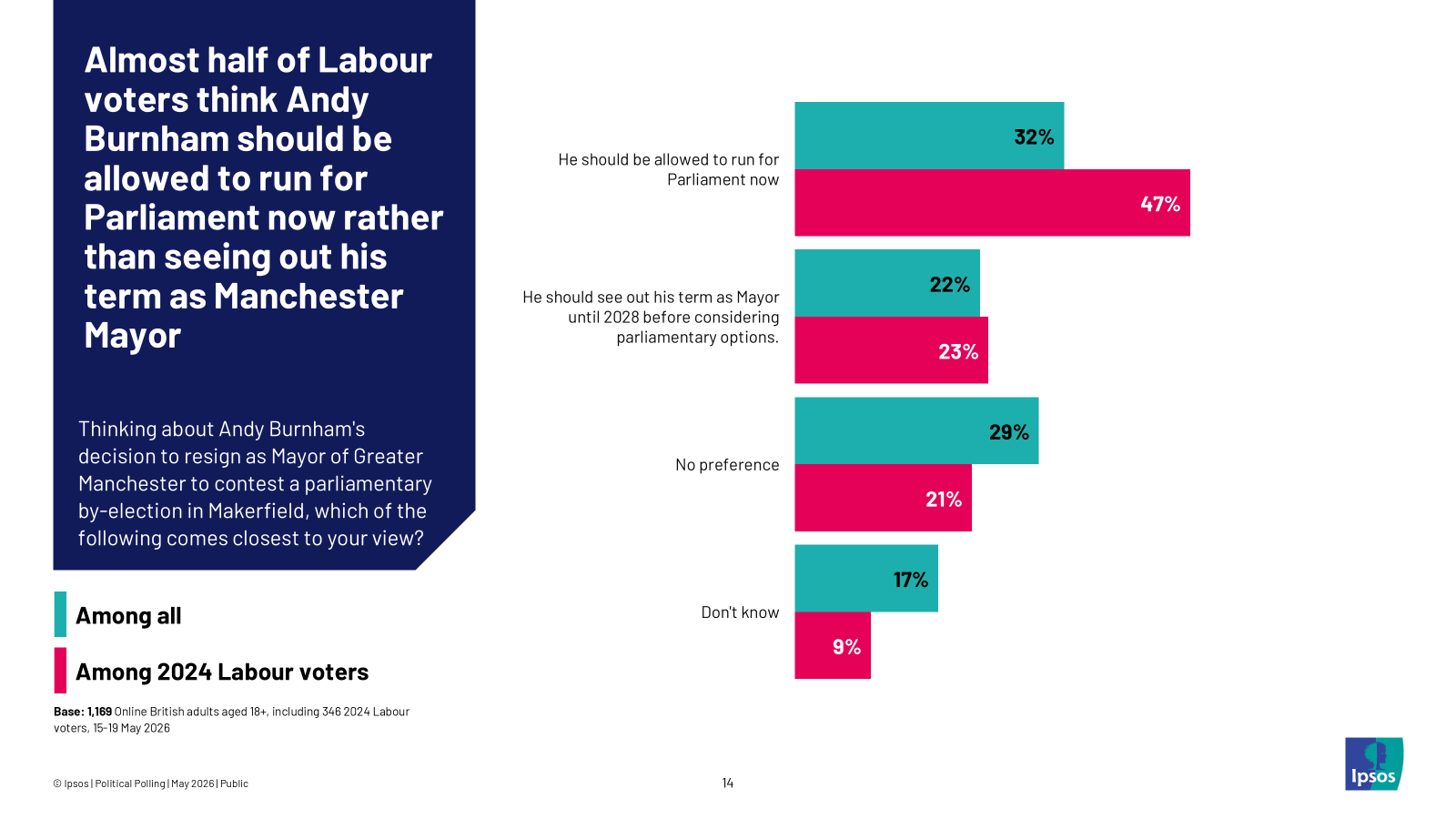
- With a key question being Burnham’s return to Parliament, 1 in 3 Britons (32%) think Andy Burnham should be allowed to run for Parliament now, rising to just under half (47%) of 2024 Labour voters. By contrast, around 1 in 5 of each group think he should see out his term as Mayor until 2028 before considering parliamentary options (22% amongst the public, 23% amongst 2024 Labour voters).
The King’s Speech and who has the best policies
While internal leadership debates intensify, the King’s Speech shows little sign of moving the dial on who the public thinks has the best policies on key issues:
- The Economy and Taxation: Labour holds a narrow 19% preference as the best party to manage the economy, followed by Reform UK at 12% and the Conservatives at 13%. On setting the right level of tax and public spending, Labour secures 18%, while Reform UK sits at 13% and the Conservatives at 11%.
- Cost of Living: Despite the rising cost of living being a key priority for the public, no single party has established a clear lead, with Labour leading marginally with 17%, ahead of Reform UK (12%) and the Conservatives (10%).
- Public Services and Crime: Labour maintains its strongest traditional advantages on the NHS (22% vs. 12% for Reform UK and 9% for the Conservatives) and education (20% vs. 10% for Reform UK and 9% for the Conservatives). However, Labour is challenged by Reform on dealing with crime and anti-social behaviour (17% to Reform UK's 19%).
- Immigration and National Security: Reform UK holds a clear lead on managing immigration and asylum with over a just quarter of Britons (27%) backing them, nearly double Labour's 14% and well clear of the Conservatives at 7%. On keeping Britain safe, Labour retains a marginal lead at 18%, compared to 15% for Reform UK and 10% for the Conservatives.
Disillusionment remains the most dominant trend across all policy domains; between 39% and 46% of British adults state that they either do not know or do not think any political party has the best policy framework on every issue.
The legislative agenda outlined in the King’s Speech on 13th May 2026 has also done little to change public minds, with only 1 in 4 (27%) saying they were following it closely.
1 in 5 Britons (21%) believe the proposals will not change anything at all for the country. While a quarter (25%) anticipate the agenda will deliver positive change, 13% fear it will bring negative change, and 30% say they have heard nothing about it at all.
The core challenge for the government lies in public doubt over affordability and competence:
- Affordability: Only 24% of Britons feel confident that the proposed policies are affordable within the UK Government’s current tax and spending plans, whereas 43% are not confident.
- Competence: Similarly, only 23% express confidence that the government will deliver these pieces of legislation competently, compared to 45% who lack confidence.