Public Spending Index - June 2009
With public debt and borrowing at record levels, there are clear challenges for the government to save money while still delivering high quality public services. Ipsos's first Public Spending Index looks in detail at the public's views and priorities and shows that most of the public do not think public services are run efficiently, and believe that efficiencies, rather than cuts, can save sufficient money.
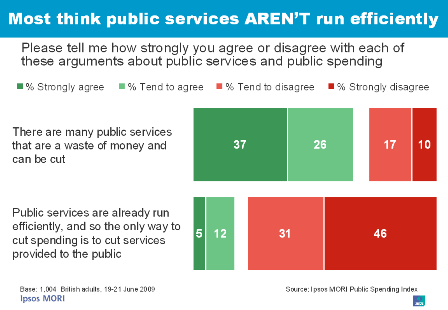
A key priority for Labour in government has been to invest in public services - and Ministers have this week outlined a new `national plan' for public service provision, moving away from the target-led approach of recent years. However, the majority of the public believe that public services are NOT run efficiently, with three in four (77%) disagreeing that they are efficient and two in three (63%) saying they believe that many services are a waste of money.
 Worryingly for Labour, the public seems to think the Conservatives are most likely to achieve these efficiencies as they have a 15 point lead over Labour in perceived ability to deliver value for public money. At the last General Election in 2005 Labour led the Conservatives by 11 points on this issue.
Many believe that efficiencies, rather than cuts, can `rebalance the books'. Four in five (79%) agree that efficiencies can help cut government spending without damaging services, while around half (51%) are not persuaded that there is a need to cut spending on services to pay off the national debt. This suggests that many of the public are either not aware of, or not facing up to, `hard truths'.
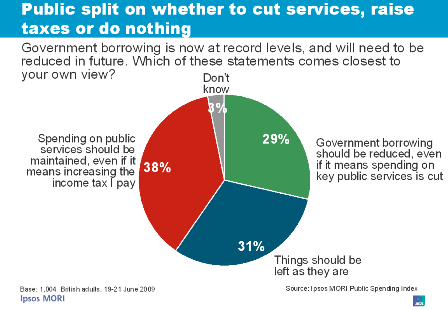
No consensus exists on how best to reduce Government borrowing, with the public divided between maintaining spending and increasing taxes (38%), cutting spending on public services (29%), and doing nothing (31%).
Worryingly for Labour, the public seems to think the Conservatives are most likely to achieve these efficiencies as they have a 15 point lead over Labour in perceived ability to deliver value for public money. At the last General Election in 2005 Labour led the Conservatives by 11 points on this issue.
Many believe that efficiencies, rather than cuts, can `rebalance the books'. Four in five (79%) agree that efficiencies can help cut government spending without damaging services, while around half (51%) are not persuaded that there is a need to cut spending on services to pay off the national debt. This suggests that many of the public are either not aware of, or not facing up to, `hard truths'.
No consensus exists on how best to reduce Government borrowing, with the public divided between maintaining spending and increasing taxes (38%), cutting spending on public services (29%), and doing nothing (31%).
 If cuts have to happen, three-quarters of the public would like to see some services protected (77%). Overseas aid and benefits are the most common candidates to be cut, while the vast majority think the NHS should be protected from cuts (82%).
Technical Detail Ipsos interviewed a representative sample of 1,004 British adults aged 18+ across Great Britain. Interviews were160conducted by telephone between 19-21 June 2009. Data weighted to match the national population profile.