Public Spending Index - November 2009
A new Ipsos poll shows that the public is split on the need to cut spending on frontline services, but messages on the tough choices ahead are slowly beginning to filter through.
The Conservatives maintain their lead over Labour as the party best able to get value for money from public spending, but the gap has closed.
While messages on the tough choices ahead are slowly beginning to filter through to the public, many still don't want to face up to the full impact the economic crisis will have on spending on frontline services. This is the story from new research carried out by the160Ipsos Social Research Institute to mark its 2009 End of Year Review.
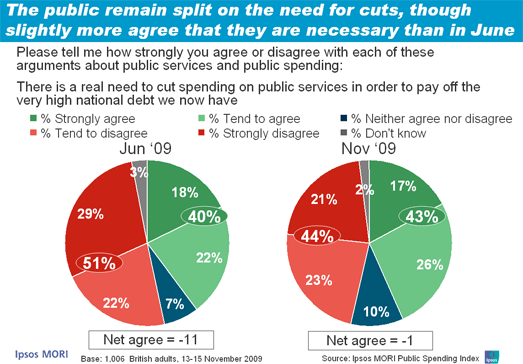
The public is split on whether there is a real need to cut spending on public services to pay off the national debt (43% agree, 44% disagree), but since the summer there has been an increase in those prepared to concede that public spending cuts are necessary. Similarly, while the majority (62%) still think that enough money can be saved just through efficiencies without damaging services, those who feel efficiencies on their own will not be enough have doubled from 13% to 26%.
The public is also split on the right approach to restoring public finances: 42% say government borrowing should be reduced, even if this means spending on key services is also cut, while 53% want spending to be maintained, even if this means an increase in taxation. Unsurprisingly, there is a clear divide along party lines. Conservative supporters prioritise reducing borrowing, while Labour and LibDem voters are most likely to say current spending should be maintained - but within each party substantial minorities also take the opposite view.
When it comes to which party is most trusted to spend public money wisely, though, the Conservatives maintain their lead. Two in five (39%) say a Conservative government would get best value from the public money it spends, against 32% who think Labour would be most effective. However, while this is a complete turnaround from 2005, when Labour was clearly ahead, the Conservative lead over Labour has fallen from 15 to seven points since June 2009.
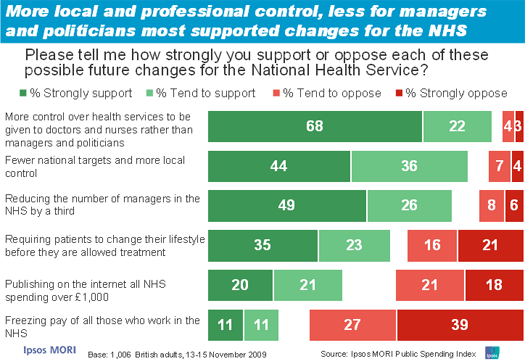
The survey also examined some specific proposals for reducing spending on the NHS in particular. In line with other research, a clear pattern emerges. There is very high support for giving more control to doctors and nurses instead of managers and politicians (reflecting the public's relative levels of trust in these different professions), reducing the number of managers in the NHS by a third, and replacing national targets with more local control (although we know that elsewhere the public are still very concerned about "the postcode lottery"). There is also majority support for requiring patients to change their lifestyle before they are allowed to treatment, for example by giving up smoking (although whether people would really be prepared to change their own lifestyles is another matter). On the other hand, the public is undecided on the impact of publishing all spending on the NHS above 1631,000, and strongly against freezing the pay of all NHS staff.
Commenting on the findings, Bobby Duffy, Managing Director of the Ipsos Social Research Institute, said,
"These results show that while messages on hard choices are slowly beginning to filter through, there is still a significant gap between public perceptions and the reality of the situation facing public finances. It's clear from this and from our other research that getting the public to accept - even grudgingly - that the services that they personally receive, or the taxes they personally pay, are going to take the brunt will be very difficult. Talk of efficiencies and moving to more frontline control at the expense of national targets and managers will be well received - but people may increasingly question whether it will be enough."
- Download the Public Spending Index160topline (PDF)
- Download the Public Spending Index computer tables (PDF)
- Download the Public Spending Index trends and charts (PDF)160
- Download the Public Spending Index press release (PDF)
Technical Note
Ipsos interviewed a representative sample of 1,006 British adults aged 18+ across Great Britain. Interviews were conducted by160telephone between 13-15 November 2009. Data are weighted to match the national population profile.