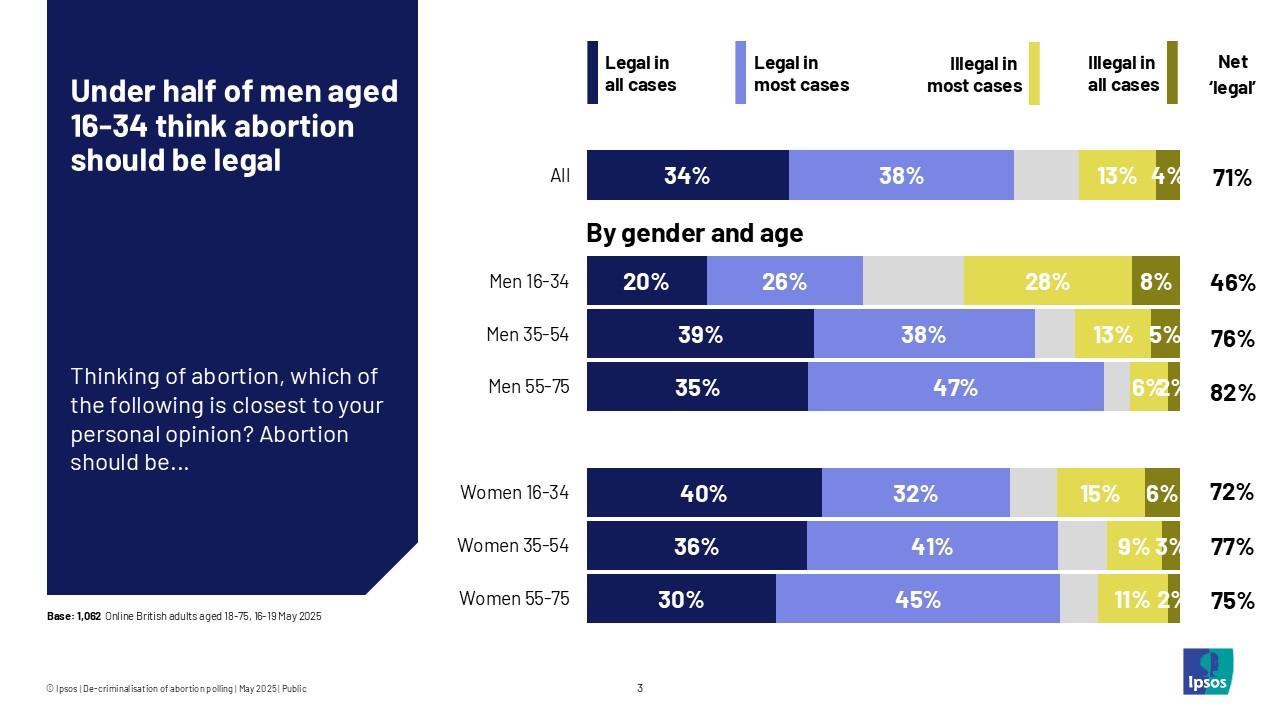
Seven in ten Britons think abortion should be legal in all or most cases – but this reduces to less than half of young men
New polling from Ipsos in the UK reveals that a significant majority of Britons (71%) believe abortion should be legal in most or all cases – but this reduces to less than half (46%) of young men aged 16-34. The survey, conducted online between the 16th-19th May 2025, among 1,062 British adults aged 16-75, explores public attitudes towards abortion legality, time limits, and potential penalties ahead of an anticipated parliamentary vote on whether to decriminalise the procedure.
Key findings
- Strong support for legal abortion…: Seven in ten (71%) Britons think abortion should be legal in all (34%) or most cases (38%). Only a small minority believe it should be illegal in most (13%) or all cases (4%). This level of support has remained relatively consistent since 2022.
- …but young men significantly less likely to agree: Less than half (46%) of men aged 16-34 believe that abortion should be legal in all or most cases, compared to three in four (76%) men aged 35-54 and 82% of men aged 55-75. Levels of support for legal abortion are relatively consistent among women of all age groups surveyed.
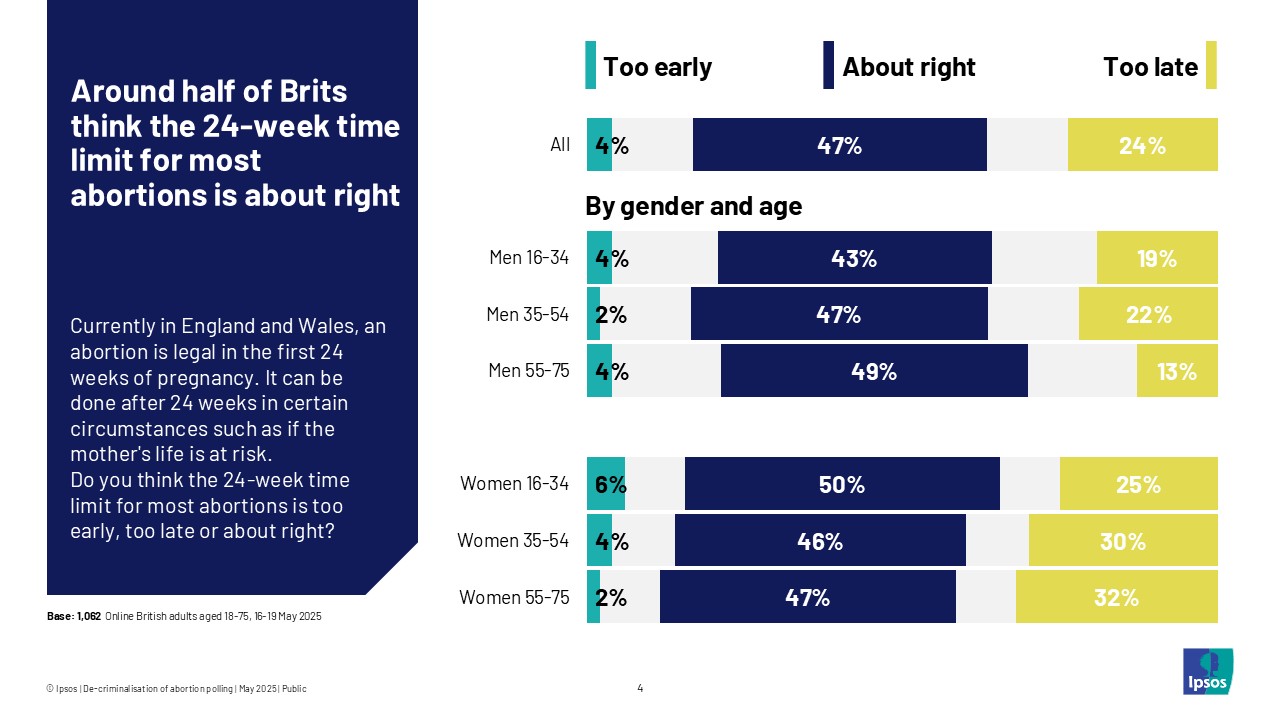
- Views on time limits: Around half (47%) of Britons believe the current 24-week time limit for most abortions in England and Wales is "about right." 24% think it is too late, while 4% think it is too early.
- Awareness of legal consequences: Half of Britons (50%) correctly believe that women can face criminal prosecution for having an abortion beyond the 24-week limit without a doctor's consent.
- Attitudes towards penalties: When asked about illegal abortions, just over half (55%) of Britons think the person who performed the abortion should face a penalty. Considerably fewer believe the woman who had the abortion (32%) or someone else who arranged the abortion (37%) should face a penalty.
Commenting on the findings, Kate Duxbury at Ipsos said:
While the majority of Britons support legal abortion, with seven in ten in favour, our polling reveals a significant fault line: less than half of young men aged 16-34 agree. This divergence, coupled with the fact that around half of Britons think the current 24-week limit is 'about right', highlights the complexities facing policymakers as they consider decriminalisation. It's clear that public opinion is far from monolithic, demanding a nuanced approach to this sensitive issue.
Technical note:
- Ipsos interviewed a representative sample of 1,062 adults aged 16-75 across Great Britain. Polling was conducted online between the 16th and 20th of May 2025.
- Data are weighted to match the profile of the population. All polls are subject to a wide range of potential sources of error.