Skills Shortage Is Top Concern For British Business
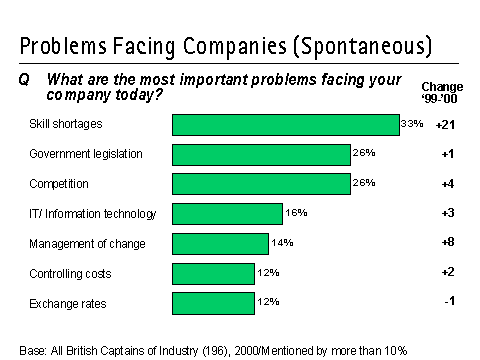
Britain's business leaders regard skills shortages as the most important problem facing their company today, according to the findings of the 2000 MORI annual survey of Britain's Captains of Industry. For the first time ever, this issue is of more concern than regulation and competition with one in three - three times as many as in 1999 - mentioning it as their major preoccupation.
Economic optimism
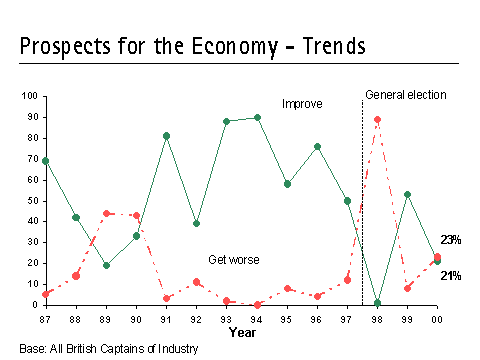
The survey also finds that confidence in the future economy has dropped substantially in the past year. Over one in five Captains expect conditions to worsen over the next 12 months, the same proportion as expect things to improve.
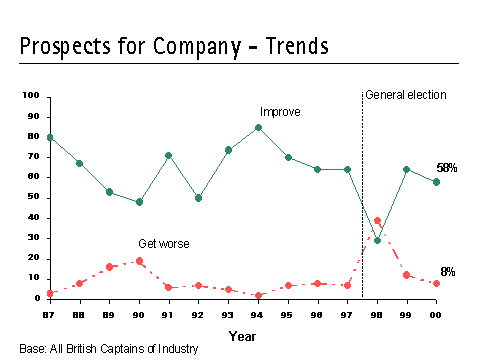
Despite their increased pessimism about the state of the British economy, these Captains are more buoyant about prospects for their own company. Over half expect to see an increase in business over the coming months.
New technology
New technology is viewed as a significant feature of the marketplace today and is making a major impact on the way that Britain's business leaders think and work . Over half see e-commerce as revolutionising their industry while nearly 6 in 10 claim that their companies have already developed on-line services to their customers over the internet. The rest are currently developing or planning to develop their on-line strategy.
The internet is also an increasingly important aspect of Captain's working lives. The majority claimed in last year's study that they would expect to have on-line access by the end of the century and they now receive an average of 34 e-mails daily with one in ten receiving over 60. Popular business sites include ft.com (visited by over half at least once), Bloomberg, the BBC, Reuters and Hemscott's.
Readership
Even though Captains are using more online publications, readership levels of the FT daily paper have remained constant.
The Single Currency
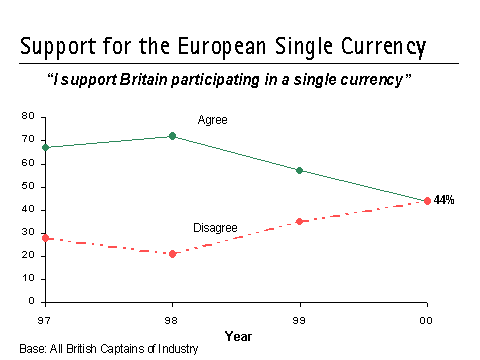
Support for the single currency continues to wane with as many disagreeing (44%) as agreeing with Britain's participation. Two years ago, over seven in ten were positive about participation, falling to six in ten in 1999. Around one in ten are now neutral on this issue.
Business Ethics
Attitudes towards business ethics have stabilised with just under half agreeing that British companies do not pay enough attention to their treatment of the environment and 38% believing that they should pay more attention to their social responsibilities. In contrast, Captains were considerably more critical of corporate social responsibility; in 1995 over six in ten felt that companies should be doing more in this respect.
Judgement about Companies
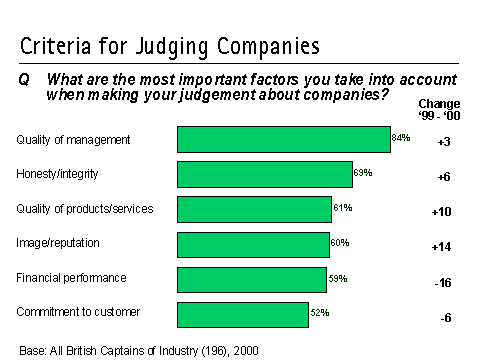
As in previous years, quality of management is the key criterion for judging a company (84%), followed by honesty and integrity (69%) Financial performance has lost some of its salience (down 16 points since 1997 to 59%) while the quality of company product and/or service offering (up 10 points to 61%) and reputation (up 14 points to 60%) have both increased in importance.
Technical details
MORI interviewed 196 board directors of Britain's leading companies selected from the top 500 companies by turnover, the FTSE top 500 and the top 100 by capital employed. Interviews were conducted face-to-face with 65% among the Chairman, CEO, MD or President of the company. Fieldwork took place between 24 September and 12 November 2000.