Understanding the gap between patient experience and public perceptions of healthcare
The public’s confidence in public institutions and healthcare quality has steeply declined over time. Yet the latest GP Patient Survey (GPPS) findings tell a more nuanced story. Across several measures, patients in England are reporting better experiences of primary care services than they were just a few years ago. Overall experience of GP practices, experience of contacting the practice, and digital access have all improved since 2024. However, the wider public conversation about healthcare often feels as negative as ever.
This raises an interesting question: if experiences are improving, why doesn't it always feel that way?
Perhaps the answer lies not only in how services are performing, but in how expectations are changing.
The age of rising expectations
Ipsos’ recent We British: From Walkmans to Wi-Fi to What? report explored four decades of social change. One of the most striking findings was that many of our core aspirations have remained remarkably consistent. People still want security, health, financial stability, meaningful relationships, and opportunities for themselves and their families. What has changed is the scope of those aspirations and the expectations that surround them.
Over the past forty years, technology has transformed daily life. Services that once required a telephone call, a letter, or a face-to-face visit can now be contacted instantly. Information is available on demand. Transactions are increasingly seamless. Personalisation has become the norm rather than the exception. And now, thanks to the rapid emergence of AI, expectations about speed, convenience, and responsiveness are rising again.
Today's innovation quickly becomes tomorrow's minimum standard.
This matters because people do not experience healthcare in isolation. Expectations are shaped by the wider environment in which people live. Every interaction with a bank, retailer, travel provider, or digital platform contributes to a broader understanding of what ‘good service’ looks like.
Healthcare in this age
Against this backdrop, primary care has been evolving too.
The GP Patient Survey in 2026 found improvements across a range of measures, including overall experience of the GP practice, experiences during the last contact, and of digital access routes such as practice websites and the NHS App. More patients are also contacting their practice online than they did two years ago.
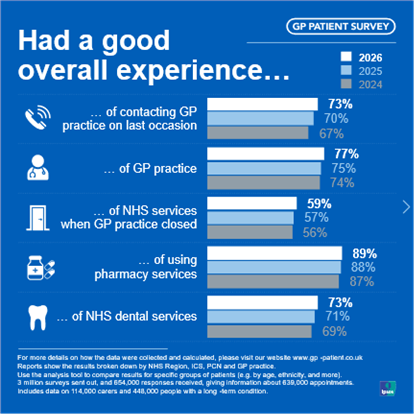
These findings suggest that primary care is adapting to changing patient needs and behaviours.
However, improvements in performance do not automatically translate into equally large shifts in public sentiment. The We British report shows a sharp decline in perceptions of healthcare quality. In 1986, 70% of Britons described the quality of healthcare as good. Today, that figure has fallen to just 25%.
Behavioural science can help us understand why this may be the case.
Understanding the perception gap
In the news, through other media channels, and by friends and family, people are exposed to often negative narratives about the wider healthcare system that extend beyond their own experiences. Stories about long waiting lists, workforce shortages, and pressures on NHS services are frequently discussed and easily recalled. Behavioural scientists refer to this as the availability heuristic. People naturally judge issues based on the examples that come most easily to mind. As a result, they can have a disproportionate influence on how people think about healthcare overall.
Related to this is negativity bias. Decades of research suggest that negative information tends to have a stronger psychological impact than positive information. Service failures are more memorable than routine successes, and bad news attracts greater attention than good news. A single frustrating encounter can often shape perceptions more strongly than several smooth interactions.
These behavioural tendencies can influence the way people approach and feel about healthcare services. However, they do not necessarily determine what people ultimately want from those services.
This distinction is important because expectations are not all the same. Behavioural researchers often distinguish between predicted expectations and desired expectations. Predicted expectations are what people realistically think will happen. Desired expectations are the level of service people believe they should receive.
Through hedonic adaptation, people quickly become accustomed to improvements in other parts of their lives, particularly faster, more personalised, and seamless digital services. As this reference point shifts, features that once felt innovative or exceptional (such as a new digital service) can rapidly become part of the expected baseline. As a result, people may anticipate a difficult healthcare experience while still wanting timely access, effective treatment, clear communication, and a smooth journey. The gap between what they expect to receive and what they believe they should receive may continue to widen.
Taken together, these factors could help explain how improving experiences and persistent pessimism can coexist.
A broader societal story
This challenge is not unique to healthcare.
The We British report paints a picture of a society that has become more pessimistic over time, with lower confidence in institutions and a much stronger sense that the country is heading in the wrong direction than was evident in previous decades.
Healthcare therefore operates within a wider context of declining institutional confidence. People's views of health services are influenced not only by individual experiences, but by broader attitudes towards public services, politics, and the direction of society more generally.
Viewed through this lens, the apparent contradiction between improving patient experience and ongoing public concern becomes less surprising.
What does this mean for public services?
The challenge for public services today may not simply be improving outcomes.
Improvement remains vital. However, in an environment where expectations continually evolve, negative information carries greater weight, and public confidence in institutions is under pressure, improvement alone may not always be enough to shift perceptions.
The more important question may be this: how can services continue to improve while helping the public recognise and experience those improvements in ways that feel meaningful?
This is where behavioural science can help. Improving services is only part of the challenge. People also need to notice those improvements and understand what they mean for their own experience of care. The NHS's ‘You said, we did’ approach is a good example. By clearly showing how patient feedback has led to change, it helps people connect improvements in services with their own experiences.
Success is not judged solely by the progress services have made. It is judged against an ever-shifting sense of what people believe good service should look like, making it essential that improvements are understood, recognised, and felt.