
Is safety the way to pitch autonomous vehicles?
While a fully autonomous vehicle is a scary notion for the average driver, the industry can promote multiple Advance Drive Assist Systems (ADAS) features for a safer, more controlled semi-autonomous experience, paving the way for broader understanding and acceptance of autonomous.
ADAS, combined with features like blind spot detection, lane centering and crash avoidance, creates a semi-autonomous experience for drivers. These combinations provide a real-world example of what the vehicle can do to avoid accidents and help the driver.
Although fewer than 20% of U.S. vehicle owners have experienced semi-autonomous vehicles, they have been gaining traction in the last few years. Since 2019, the percentage of American drivers who report driving or riding in semi-autonomous modes grew by 8 percentage points. This is a result of many automakers including ADAS as a standard feature in new vehicles.
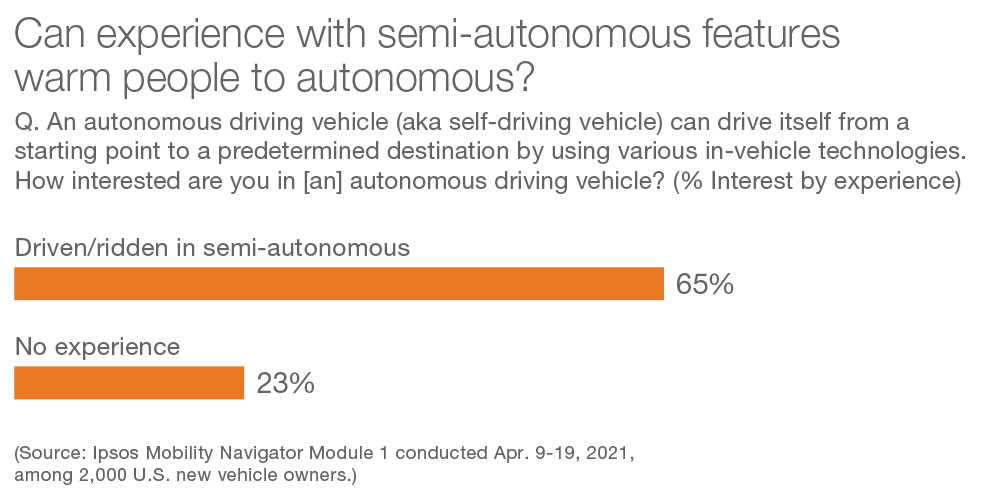
What’s key is that Americans who have experience using semi-autonomous features were three times more likely to have interest in getting a vehicle with an autonomous driving functionality, according to the Ipsos Mobility Navigator Global study.
Safety has always been an important factor in automotive decision-making. Clearly, that definition is evolving in importance over the last year with crash protection, crash prevention, personal safety and now personal protection from COVID-19.
Another trend is the growing level of driver distraction from multiple alerts in the vehicle, consumers talking on their smartphones or even reading or texting on their smartphones. Today’s drivers believe they encounter a distracted driver in one of every two drives they take, per another recent Ipsos survey. Drivers need help to remain safer while driving, even if they don’t want to admit it.
Auto manufacturers that connect ADAS marketing efforts to the core consumer need of “safety” can persuade customers to use the functionality of these features and reduce accidents in the future.
This article was originally published in What the Future Commuting, a research magazine by Ipsos exploring the changing dynamics of business travel, hotel stays, the points economy, and virtual technologies will shape our future getaways. Download the magazine here.


![[WEBINAR] Global Voices of Experience 2026](/sites/default/files/styles/list_item_image/public/ct/event/2026-02/thumbnail-global-voices-experience.jpg?itok=NN6W-9Ft)