

Americans overwhelmingly support 988 Lifeline funding
Washington, D.C., July 16, 2026 – A new national poll from NAMI and Ipsos finds that awareness of the 988 Suicide & Crisis Lifeline has increased substantially since its 2022 launch. Americans trust 988 at nearly the same rate as 911, and three-quarters of those who have contacted the Lifeline report receiving the help they needed. Americans also support federal and state investment in 988 crisis services. However, actual use remains low. Common barriers include concerns about being charged for services and law enforcement being sent to their location.
Detailed Findings:
1. 988 awareness has seen substantial growth since prior to launch, and trust is close to trust in 911
- Since the 988 Suicide & Crisis Lifeline launched in July 2022, public recognition has grown rapidly, and Americans now express strong confidence in the service.
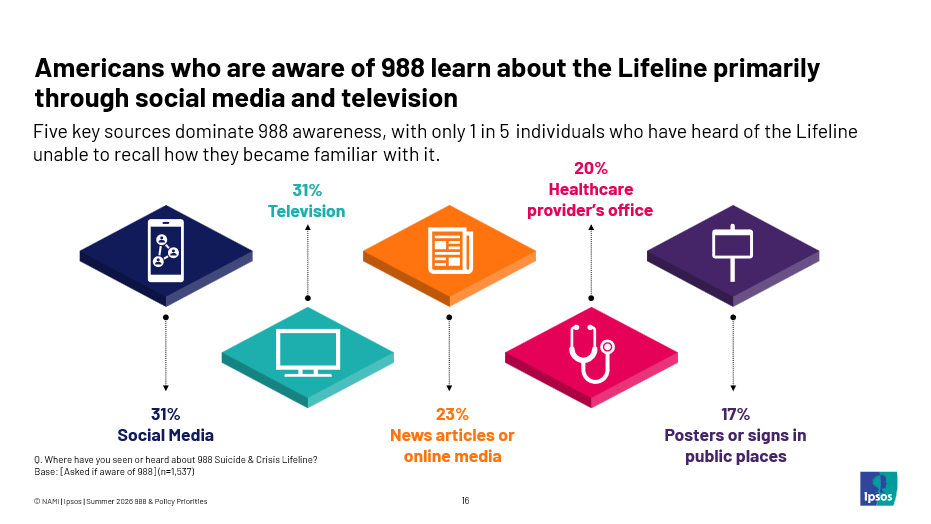
- Nearly three in four Americans (74%) are aware of the 988 Suicide & Crisis Lifeline, up from just 18% prior to the Lifeline's launch. Among those who are aware of 988, nearly one in three heard of the Lifeline through social media (31%) or television (31%).
- Seventy-four percent of Americans trust that they would receive the help they need from 988 for a mental health, alcohol/drug, or suicide crisis. This is close to the 80% who trust 911 for physical health emergencies.
- Among those who have contacted 988, 75% report receiving the help they needed, up from 55% in 2023.
2. Americans strongly support policies to fund 988
- Ninety-one percent of Americans support creating 24/7 mental health, alcohol/drug, and suicide crisis call centers that can respond effectively to callers and follow up later. Eighty-seven percent support both federal and state funding for 988 Suicide & Crisis Lifeline call-center operations and crisis response services.
- Sixty-three percent say Congress should make mental health care a high priority for federal funding, 56% say the same for suicide prevention programs, and 54% prioritize the 988 Suicide & Crisis Lifeline.
- Americans also overwhelmingly support providing communities with access to mental health crisis services tailored to their specific experience, including veterans (93%), people who are Deaf and Hard of Hearing (91%), people living in rural communities (87%), Spanish-speaking individuals (76%), and LGBTQ+ youth and young adults (72%).
3. Reporting usage of 988 is highest among younger adults, LGBTQ+ individuals, lower-income Americans, and parents of minor children
- While awareness has grown dramatically, actual contact with 988 remains low.
- Six percent of Americans report having contacted 988 while experiencing a mental health, substance use, or suicide crisis, and 7% have contacted 988 for someone else. Both figures have doubled since June 2023.
- LGBTQ+ individuals contact 988 at more than twice the rate of non-LGBTQ+ peers (11% vs. 5%), and adults under 30 contact 988 at nine times the rate of those 65 and older (9% vs. 1%).
- Lower-income Americans contact 988 at more than twice the rate of those earning $100,000 or more (9% vs. 4%), and parents of minor children report higher rates of contact than non-parents (9% vs. 5%).
4. Barriers to access persist, especially for vulnerable groups.
- Despite rising awareness and trust, concerns about perceived cost and law enforcement involvement prevent many Americans from reaching out.
- Fifty-four percent of Americans express concern they might end up being charged for services without being able to pay, and 52% express concern that law enforcement might be sent to their location.
- LGBTQ+ individuals express significantly greater concern that law enforcement might be sent to their location (69% vs. 49% of non-LGBTQ+ peers).
- Half of Americans (50%) express concern that 988 responders wouldn't be able to handle the issue.
Learn more at NAMI Summer 2026 Poll.
About the Study
This NAMI/Ipsos poll was conducted June 12 – 14, 2026 by Ipsos using the probability-based KnowledgePanel®. This poll is based on a nationally representative probability sample of 2,046 general population adults age 18 or older.
The survey was conducted using KnowledgePanel, the largest and most well-established online probability-based panel that is representative of the adult U.S. population. Our recruitment process employs a scientifically developed addressed-based sampling methodology using the latest Delivery Sequence File of the USPS – a database with full coverage of all delivery points in the U.S. Households invited to join the panel are randomly selected from all available households in the U.S. Persons in the sampled households are invited to join and participate in the panel. Those selected who do not already have internet access are provided a tablet and internet connection at no cost to the panel member. Those who join the panel and who are selected to participate in a survey are sent a unique password-protected log-in used to complete surveys online. As a result of our recruitment and sampling methodologies, samples from KnowledgePanel cover all households regardless of their phone or internet status and findings can be reported with a margin of sampling error and projected to the general population.
The study was conducted in English. The data for the total sample were weighted to adjust for gender by age, race/ethnicity, education, Census region, metropolitan status, and household income. The demographic benchmarks came from the 2025 March Supplement of the Current Population Survey (CPS). Party ID benchmarks are from the 2025 National Public Opinion Reference Survey (NPORS).
- Gender (Male, Female) by Age (18–29, 30–44, 45-59 and 60+)
- Race/Hispanic Ethnicity (White Non-Hispanic, Black Non-Hispanic, Other, Non-Hispanic, Hispanic, 2+ Races, Non-Hispanic)
- Education (Less than High School, High School, Some College, Bachelor or higher)
- Census Region (Northeast, Midwest, South, West)
- Metropolitan status (Metro, non-Metro)
- Household Income (Under $25,000, $25,000-$49,999, $50,000-$74,999, $75,000-$99,999, $100,000-$149,999, $150,000+)
- Party Identification (Republican, Lean Republican, Independent/Not lean, Lean Democrat, Democrat)
The margin of sampling error is plus or minus 2.2 percentage points at the 95% confidence level, for results based on the entire sample of adults. The margin of sampling error takes into account the design effect, which was 1.05.
The margin of sampling error is higher and varies for results based on sub-samples. In our reporting of the findings, percentage points are rounded off to the nearest whole number. As a result, percentages in a given table column may total slightly higher or lower than 100%. In questions that permit multiple responses, columns may total substantially more than 100%, depending on the number of different responses offered by each respondent.
For more information on this news release, please contact:
Mallory Newall
Vice President, US
Public Affairs
[email protected]
About Ipsos
Ipsos is one of the largest market research and polling companies globally, operating in 90 markets and employing nearly 20,000 people.
Our passionately curious research professionals, analysts and scientists have built unique multi-specialist capabilities that provide true understanding and powerful insights into the actions, opinions and motivations of citizens, consumers, patients, customers or employees. Our 75 business solutions are based on primary data from our surveys, social media monitoring, and qualitative or observational techniques.
“Game Changers” – our tagline – summarizes our ambition to help our 5,000 clients navigate with confidence our rapidly changing world.
Founded in France in 1975, Ipsos has been listed on the Euronext Paris since July 1, 1999. The company is part of the SBF 120, Mid-60 indices, and is eligible for the Deferred Settlement Service (SRD).
ISIN code FR0000073298, Reuters ISOS.PA, Bloomberg IPS:FP www.ipsos.com


