
Most Employees Say Mental Health Talk is Work-Appropriate; Stigma Persists
Washington, D.C., March 17, 2026 – Three in four full-time employees say it is appropriate to discuss mental health at work, yet nearly half worry they would be judged for doing so, according to the latest NAMI/Ipsos Workplace Mental Health Poll. This hesitation persists as reported stress about the state of the world is on the rise. The share of employees feeling "very stressed" nearly doubled since 2024, and more than half report feeling burned out on the job. Workplace mental health training may help; employees at companies offering such training are more likely to feel supported and less worried about stigma, yet only about one in three have received it.
*Note: This study includes a nationally representative sample of 2,153 adults who are employed full-time and work at a business or company with at least 100 employees. Mentions of "employees" throughout this study refers to those who meet this criteria.
Detailed Findings:
1. Employees consistently say discussing mental health at work is appropriate, but stigma and fear hold some back from actually doing so.
- Three in four employees (74%) say it is appropriate to discuss mental health at work, and a similar share (77%) say they would feel comfortable if a coworker approached them to talk about mental health. However, only 61% feel comfortable sharing about their own mental health at work. Comfort decreases when talking to HR (39%) or senior leadership (30%) specifically.
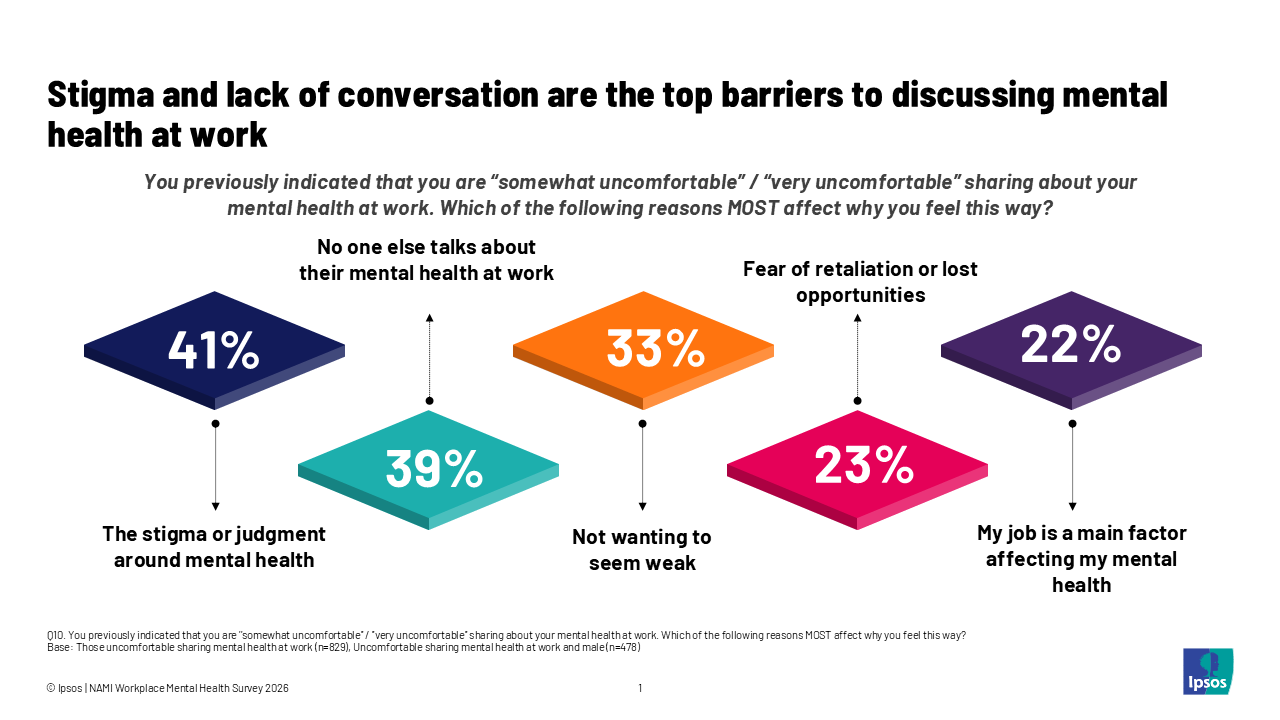
- Nearly half (48%) worry they would be judged for sharing mental health struggles. Among those uncomfortable sharing at work, top reasons include stigma (41%), the fact that no one else discusses mental health (39%), not wanting to seem weak (33%), and fear of retaliation (23%).
- Employees are more likely to support others than speak up for themselves: 38% have supported a struggling coworker, but only 15% have told their manager their own mental health is suffering due to work.
2. Stress about the state of the world is rising, and burnout at work is widespread, particularly among caregivers.
- Seventy percent report feeling stressed about the state of the world. While overall stress levels have remained steady since 2024, the intensity has grown: the share feeling "very stressed" has risen from 19% in 2024 to 30% in 2026.
- Concern about personal mental health is also climbing. More than four in ten employees (43%) say they are concerned about their own mental health, up from 35% in 2024.
- More than half of employees (53%) report feeling burned out because of their job in the past year. Additionally, nearly four in ten felt their mental health suffer due to work demands.
- Caregivers* report higher levels of burnout and strain. Sixty-one percent felt burned out in the past year, compared to 49% of non-caregivers. Nearly half of caregivers (48%) say their mental health suffered due to work demands, compared to 34% of non-caregivers.
- Sandwich generation caregivers—those caring for both a child and a parent—report the most acute challenges: 52% felt overwhelmed (vs. 38% non-sandwich caregiver) and 37% considered quitting (vs. 26% non-sandwich caregiver).
*Note: Caregivers represent those who report that they were an unpaid caregiver for a parent, child, spouse/partner, other relative, or close friend including helping them take care of themselves, helping with personal needs, household chores, or managing their finances any time in the last 12 months.
3. Mental health training is linked to more positive workplace experiences, but most employees—and managers—haven't received it.
- Employees at companies that offer mental health training report notably different experiences than those at companies that do not. For example:
- 86% feel their manager cares about them (vs. 70% without training)
- 69% believe their company prioritizes their mental health (vs. 40% without training)
- 58% feel C-suite leadership cares about them (vs. 43% without training)
- 43% worry about being judged for sharing struggles (vs. 52% without training)
- However, only about one in three employees (32%) report having received training about mental health resources from their employer, and just one in four have received training about mental health conditions or symptoms.
- About seven in ten managers (69%) say their company has provided them with proper resources to support their team's mental and emotional health—but those who lack such resources report starkly different outcomes:
- 90% of managers with adequate resources feel prepared to support their team's mental health (vs. 61% without)
- 45% of managers with resources report feeling burned out (vs. 73% without)
- 18% of managers with resources considered quitting due to mental health impact (vs. 41% without)
Learn more at 2026 NAMI-Ipsos Workplace Mental Health Poll | NAMI
About the Study
This NAMI/Ipsos poll was conducted January 27 – February 2, 2026, by Ipsos using the probability-based KnowledgePanel®. This poll is based on a nationally representative probability sample of 2,153 general population adults, age 18 or older, who are employed full-time and work at a business or company with at least 100 employees.
The data for the total sample were weighted to adjust for gender by age, race/ethnicity, Census region, education, and household income. The demographic benchmarks came from the 2025 March Supplement of the Current Population Survey (CPS).
- Gender (Male, Female) by Age (18-29, 30-44, 45-59, 60+)
- Race-Ethnicity (White/Non-Hispanic, Black/Non-Hispanic, Other/Non-Hispanic, Hispanic, 2+
Races/Non-Hispanic) - Census Region (Northeast, Midwest, South, West) by Metropolitan Status (Metro, Non-Metro)
- Education (Less than High School, High School, Some College, Bachelor or higher)
- Household Income (under $25K, $25K-$49,999, $50K-$74,999, $75K-$99,999, $100K-$149,999,
$150K and over)
The margin of sampling error for this study is plus or minus 2.3 percentage points at the 95% confidence level, for results based on the entire sample of adults. The margin of sampling error takes into account the design effect, which was 1.15. The margin of sampling error is higher and varies for results based on other sub-samples. In our reporting of the findings, percentage points are rounded off to the nearest whole number. As a result, percentages in a given table column may total slightly higher or lower than 100%. In questions that permit multiple responses, columns may total substantially more than 100%, depending on the number of different responses offered by each respondent.
For more information on this news release, please contact:
Mallory Newall
Vice President, US
Public Affairs
[email protected]
About Ipsos
Ipsos is one of the largest market research and polling companies globally, operating in 90 markets and employing nearly 20,000 people.
Our passionately curious research professionals, analysts and scientists have built unique multi-specialist capabilities that provide true understanding and powerful insights into the actions, opinions and motivations of citizens, consumers, patients, customers or employees. Our 75 business solutions are based on primary data from our surveys, social media monitoring, and qualitative or observational techniques.
“Game Changers” – our tagline – summarizes our ambition to help our 5,000 clients navigate with confidence our rapidly changing world.
Founded in France in 1975, Ipsos has been listed on the Euronext Paris since July 1, 1999. The company is part of the SBF 120, Mid-60 indices, and is eligible for the Deferred Settlement Service (SRD).
ISIN code FR0000073298, Reuters ISOS.PA, Bloomberg IPS:FP www.ipsos.com