Global consumer sentiment continues inching up
Global consumer sentiment continues inching up
More countries saw gains than incurred losses in the past month, but consumer confidence remains below pre-pandemic levels almost everywhere
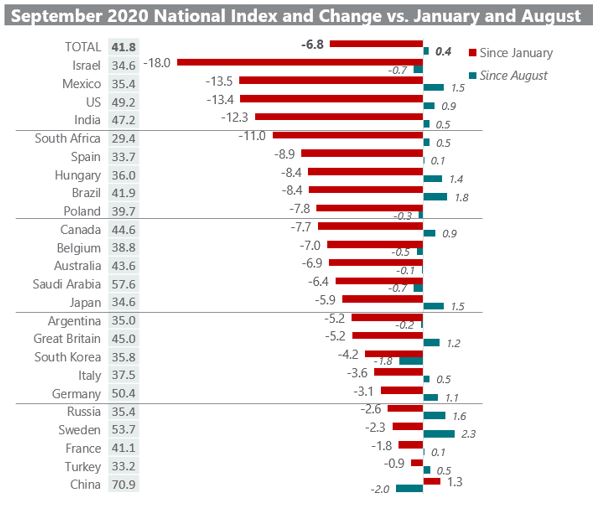
Washington, DC, September 15, 2020 — At 41.8, the Global Consumer Confidence Index is up slightly over last month (41.4). September is the third consecutive month showing gains-in consumer sentiment at the global level after bottoming out in June. However, the index remains 6.8 points lower than its pre-pandemic level recorded in January and nearly five points lower than its historic average spanning over 10 years.
The Global Consumer Confidence Index is the average of each of the 24 world markets’ National Indices. It is based on a monthly survey of more than 17,500 adults under the age of 75 conducted on Ipsos’ Global Advisor online platform.
This month, five countries show significant growth (1.5 points or more) in their National Index: Sweden (+2.3), Brazil (+1.8), Russia (+1.6), Mexico (+1.5), and Japan (+1.5). Sweden and Russia have shown significant gains in each of the past three months, while Brazil has seen significant growth in the past two.
China (-2.0) and South Korea (-1.8) are the only countries showing significant drops in their National Index this month. Despite this month’s decrease, China’s National Index (70.9) remains higher than it was pre-pandemic and higher than that of any other country surveyed. In contrast, at 35.8, South Korea’s National Index is lower than it’s ever been in the past 10 years.
National Index Trends
Compared to January, every single country’s National Index is down except for China’s (+1.3). The National Index of five countries (Israel, Mexico, the U.S., India, and South Africa) is down by over 10 points vs. January and that of eleven other countries is down by five to 10 points.
- While 11 of the 24 countries surveyed had a National Index higher than 50 back in January, this is now the case of only four countries: China (70.9), Saudi Arabia (57.6), Sweden (53.7), and Germany (50.4).
- At the other end of the spectrum, six countries now have a National index at 35 or below, compared to just one (Turkey) in January: South Africa (29.4), Turkey (33.2), Spain (33.7), Japan (34.6), Israel (34.6) and Argentina (35.0). However, none of these countries are seeing a significant drop in their National Index vs. last month and one is seeing a significant increase (Japan, +1.5).
Expectations, Jobs, and Investment Index Trends
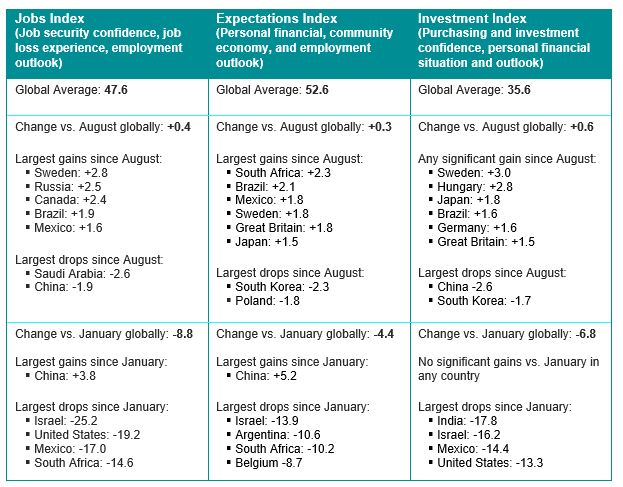
At a global level, each of the Jobs Index (+0.4), the Expectations Index (+0.3), and the Investment Index (+0.6) shows a small growth over the last month.
- The Jobs Index, indicative of confidence in job security and the employment outlook (47.6 globally), is showing significant gains in five countries (compared to nine last month, six in July, and none in June). It is down significantly in only two countries, continuing a trend (it was down in 14 countries in June, five in July, and four in August).
- The Expectations Index, reflective of consumers’ outlook on their local economy, financial situation, and employment (52.6 globally), is up significantly in six countries (compared to 11 countries in August).
- The Investment Index, indicative of the investment climate (35.6 globally) is up significantly in six countries, including Brazil and Germany for the second month in a row. It is down significantly only in China (-2.6) and South Korea (-1.7). For comparison, the Investment Index showed significant drops from May to June in as many as 15 countries.
About the Study
These findings are based on data from Refinitiv /Ipsos’ Primary Consumer Sentiment Index (PCSI) collected in a monthly survey of consumers from 24 markets via Ipsos’ Global Advisor online survey platform. For this survey, Ipsos interviews a total of 17,500+ adults aged 18-74 in the United States of America, Canada, Israel, Turkey, South Africa; and age 16-74 in all other markets each month. The monthly sample consists of 1,000+ individuals in each of Australia, Brazil, Canada, China (mainland), France, Germany, Italy, Japan, Spain, Great Britain and the USA, and 500+ individuals in each of Argentina, Belgium, Hungary, India, Israel, Mexico, Poland, Russia, Saudi Arabia, South Africa, South Korea, Sweden and Turkey.
Data collected each month are weighted so that each country’s sample composition best reflects the demographic profile of the adult population according to the country’s most recent census data. Data collected each month are also weighted to give each country an equal weight in the total “global” sample. Online surveys can be taken as representative of the general working age population in Argentina, Australia, Belgium, Canada, France, Germany, Great Britain, Hungary, Italy, Japan, Poland, South Korea, Spain, Sweden, and the United States. Online samples in Brazil, mainland China, India, Israel, Mexico, Russia, Saudi Arabia, South Africa and Turkey are more urban, more educated and/or more affluent than the general population and the results should be viewed as reflecting the views of a more “connected” population.
Sample surveys and polls may be subject to other sources of error, including, but not limited to coverage error, and measurement error. The precision of the Refinitiv/Ipsos online surveys is measured using a Bayesian Credibility Interval. Here, the poll has a credibility interval of +/- 2.0 points for countries where the 3-month sample is 3,000+ and +/- 2.9 points for countries where the 3-month sample is 1,500+. Please click on this link for more information on credibility intervals.
The publication of these findings abides by local rules and regulations.
The results reported each month in the Refinitiv/Ipsos’ Primary Consumer Sentiment Index are based only on that month’s data (hence, the base for each country is 500+ or 1,000+) and comparisons are made against results from other months which are also each based on one month’s data. In contrast, the results reported any given month in Ipsos’s Global Consumer Confidence at-a-Glance are based on data collected not only that month, but also during to the two previous months and consist of past 3-month “rolling averages”. This technique allows for tripling the sample size for each metric. Hence, the base for any country ranges from 1,500+ to 3,000+. This increases the reliability of the findings and the statistical significance of reported variations over time, However, to heighten the freshness of the findings reported any given month, the data from the same month is given a weight of 45%, the data from the previous month a lesser weight of 35%, and the data from the earliest of the three months an even lesser weight of 20%.
The Refinitiv/Ipsos Primary Consumer Sentiment Index (PCSI), ongoing since 2010, is a monthly survey of consumer attitudes on the current and future state of local economies, personal finance situations, savings and confidence to make large investments. The PCSI metrics reported each month for each of the 24 countries surveyed consist of a “Primary Index” based on all 11 questions below and of several “sub-indices” each based on a subset of these 11 questions. Those sub-indices include an Expectations Index; Investment Index; and, Jobs Index.
For more information on this news release, please contact:
Chris Jackson
Senior Vice President, US
Public Affairs
+1 202 420 2025
[email protected]
Kate Silverstein
Media Relations Specialist, US
Public Affairs
+1 718 755 8829
[email protected]
About Ipsos
Ipsos is the world’s third largest market research company, present in 90 markets and employing more than 18,000 people.
Our passionately curious research professionals, analysts and scientists have built unique multi-specialist capabilities that provide true understanding and powerful insights into the actions, opinions and motivations of citizens, consumers, patients, customers or employees. We serve more than 5000 clients across the world with 75 business solutions.
Founded in France in 1975, Ipsos is listed on the Euronext Paris since July 1st, 1999. The company is part of the SBF 120 and the Mid-60 index and is eligible for the Deferred Settlement Service (SRD).
ISIN code FR0000073298, Reuters ISOS.PA, Bloomberg IPS:FP