The economy slows
GDP growth slowed for the second consecutive quarter, putting us in recession territory. Some policymakers and leaders have softened some of their recession calls, but the point still stands: the economy is slowing.
The fundamentals point to trouble. Inflation is the problem of the hour, and the Federal Reserve aims to reel it in by aggressively raising interest rates. The Fed has never successfully curbed inflation without leading to a recession.
Where does that leave Americans? For now, they are squeezed from all sides.
Below are five charts on where the economy and Americans stand during this inflationary period.
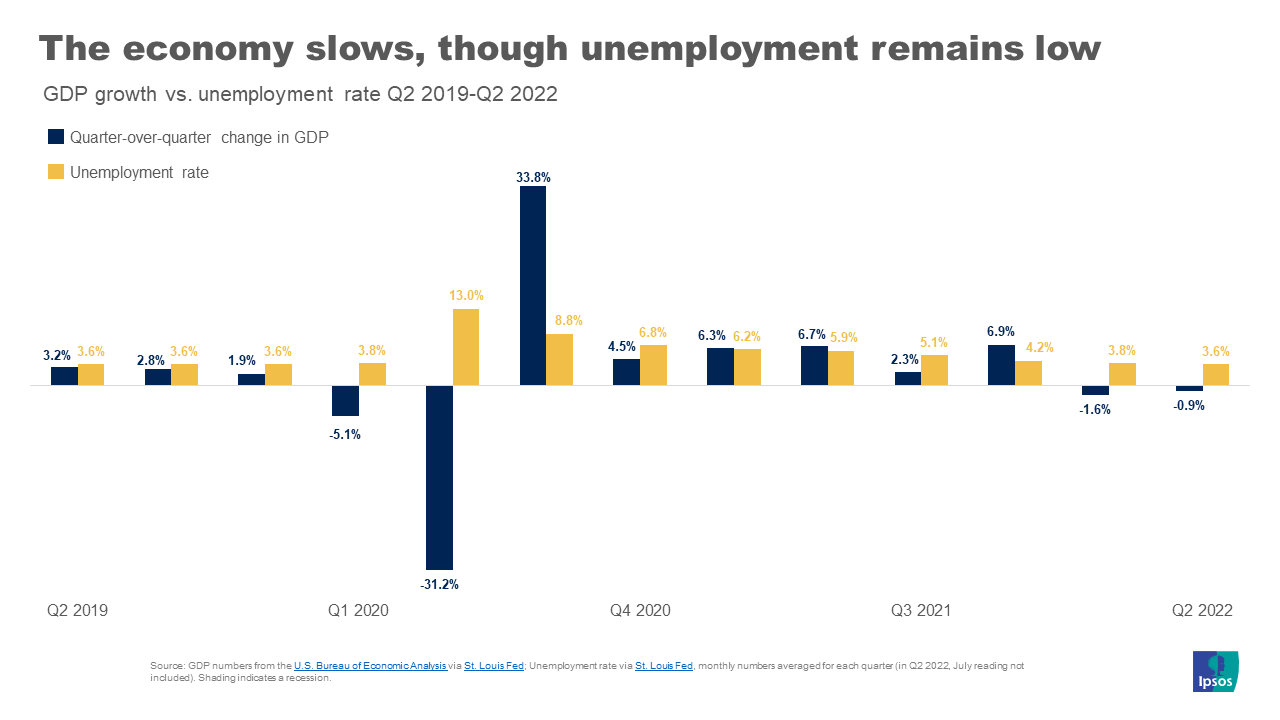
- Mixed signals. The economy slows for this quarter. It is nowhere near as severe as the initial recession during the early days of COVID. Unemployment still sits at pre-pandemic levels. Will that last? We will see.
- Catching up. As inflation rose during the first part of 2021, policymakers were slow to react. Now, the Fed is playing catch up. The past two months of rate hikes represent some of the most aggressive actions the Fed has ever taken. The question is whether this will set our economic growth back even further, pushing us deeper into a recession. Dark clouds on the horizon.

- The Confidence Blues. Consumers are feeling less confident in the economy. In the U.S., this dip is especially pronounced. Initially, confidence rose to pre-pandemic levels during the summer of 2021. Now, confidence is roughly equivalent to what it was in early 2021, when few were vaccinated. This more pessimistic take is being felt around the world too. Here, again, we can blame inflation.

- Jobs Bulwark. Inflation is putting people in a pinch. Few feel comfortable making everyday household purchases, like groceries and toiletries. That’s on par with what people were feeling in March 2020. Many still feel fairly secure about their job, though that number has also come down since this time last year. Glimmers of hope? Or storm clouds on the horizon?

- Regressive tax. Inflation is a regressive tax. It does not affect all equally. Look at the data. Low-income Americans were hit first by this inflationary moment. Now middle-income Americans are right there with them. Who is insulated? The wealthy. But even they are still feeling the inflationary pressures. Expect changes in how people spend and what they spend on. The tale of two Americas—one rich; the other poor.

Right now, there are many mixed signals in the economy. Economic growth is slowing, and inflation is high, but unemployment remains low. Consumers are caught in the middle, getting hit with higher prices, and dampening confidence in the economy.
What happens in the short term may tell us which way we are headed: closer towards a more pronounced recession or continuing in this state of economic limbo. Things, though, look more negative than positive.