Most in the U.S. and globally are yet to be convinced their government has a clear plan to tackle climate change
Washington, DC, April 22, 2021 — Just one in five Americans believe that the government has a clear plan in place to address climate change, according to a new Ipsos Global Advisor Earth Day survey. On average, across the 30 countries and markets where the online survey was conducted, 31% agree their government has such a plan in place. In the United States, only 18% agree – less than in any country surveyed except Japan.
In most countries, a majority of those surveyed believe their government will be failing its citizens by not acting now to combat climate change. This is the view of 63% in the U.S. and 65% on average across all 30 countries and markets.
However, most people throughout the world do not lay the responsibility solely on their government. Two-thirds in the U.S. (65%) and 68% on average across all 30 countries and markets express the belief that if businesses do not take action now to combat climate change, they will be failing their customers. And slightly higher proportions both in the U.S. (68%) and globally (72%) agree that if individuals do not take action now to combat climate change, they will be failing future generations.

Two-thirds of those surveyed in the U.S. (65%) and on average across the 30 markets (69%) agree with the statement, “I feel I understand what action I need to take to play my part in tackling climate change”. However, consumers in the U.S. and across the globe tend to be selective when it comes to more sustainable consumption, shopping, and travel behaviors they are willing to adopt.
Detailed Findings
Actions Americans are most likely to take to combat climate change
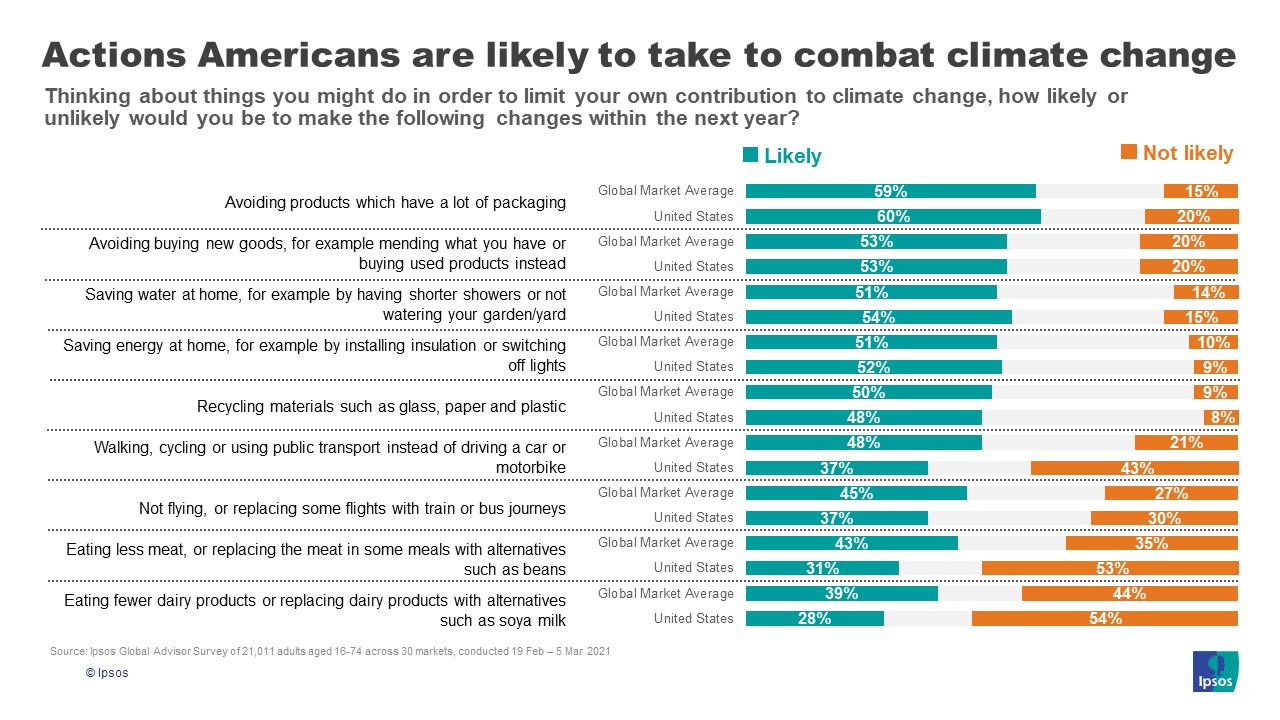
Americans are right in line with the global average when it comes to the adoption of certain behaviors to limit their contribution to climate change in the next year, but fall behind on others.
- Nearly on par with the 30-market average, 60% of Americans say they are likely to avoid buying products with excessive packaging in the year to come.
- Also similar to the global average, about half of U.S. adults say they are likely to:
- Conserve water at home (54%),
- Avoid buying new goods if they can repurpose others or buy used ones (53%),
- Save energy at home (52%), and
- Recycle (48%).
- Americans are less likely than their global peers to adopt other behaviors:
- Walk, cycle, or use public transit more often instead of driving (37% vs. 48% globally),
- Not fly or fly less (37% vs. 45%),
- Eat less meat (31% vs. 43%), and
- Eat fewer dairy products (28% vs 39%).
Most Americans are not planning to adopt more sustainable behaviors after the pandemic
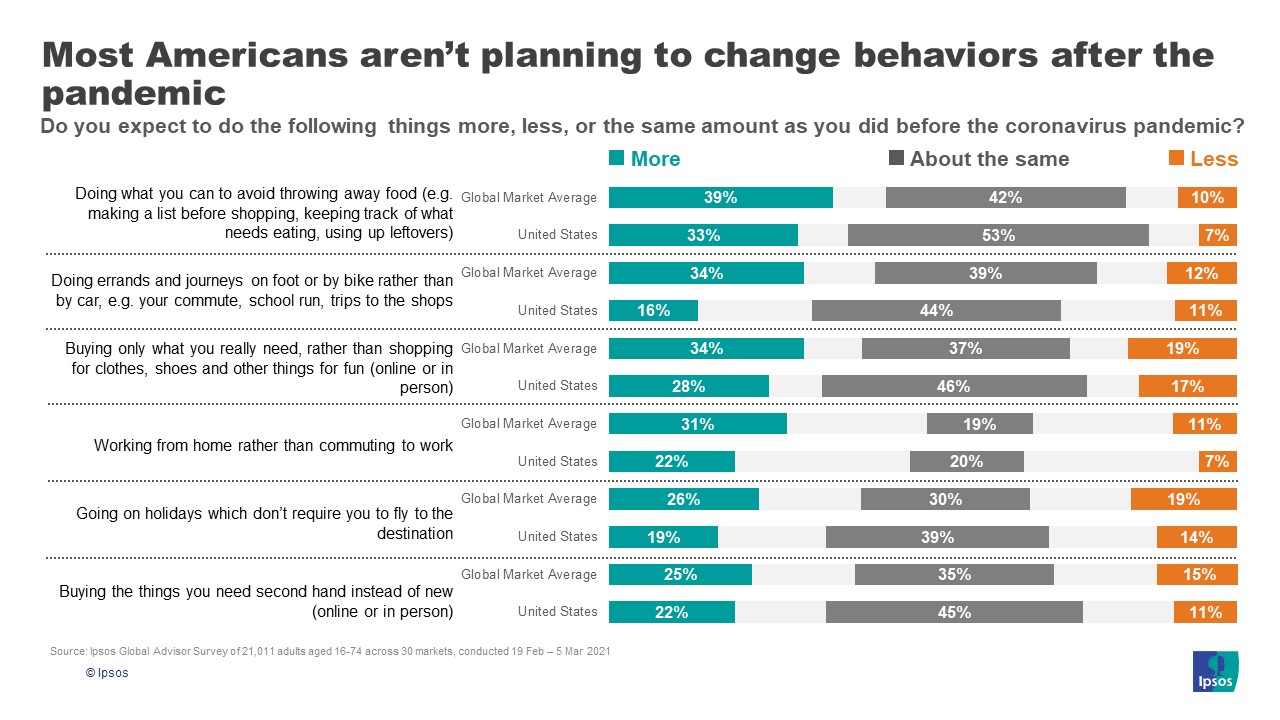
At a global level, there are signs that the pandemic is leading consumers toward pro-environmental behaviors. On average across all 30 countries and markets, around one in three adults expect to do more to reduce food waste, use alternatives to the car, restrict their shopping to just what they need, or work from home rather than commuting. However, Americans are less likely than their counterparts in most countries to expect doing so – and more likely to expect they will behave just as they did before the pandemic.
In the U.S.:
- 33% expect to do more to reduce food waste than before the pandemic (vs. 39% on average, globally)
- 28% expect to be more vigilant about buying only what they need (vs. 34%)
- 22% expect to buy things second hand rather than new more often (vs. 25%)
- 19% expect to vacation more often in places they can access with taking a flight (vs. 26%)
- Only 16% expect to run errands by foot, bicycle, or public transit more often than by car (vs. 34%)
About the Study
These are some of the results of a 30-market Global Advisor survey was conducted between February 19 and March 5, 2021 via the Ipsos Online Panel system among 21,011 adults aged 18-74 in the United States, Canada, Hong Kong S.A.R., Malaysia, South Africa, and Turkey, and 16-74 in 24 other markets.
The sample consists of approximately 1,000 individuals in each of Australia, Belgium, Brazil, Canada, China (mainland), France, Germany, Great Britain, Italy, Japan, Spain, and the U.S., and 500 individuals in each of Argentina, Chile, Colombia, Hong Kong S.A.R., Hungary, India, Malaysia, Mexico, the Netherlands, Peru, Poland, Russia, Saudi Arabia, South Africa, South Korea, Sweden, Switzerland, and Turkey.
The samples in Argentina, Australia, Belgium, Canada, France, Germany, Great Britain, Hungary, Italy, Japan, the Netherlands, Poland, South Korea, Spain, Sweden, Switzerland, and the U.S. can be taken as representative of these countries’ general adult population under the age of 75.
The samples in Brazil, Chile, China (mainland), Colombia, Hong Kong S.A.R, India, Malaysia, Mexico, Peru, Russia, Saudi Arabia, South Africa, and Turkey are more urban, more educated, and/or more affluent than the general population. The survey results for these markets should be viewed as reflecting the views of the more “connected” segment of their population.
The data is weighted so that each market’s sample composition best reflects the demographic profile of the adult population according to the most recent census data.
The “Global Country Average” reflects the average result for all the countries and markets where the survey was conducted. It has not been adjusted to the population size of each country or market and is not intended to suggest a total result.
Where results do not sum to 100 or the ‘difference’ appears to be +/-1 more/less than the actual, this may be due to rounding, multiple responses, or the exclusion of don't know or not stated responses.
The precision of Ipsos online polls is calculated using a credibility interval with a poll of 1,000 accurate to +/- 3.5 percentage points and of 500 accurate to +/- 4.8 percentage points. For more information on Ipsos’ use of credibility intervals, please visit the Ipsos website.
The publication of these findings abides by local rules and regulations.
For more information on this news release, please contact:
Nicolas Boyon
Senior Vice President, U.S., Public Affairs
+1 646 309 4879
[email protected]
Kate Silverstein
Media Relations Specialist, U.S., Public Affairs
+1 718 755 8829
About Ipsos
Ipsos is the world’s third largest Insights and Analytics company, present in 90 markets and employing more than 18,000 people.
Our passionately curious research professionals, analysts and scientists have built unique multi-specialist capabilities that provide true understanding and powerful insights into the actions, opinions and motivations of citizens, consumers, patients, customers, or employees. We serve more than 5000 clients across the world with 75 business solutions.
Founded in France in 1975, Ipsos is listed on the Euronext Paris since July 1st, 1999. The company is part of the SBF 120 and the Mid-60 index and is eligible for the Deferred Settlement Service (SRD).
ISIN code FR0000073298, Reuters ISOS.PA, Bloomberg IPS:FP www.ipsos.com