Untapped Potential: Entrepreneurialism in Inflationary Times
New York, July 22, 2022 — Entrepreneurialism is what drives the creation of small businesses, which is essential to the health of most economies. Small businesses took the brunt of pandemic shutdowns and are recovering only now. So, what does the spawning ground of economic activity look like today?
A new global Ipsos poll finds that entrepreneurial activity is alive and well in some countries but lacking in others.
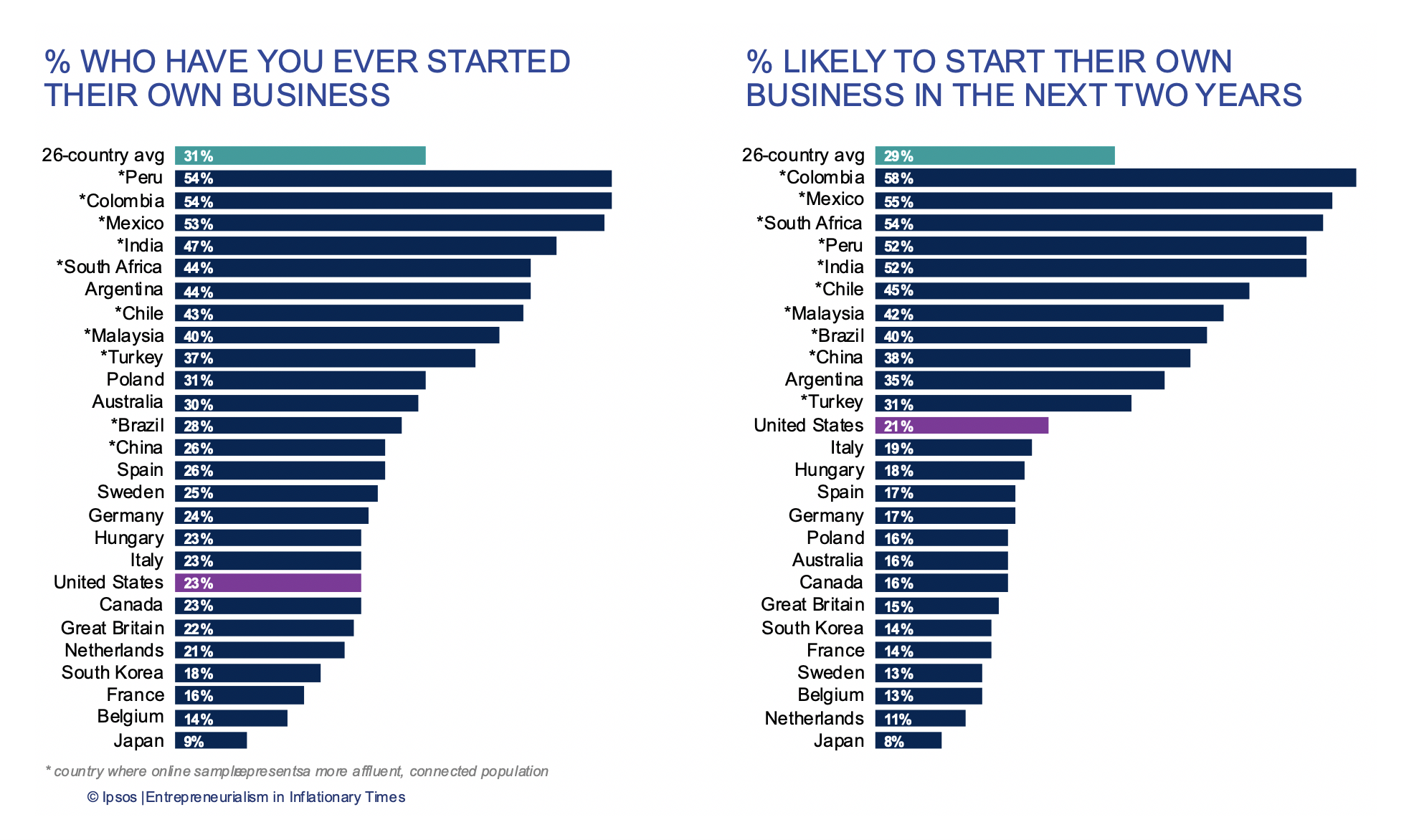 On average across 26 countries, three in ten adults surveyed (31%) say that they have ever started a business. Although the United States is generally viewed as a particularly business-friendly country, the proportion of Americans who report having ever started a business (23%) is lower than the global average.
Intentions to start a business show a similar pattern. While 29% on average globally say they are likely to start a business in the next two years, only 21% in the U.S. say so. However, this is a larger proportion than in all other advanced economies.
Indeed, entrepreneurial activity and aspirations vary widely by country. For example:
- Peru (54%), Colombia (54%), and Mexico (53%) have the highest proportion of people saying they have started a business in the past, while South Korea (18%), France (16%), Belgium (14%) and Japan (9%) have the lowest rates of entrepreneurial experience.
- Colombia (58%), Mexico (55%), and South Africa (54%) have the highest proportion of adults saying they are likely to start a business in the future, while Sweden (13%), Belgium (13%), the Netherlands (11%) and Japan (8%) have the lowest.
Americans are not as likely as others to view government as a key contributor to new business success
At a global level, when it comes to how much each contributes to the success of new business endeavors, government support ranks first (cited by a 26-country average of 56%), interest rates second (50%), and inflation third (40%). Americans tend to see things differently as they are more likely to single out inflation (58%) and interest rates (50%) than government (41%) as major factors contributing to the ongoing success of starting a business.
But only 30% on average across 26 countries and 19% in the U.S. say that government is doing a good job fostering entrepreneurialism in their countries. The private sector and banks do not fare much better. Only 31% globally and 25% in the U.S. say that the private sector does a good job fostering entrepreneurialism in their country and only 31% and 26%, respectively, say so of banks.
Non-traditional groups becoming active
Globally, entrepreneurialism is no longer the domain of men and higher socio-economic groups as it may have been in the past. On average across the 26 countries surveyed, the demographic groups showing the largest increases since 2018 in both entrepreneurial experience (ever started a business) and aspirations (likelihood to start one in the next two years) are:
- Women (+5 and +6 percentage points, respectively),
- Gen Z/Millennial (+18 and +6 points), and
- Lower-income earners (+7 and +9 points).
Funding holding people back most in emerging countries
At a global level, funding is most widely viewed as the key barrier to starting a new business (41%on average across all 26 countries), far ahead of lack of interest (19%) the condition of the economy (19%), and lack of knowledge about how to do it (17%).
However, in the U.S., more cite lack of interest as the #1 barrier (43%) than funding (29%), lack of knowledge (13%), and the state of the economy (10%). Other advanced economies such as Germany, Great Britain, the Netherlands, Sweden, and Australia show a similar pattern.
This suggests that entrepreneurialism is a necessity in emerging countries and a choice in affluent ones such as the U.S.
Social entrepreneurialism competing with business entrepreneurialism
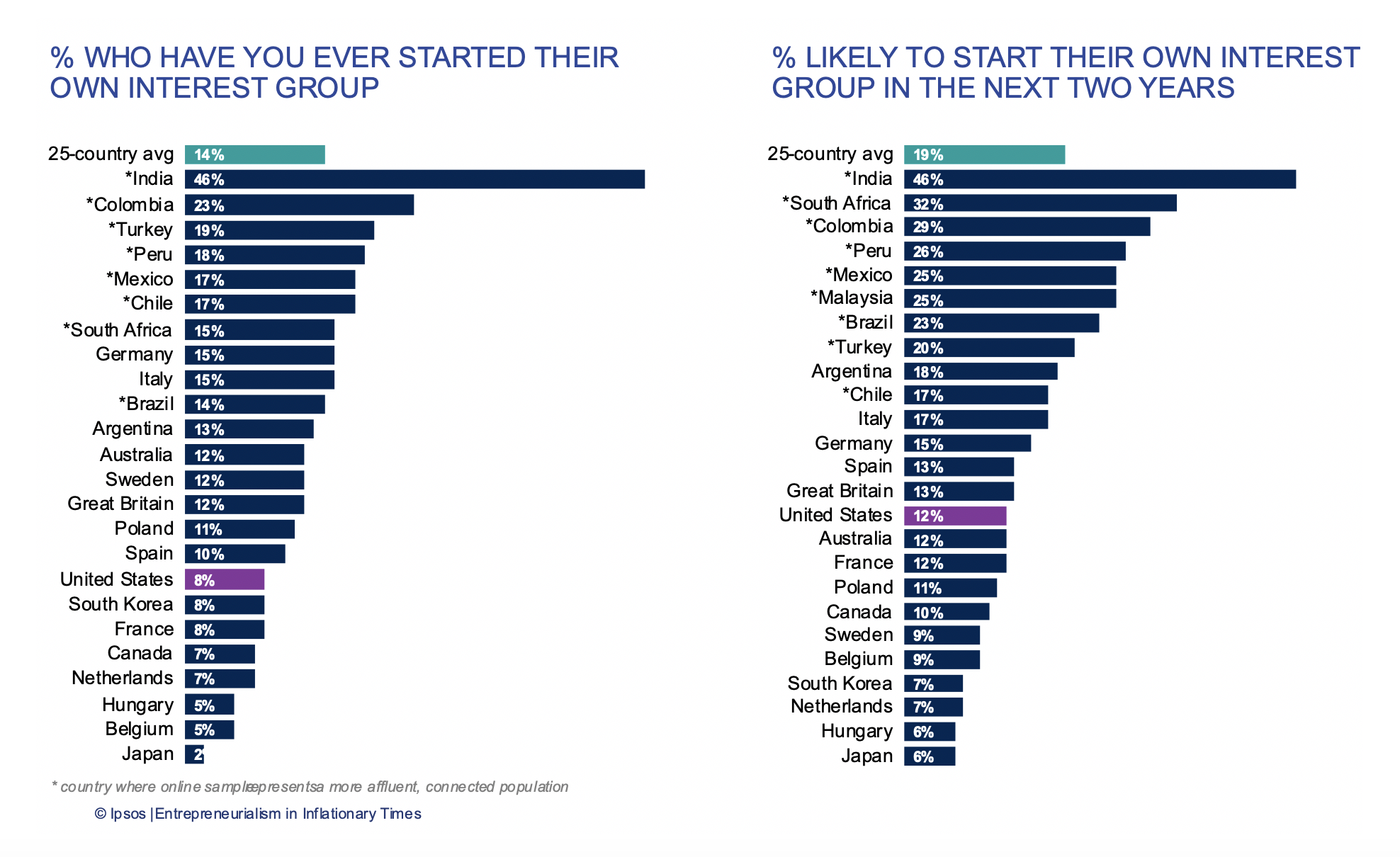 Entrepreneurialism is being manifested mostly in its traditional way, i.e., through business creation (“business entrepreneurialism”).
However, it is also being manifested – sometimes in conjunction with business creation but sometimes not – as “social entrepreneurialism”, captured as those who’ve created an interest group. Globally, 14% say that they have started an interest group in the past and 19% say that they are likely to in the next 2 years. In the U.S., it is the case of 8% and 12%, respectively.
As well, social entrepreneurialism tends to be a more recent phenomenon than business entrepreneurialism, with a greater proportion of those who created an interest group reporting having done so in the past two years (76% on average globally) than among those who started their business in the past 2 years (52%).
This reflects the reality of who current and likely entrepreneurs are as people — they are much more likely than non-entrepreneurs to be participating/active in society generally (i.e., follow the news, donate time/money, etc.).
Women not treated fairly
Just under two in five both on average globally (37%) and in the U.S. (35%) believe that women are treated fairly when they try to start a business. However, this varies widely across countries with majorities in China (67%), India (60%), and Malaysia (55%) believing it is the case. Countries where this view is least common are Italy (26%), France (26%), Brazil (25%), South Korea (24%), and Japan (14%).
The bottom line
Our Ipsos entrepreneurialism study shows that there is significant untapped potential for entrepreneurial activity moving further into 2022 and beyond.
And key to tapping this potential is recognizing that traditionally underrepresented groups, like women, those with a lower level of education, and those with lower incomes, are catching up with traditional groups, such as men, in their entrepreneurial aspirations.
Also key in tapping into entrepreneurialism is recognizing that business entrepreneurialism often goes hand in hand with social entrepreneurialism.
About the Study
These are the findings of a 26-country Ipsos survey conducted May 27-June 7, 2022, among 20,504 adults aged 18-74 in the United States, Canada, Malaysia, South Africa, and Turkey, and among people aged 16-74 in 21 other countries, via Ipsos’ Global Advisor online survey platform.
Each country’s sample consists of ca. 1,000 individuals in each of Australia, Brazil, Canada, China (mainland), France, Germany, Great Britain, Italy, Japan, Spain, and the United States, and ca. 500 individuals in each of Argentina, Belgium, Chile, Colombia, Hungary, India, Malaysia, Mexico, the Netherlands, Peru, Poland, South Africa, South Korea, Sweden, Switzerland, and Turkey.
The samples in Argentina, Australia, Belgium, Canada, France, Germany, Great Britain, Hungary, Italy, Japan, the Netherlands, Poland, South Korea, Spain, Sweden, Switzerland, and the United States can be taken as representative of these countries’ general adult population under the age of 75.
The samples in Brazil, Chile, China, Colombia, India, Malaysia, Mexico, Peru, South Africa, and Turkey are more urban, more educated, and/or more affluent than the general population. The survey results for these markets should be viewed as reflecting the views of the more “connected” segment of their population. The data is weighted so that each country’s sample composition best reflects the demographic profile of the adult population according to the most recent census data.
“The Global Country Average” reflects the average result for all the countries and markets where the survey was conducted. It has not been adjusted to the population size of each country or market and is not intended to suggest a total result.
Where results do not sum to 100 or the difference appears to be +/-1 more/less than the actual, this may be due to rounding, multiple responses, or the exclusion of “don't know” or not stated responses.
The precision of Ipsos online polls is calculated using a credibility interval with a poll of 1,000 accurate to +/- 3.8 percentage points and of 500 accurate to +/- 5.4 percentage points. For more information on Ipsos' use of credibility intervals, please visit the Ipsos website. The publication of these findings abides by local rules and regulations.
About Ipsos
Ipsos is the world’s third largest market research company, present in 90 markets and employing more than 18,000 people.
Our passionately curious research professionals, analysts and scientists have built unique multi-specialist capabilities that provide true understanding and powerful insights into the actions, opinions and motivations of citizens, consumers, patients, customers, or employees. We serve more than 5000 clients across the world with 75 business solutions.
Founded in France in 1975, Ipsos is listed on the Euronext Paris since July 1st, 1999. The company is part of the SBF 120 and the Mid-60 index and is eligible for the Deferred Settlement Service (SRD).
ISIN code FR0000073298, Reuters ISOS.PA, Bloomberg IPS:FP