
Most Americans unfamiliar with Medicaid community engagement requirements
Washington, D.C., July 28, 2026 – A new national NAMI/Ipsos poll finds that Americans broadly value Medicaid’s role in supporting access to health and mental health care, particularly for vulnerable populations. While most adults have heard of Medicaid work requirements, most are unsure about key details, including when they take effect and who may be affected. At the same time, the survey finds strong public support for policies that protect people with disabilities and mental illness from losing Medicaid.
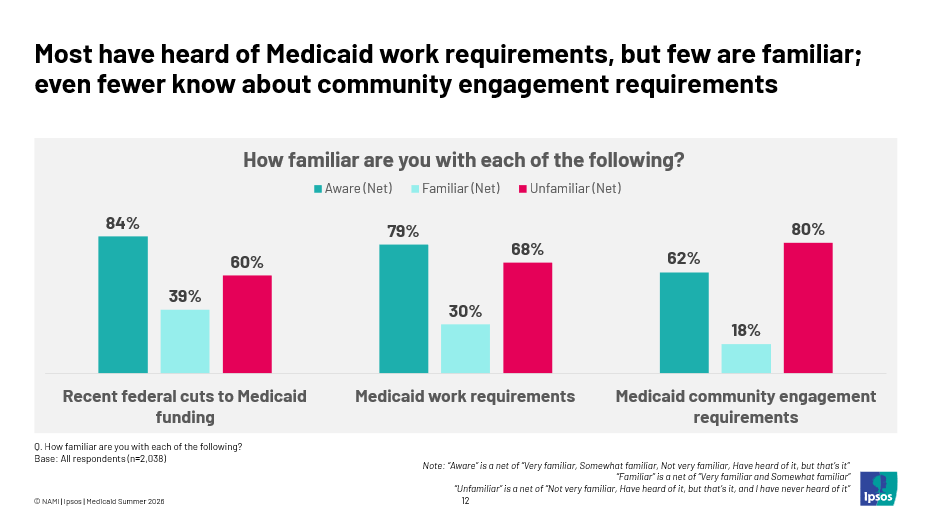
Detailed Findings:
1. Americans broadly view Medicaid as an essential source of care.
Nearly eight in ten adults (78%) agree that Medicaid is essential for providing health care to vulnerable populations, and nearly three-quarters (73%) agree that Medicaid saves lives by helping people access mental health care.
Among those with Medicaid experience, 83% say it helped them access doctors’ office visits, and about seven in ten (69%) say it helped them access health care, including mental health care.
2. Familiarity with Medicaid community engagement requirements is limited.
Fewer than one in five adults (18%) say they are familiar with Medicaid community engagement requirements, compared with three in ten (30%) who say they are familiar with Medicaid work requirements.
After respondents were shown a brief description explaining that community engagement requirements would require certain adults to verify they are working, in school, volunteering, or meeting another qualifying activity to keep Medicaid coverage, most still said they did not know key policy details.
Nearly eight in ten (78%) say they do not know whether the requirements take effect in January 2027, and nearly three-quarters (74%) say they do not know whether people with serious mental illness are exempt.
3. Americans support protecting people from losing Medicaid coverage.
Two in three adults (65%) say they are concerned about people losing Medicaid coverage when community engagement requirements take effect on January 1, 2027.
Americans show strong support for policies that help people with disabilities and mental illness keep Medicaid coverage: more than eight in ten adults (81%) support protecting people with disabilities, including mental illness, from losing coverage, and nearly eight in ten (79%) support allowing people with mental illness who are on Medicaid to keep their coverage.
Learn more at NAMI Medicaid Summer 2026 Poll.
For more information on this news release, please contact:
Mallory Newall
Senior Vice President, US
Public Affairs
[email protected]
About the Study
This NAMI/Ipsos poll was conducted July 10 – 12, 2026 by Ipsos using the probability-based KnowledgePanel®. This poll is based on a nationally representative probability sample of 2,038 general population adults age 18 or older.
The survey was conducted using KnowledgePanel, the largest and most well-established online probability-based panel that is representative of the adult U.S. population. Our recruitment process employs a scientifically developed addressed-based sampling methodology using the latest Delivery Sequence File of the USPS – a database with full coverage of all delivery points in the U.S. Households invited to join the panel are randomly selected from all available households in the U.S. Persons in the sampled households are invited to join and participate in the panel. Those selected who do not already have internet access are provided a tablet and internet connection at no cost to the panel member. Those who join the panel and who are selected to participate in a survey are sent a unique password-protected log-in used to complete surveys online. As a result of our recruitment and sampling methodologies, samples from KnowledgePanel cover all households regardless of their phone or internet status and findings can be reported with a margin of sampling error and projected to the general population.
The study was conducted in English. The data for the total sample were weighted to adjust for gender by age, race/ethnicity, education, Census region, metropolitan status, and household income. The demographic benchmarks came from the 2025 March Supplement of the Current Population Survey (CPS). Party Identification benchmark came from the 2025 Pew’s National Public Opinion Reference Survey (NPORS) with a midyear adjustment estimated across aggregated KnowledgePanel surveys accounting for changes in panelists’ party identification over time.
- Gender (Male, Female) by Age (18–29, 30–44, 45-59 and 60+)
- Race/Hispanic Ethnicity (White Non-Hispanic, Black Non-Hispanic, Other, Non-Hispanic, Hispanic, 2+ Races, Non-Hispanic)
- Education (Less than High School, High School, Some College, Bachelor or higher)
- Census Region (Northeast, Midwest, South, West)
- Metropolitan status (Metro, non-Metro)
- Household Income (Under $25,000, $25,000-$49,999, $50,000-$74,999, $75,000-$99,999, $100,000-$149,999, $150,000+)
- Party Identification (Republican, Lean Republican, Independent/Not lean, Lean Democrat, Democrat)
The margin of sampling error is plus or minus 2.2 percentage points at the 95% confidence level, for results based on the entire sample of adults. The margin of sampling error takes into account the design effect, which was 1.05.
The margin of sampling error is higher and varies for results based on sub-samples. In our reporting of the findings, percentage points are rounded off to the nearest whole number. As a result, percentages in a given table column may total slightly higher or lower than 100%. In questions that permit multiple responses, columns may total substantially more than 100%, depending on the number of different responses offered by each respondent.
About Ipsos
Ipsos is one of the largest market research and polling companies globally, operating in 90 markets and employing nearly 20,000 people.
Our passionately curious research professionals, analysts and scientists have built unique multi-specialist capabilities that provide true understanding and powerful insights into the actions, opinions and motivations of citizens, consumers, patients, customers or employees. Our 75 business solutions are based on primary data from our surveys, social media monitoring, and qualitative or observational techniques.
“Game Changers” – our tagline – summarizes our ambition to help our 5,000 clients navigate with confidence our rapidly changing world.
Founded in France in 1975, Ipsos has been listed on the Euronext Paris since July 1, 1999. The company is part of the SBF 120, Mid-60 indices, and is eligible for the Deferred Settlement Service (SRD).
ISIN code FR0000073298, Reuters ISOS.PA, Bloomberg IPS:FP www.ipsos.com