
Hidden common ground on immigration
Washington, DC, August 13, 2020 –The newest addition Public Agenda/USA Today/Ipsos Hidden Common Ground initiative explores the views and values of the American public on immigration, including how much change people think the immigration system needs, their goals and priorities for changing it, and their views on various proposals for doing so.
Detailed Findings
Americans across the political spectrum agree on several aspects of immigration policy, including creating a path to citizenship for people brought to the U.S. illegally as children; quickly and fairly processing people who enter the U.S. illegally; enforcing border security; and welcoming immigrants who are skilled, financially secure or escaping war.
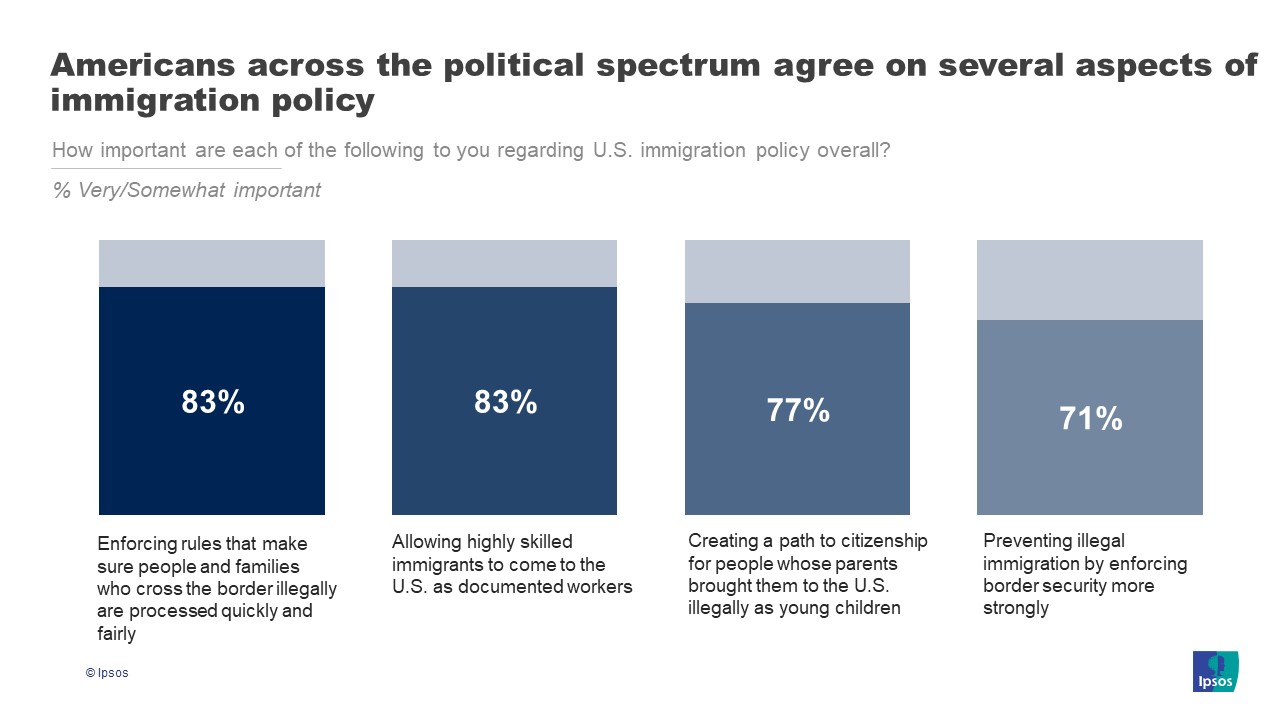
- While Americans differ on whether to create a path to citizenship for people who came illegally as adults, they share a discomfort with allowing undocumented immigrants who fail to pay taxes or commit crimes to stay in the U.S.
Democrats and Independents consistently favor more welcoming immigration policies, while Republicans and apolitical people tend to express mixed or ambivalent views.
- For example, Democrats and Independents strongly support a path to citizenship for undocumented immigrants while Republicans and apolitical people express different views on a path to citizenship depending on how they are asked.
- Republicans and apolitical people also express mixed opinions on whether to welcome low-wage workers as legal immigrants.
- Most Americans think immigrants play positive roles in our nation, but those views are strongest among Democrats and Independents while Republicans and apolitical people are often unsure.
Disagreement along the political spectrum is pronounced regarding building a wall on the U.S.-Mexico border, separating families at the border, and how to handle immigration during the coronavirus crisis.
- Few Americans think the wall will effectively stop people from entering the country illegally, but most Republicans say it is an important symbol, nonetheless.
Many Americans are misinformed or unsure about key aspects of immigration.
- For example, few people know that most immigrants live in the U.S. legally or that many undocumented immigrants pay taxes.
- Americans who are more accurately informed tend to express more positive views of immigrants and favor more welcoming immigration policies.
Hidden Common Ground 2020 is supported by a diverse group of foundations, including the John S. and James L. Knight Foundation, the Charles Koch Foundation, and the Rockefeller Brothers Fund, as well as through a research partnership with the Kettering Foundation and by individual donors.
Please visit www.publicagenda.org to read the full report and www.usatoday.com to read the full article.
Methodology
This Public Agenda/USA Today/Ipsos Poll was conducted May 15th-24th, 2020 using the probability-based KnowledgePanel®. This poll was based on a nationally-representative probability sample of adults age 18 or older (n=1,054).
The survey was conducted using KnowledgePanel, the largest and most well-established online probability-based panel that is representative of the adult US population. Our recruitment process employs a scientifically developed addressed-based sampling methodology using the latest Delivery Sequence File of the USPS – a database with full coverage of all delivery points in the US. Households invited to join the panel are randomly selected from all available households in the U.S. Persons in the sampled households are invited to join and participate in the panel. Those selected who do not already have internet access are provided a tablet and internet connection at no cost to the panel member. Those who join the panel and who are selected to participate in a survey are sent a unique password-protected log-in used to complete surveys online. As a result of our recruitment and sampling methodologies, samples from KnowledgePanel cover all households regardless of their phone or internet status and findings can be reported with a margin of sampling error and projected to the general population.
The survey was conducted in both English and Spanish. The data was weighted to adjust for gender by age, race, education, Census region by metropolitan status, household income and language proficiency. The above design weights for KP respondents were then raked to the following geodemographic distributions of the 18 and over adult population. The needed benchmarks were obtained from the 2019 March Supplement of the Current Population Survey (CPS). Moreover, we used the 2018 American Community Survey (ACS) to obtain language proficiency benchmarks to adjust weights for Hispanic respondents.
- Gender (Male and Female) by Age (18-29, 30-44, 45-59, 60+)
- Race-Ethnicity (White/Non-Hispanic, Black/Non-Hispanic, Other/Non-Hispanic, Hispanic, 2+ Races/Non-Hispanic)
- Census Region (Northeast, Midwest, South, and West) by Metropolitan Status (Metro and Non-Metro)
- Education (Less than High School, High School, Some College, Bachelor or Higher)
- Household Income (Under $25K, $25K-$49,999, $50K-$74,999, $75K-$99,999, $100K-$149,999, $150K and Over)
- Language Proficiency (Non-Hispanic, English Proficient Hispanic, Bilingual Hispanic, Spanish Proficient Hispanic)
The margin of sampling error among the total sample of adults age 18 or older is plus or minus 3.3 percentage points at the 95% confidence level, the Republican sample is plus or minus 6.0 percentage points, the Democrat sample is plus or minus 5.8 percentage points, the Independent sample is plus or minus 6.4 percentage points, and the Apolitical sample is plus or minus 10.7 percentage points. The margin of sampling error takes into account the design effect, which was plus or minus 1.21 percentage points. The margin of sampling error is higher and varies for results based on sub-samples. In our reporting of the findings, percentage points are rounded off to the nearest whole number. As a result, percentages in a given table column may total slightly higher or lower than 100%. In questions that permit multiple responses, columns may total substantially more than 100%, depending on the number of different responses offered by each respondent.
For more information on this news release, please contact:
Chris Jackson
Senior Vice President, US Public Affairs
+1 202 420-2025
[email protected]
About Ipsos
Ipsos is the world’s third largest market research company, present in 90 markets and employing more than 18,000 people.
Our passionately curious research professionals, analysts and scientists have built unique multi-specialist capabilities that provide true understanding and powerful insights into the actions, opinions and motivations of citizens, consumers, patients, customers or employees. We serve more than 5000 clients across the world with 75 business solutions.
Founded in France in 1975, Ipsos is listed on the Euronext Paris since July 1st, 1999. The company is part of the SBF 120 and the Mid-60 index and is eligible for the Deferred Settlement Service (SRD).
ISIN code FR0000073298, Reuters ISOS.PA, Bloomberg IPS:FP www.ipsos.com


