
Get Ready for the Big Reset in Travel
We recently passed the one-year anniversary of COVID-19 in North America, where the travel and hospitality industry was hit especially hard. Some trends in the industry will resume, but it will not be a linear recovery. Leisure travel will likely return before business travel, and domestic travel will return before international. Companies need to prepare now to catch customers at the right time with an eye on turning them into loyal advocates. There are several areas those in the travel industry must focus on in order to win customers and gain market share.
- Make guest personalization a strategic priority. Organizations need to be using intelligence for targeted communications so the right customer gets the right message at the right time. Showcasing how you can help them escape the everyday through a unique and tailored experience will be essential. Leisure will return before business travel. Therefore, travel companies must put a greater focus on the leisure traveler and figure out what the company can do to exceed customer expectations and keep them coming back for more. Knowing what customers want does not happen overnight. Companies that have the right measurements systems in place to garner insight and holistic knowledge around their customers will win in the market.
- Offer flexibility. In addition, we’re already seeing that the pandemic has put more power in the hands of the consumer. It’s quickly becoming the norm for travel companies to offer more flexibility to the customer with options for adjusting/canceling a trip without a fee. Companies must be aware of these trends and adjust their policies accordingly.
- Finally, safety should be top of mind for both airlines and hotels. They need to take safety and cleanliness seriously but also need to succinctly tell customers what they are doing to ensure proper safety protocols (e.g., wearing masks, performing extra cleanings, etc.). From an operational perspective, touch points and in-person contact should also be reduced where possible. For some companies, this may mean upgrading their mobile apps to allow mobile check-in and the ability to contact a concierge or report a problem. Having a CX measurement process in place with closed-loop feedback is extremely important to measure what is working and what is falling short.
Download our latest paper for more insights and tips for ensuring you have the right measurement systems in place to prepare for the next wave in hospitality.
We recently passed the one-year anniversary of COVID-19 in North America, where the travel and hospitality industry was hit especially hard. Some trends in the industry will resume, but it will not be a linear recovery. Leisure travel will likely return before business travel and domestic travel will return before international. As we’ve already seen elsewhere, the pandemic has forced organizations and people to work differently. While 2020 was very much a year of survival, there are several things those in travel and hospitality can do to attract and retain customers for a more successful 2021.
Key Takeways:
- Personalization must be a strategic priority
- Flexibility is more important than ever
- Take safety seriously and clearly tell customers how you take it seriously
53% of business travelers said they expect to travel less often for business this year than they did before the pandemic
As a result of the increased utilization of video calls and conference meetings, it may be a while before business travel returns. A recent Ipsos study found that 53% of respondents said they expect to travel less often for business this year than they did before the pandemic. In addition, 64% said they will have more “virtual” meetings than they did before the pandemic instead of traveling.
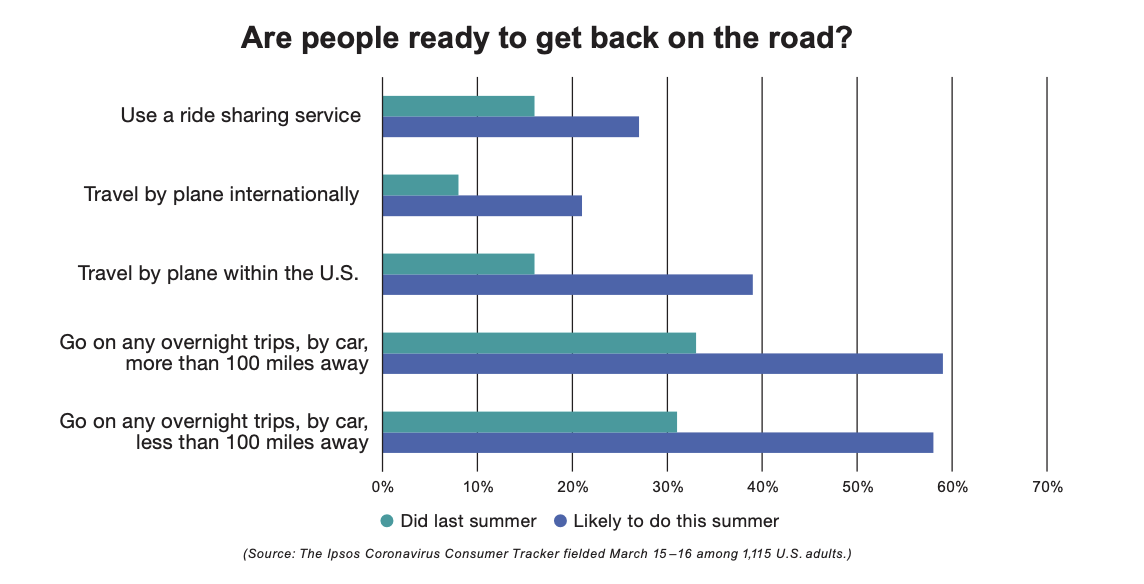
Those saying they plan to travel by plane within the U.S. this summer more than doubled.
On the leisure side, however, we are seeing some signs of hope. A recent Skift.com article shows consumer confidence around travel on the rise, with 72% of respondents saying that they would definitely or likely travel in 2021. For most people around the world, the last 12 months have felt confining. Many have been limited to interacting with only a few people in their trusted inner circle. Netflix and other streaming services have been helpful in providing an escape, but people are getting restless and craving something more authentic. They are eager to see the world once again, and those who can afford it will be the first to dive in. With vaccines gaining steam and cases in many parts of the country going down, consumers are looking for the right time to book their next getaway. Those in the industry have predicted that domestic travel would return before international travel, and recent studies support this. Twice as many respondents said they plan to go on overnight trips by car compared to last summer, according to findings from the latest Ipsos Coronavirus Tracker. Those saying they plan to travel by plane within the U.S. this summer more than doubled compared to those who traveled by plane last summer. International travel plans remain low, but we are seeing a slight improvement. Roughly one in 10 of those surveyed said they planned travel internationally last summer, while that result increased to one in 5 for this summer.
So what does all this mean? The next wave in travel is just around the corner. Companies need to prepare now to catch customers at the right time with an eye on turning them into loyal advocates. There are several areas those in the travel industry must focus on in order to win customers and gain market share.
- Make guest personalization a strategic priority. Organizations need to be using intelligence for targeted communications so the right customer gets the right message at the right time. Showcasing how you can help them escape the everyday through a unique and tailored experience will be essential. Leisure will return before business travel. Therefore, travel companies must put a greater focus on the leisure traveler and figure out what the company can do to exceed customer expectations and keep them coming back for more. Knowing what customers want does not happen overnight. Companies that have the right measurements systems in place to garner insight and holistic knowledge around their customers will win in the market.
- Offer flexibility. In addition, we’re already seeing that the pandemic has put more power in the hands of the consumer. It’s quickly becoming the norm for travel companies to offer more flexibility to the customer with options for adjusting/canceling a trip without a fee. Companies must be aware of these trends and adjust their policies accordingly.
- Finally, safety should be top of mind for both airlines and hotels. They need to take safety and cleanliness seriously but also need to succinctly tell customers what they are doing to ensure proper safety protocols (e.g., wearing masks, performing extra cleanings, etc.). From an operational perspective, touch points and in-person contact should also be reduced where possible. For some companies, this may mean upgrading their mobile apps to allow mobile check-in and the ability to contact a concierge or report a problem. Having a CX measurement process in place with closed-loop feedback is extremely important to measure what is working and what is falling short.
A robust CX Measurement Strategy is critical to providing leaders with valuable intelligence for improving operations and better understanding customers. Creating a CX measurement program aligned to business objectives is no small or easy task. Do you have the right measurement systems in place to prepare for the next wave in hospitality? Ipsos can help.
Key Insights:
- Make guest personalization a strategic priority
- Offer flexibility
- Practice safety and tell your customers how you are practicing safety


![[WEBINAR] Global Voices of Experience 2026](/sites/default/files/styles/list_item_image/public/ct/event/2026-02/thumbnail-global-voices-experience.jpg?itok=NN6W-9Ft)