Where the nation stands on abortion
If you’ve been following the news lately, you’ve probably heard that abortion is back before the Supreme Court. In 2022, the justices will decide upon the constitutionality of Mississippi’s ban on abortion after 15 weeks of pregnancy, with implications for the future of Roe v. Wade.
But what do Americans really think about abortion? While it’s often painted as an issue that splits the country into two diametrically opposed camps, in fact, it’s not so simple.
Although just two in five support the right to choose no matter the circumstance, more support terminating a pregnancy in certain extenuating circumstances. For instance, in cases where the pregnancy endangers the pregnant person’s health, or if the pregnancy is the result of rape. Those who oppose it altogether, no matter the external circumstances, are a tiny fraction of the total population – around one in ten.
In short, it’s a complex issue and one where the facts of the matter are not always the deciding factor in where opinion falls.
- Abortion’s conditionality. Again, Americans are more tolerant of abortion in extraordinary circumstances, while support breaks down more when it becomes a matter of personal choice. This central tension has been a constant in American life throughout the decades following the landmark 1973 Roe v. Wade decision. But, as the data shows, America’s views on abortion are rarely absolute.

- Polarizing partisans. As with so many other aspects of America today, those steady topline numbers mask a growing partisan split on the issue. The further the country moves apart, the more things equal out, creating the illusion of stability. Yet, another instance of the tale of two Americas – one red, one blue.

- Global context. As the parties drift further apart on the issue, Americans fall somewhere toward the more conservative ends of the global spectrum in attitudes towards abortion, as seen in recent Global Advisor polling.

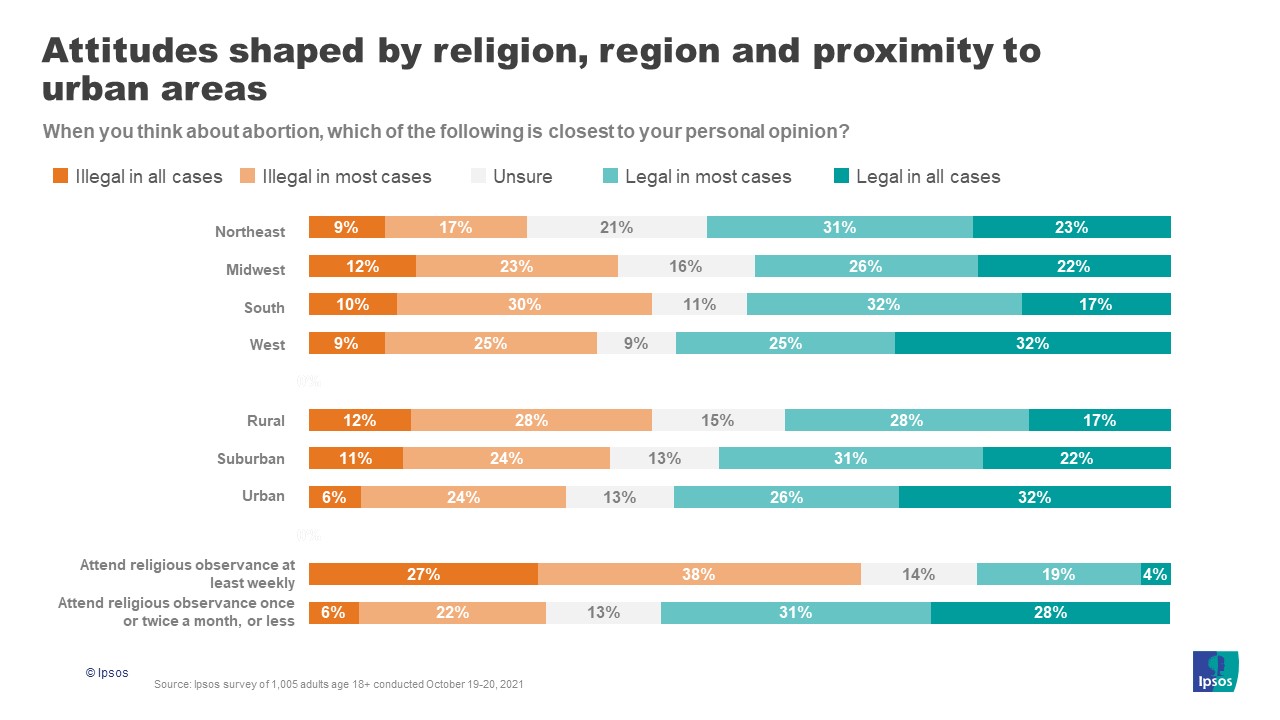
- Demographic dividing line. Attitudes towards abortion follow clear demographic contours. Religious observance is one of the clearest distinguishing factors for and against. Yet regional differences play a part too. Support tends to be strongest in urban areas and parts of the country that tilt blue, while rural America opposes it most strongly. Again, the tale of two Americas.
- Unknown unknowns. Certain facts have become flashpoints in the debate around abortion. Yet as Ipsos analysis underlines, many Americans are simply unaware of what’s true and what’s false, even around some of the more basic truths – such as the legality of abortion across the U.S. Perhaps even more pertinent to the looming Supreme Court decision, many do not think or do not know that most states already have restrictions in place around when a pregnancy can be terminated.

Most Americans agree that abortion should be allowed when the circumstances are heart-wrenchingly awful – the pregnant person’s life is at stake, or the pregnancy is the result of a traumatic event. Beyond that, opinion grows more clouded, although when probed, it becomes clear that many are not highly dialed into the particulars of the debate. Yet as the Mississippi case winds its way through the Supreme Court, it (and others like it) will only bring the issue more firmly front and center.