Americans with the highest level of knowledge on fetal development show strong support for abortion legality
Washington, DC, November 30, 2021
With a number of states basing their abortion policies on varying points of fetal growth, a new Ipsos poll finds that Americans have a minimal understanding of the stages of fetal development as it relates to pregnancy. Given a series of true or false statements regarding different aspects of fetal development, less than a quarter of Americans can correctly identify the majority of statements as true or false. Knowledge levels were low even among the those saying they have prior education on the subject. Importantly, the poll also finds that the most well-informed American’s are more likely to support abortion legality than those who are less informed.
Detailed Findings
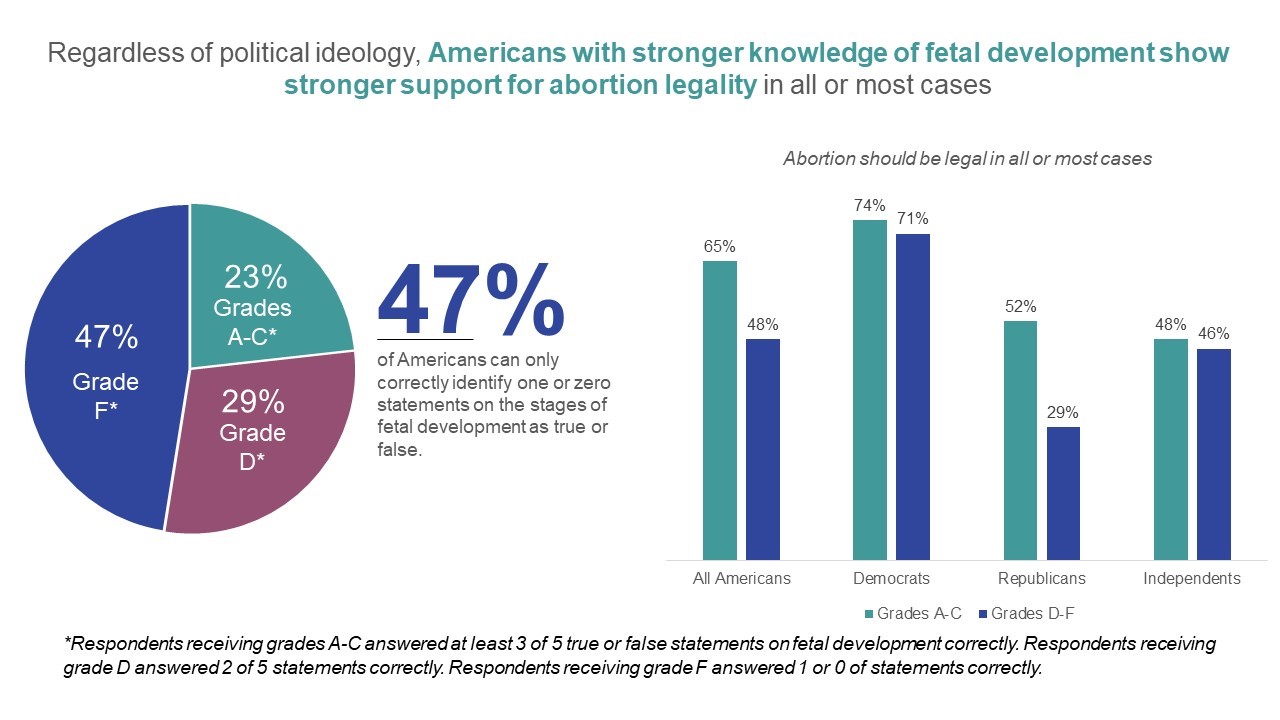
1. American’s level of knowledge on pregnancy and fetal development relates to their opinions on abortions, with the most well-informed American’s showing stronger support for abortion legality than those less informed.
- Given a series of five true or false statements regarding different stages of fetal development, nearly half of all Americans (47%) can only correctly identify one or zero statements. Twenty-nine percent correctly identify two statements and just twenty-three percent answer three or more correctly.
|
Grade |
Total |
|
5-3/5 correct: Grade A-C |
23% |
|
2/5 correct: Grade D |
29% |
|
1-0/5 correct: Grade F |
47% |
- Sixty-five percent of Americans receiving a grade of A-C on fetal development knowledge support abortions being legal in all or most cases. On the other hand, 45% of Americans with grade D and 50% of Americans with grade F say the same. Furthermore, Republicans who are better informed on fetal development are more likely to support abortions being legal in all or most cases (52%) than are Republicans who are less informed (29%).
- This same pattern holds when looking at abortion legality in different circumstances. Regardless of the varying circumstances for an abortion, such as the person does not want to have a child or a pregnancy is caused by incest or rape, Americans achieving grades A-C on fetal development stages are less likely than those achieving grade D to say abortions should be illegal always in these varying circumstances.
2. In general, Americans have a minimal understanding of the stages of fetal development as it relates to pregnancy. Less than a quarter are able to correctly recognize as true or false the majority of statements on the stages of fetal development.
- About one in five Americans say they have never learned about the stages of fetal development and pregnancy (21%). Even among those claiming to have a prior education on the subject, less than a third achieve a grade of A-C (28% those with a formal education, 29% those with an alternative education such as self-taught or through family). Additionally, while parents are more likely than non-parents to correctly identify at least three statements, still less than half are able to do so (30% parents, 22% non-parents).
- Knowledge of abortion policy was overall better than knowledge of fetal development, though Americans show signs of confusion on this subject as well. Sixty-eight percent correctly believe abortion is legal, in at least some circumstances, nationwide. However, a quarter of Americans (24%) falsely believe most states have no restrictions on what point in pregnancy a person can have an abortion, and thirty percent don’t know if this statement is true or false.
3. For the most part, Americans are not misinformed but instead are aware of their lack of knowledge. On the majority of statements given on aspects of fetal development, the largest share of respondents say they ‘don’t know’ instead of incorrectly identifying it as true or false.
- Looking specifically at what aspects of fetal development Americans lack knowledge in, at least two in five say they don’t know when a fetus’ brain starts working (54%), when a fetus begins to practice breathing on its own (52%), when a fetus can feel pain (49%), or when a fetus has a strong chance of survival outside of the womb (38%), measures which are all used to determine abortion policy nationwide.
- Americans are most knowledgeable about the development of the heart, with over three in five (63%) correctly identifying that a fetal heartbeat is usually first detected at six weeks of pregnancy. Republicans are more likely to correctly identify this statement as true (75%) than Democrats or Independents (both 58%).
- In contrast, Americans are most likely to be misinformed on when a fetus can begin to feel pain. Forty percent of Americans incorrectly say that a fetus can feel pain by the start of the second trimester, around week 13 of pregnancy, while many doctors agree fetal perception of pain is unlikely before the third trimester[1]. Americans who attend religious services at least once per week were the most likely to falsely believe this statement (68%), followed by Republicans (60%).
[1] “Facts are Important: Fetal Pain” ACGOG.Org, The American College of Obstetricians and Gynecologists, https://www.acog.org/advocacy/facts-are-important/fetal-pain. October 29, 2021.
About the Study
These are the findings of an Ipsos poll conducted between October 19 – 20. For this survey, a sample of 1,005 adults age 18+ from the continental U.S., Alaska, and Hawaii was interviewed online in English.
The sample was randomly drawn from Ipsos’ online panel, partner online panel sources, and “river” sampling and does not rely on a population frame in the traditional sense. Ipsos uses fixed sample targets, unique to each study, in drawing a sample. After a sample has been obtained from the Ipsos panel, Ipsos calibrates respondent characteristics to be representative of the U.S. Population using standard procedures such as raking-ratio adjustments. The source of these population targets is U.S. Census 2018 American Community Survey data. The sample drawn for this study reflects fixed sample targets on demographics. Posthoc weights were made to the population characteristics on gender, age, race/ethnicity, region, and education.
Statistical margins of error are not applicable to online non-probability polls. All sample surveys and polls may be subject to other sources of error, including, but not limited to coverage error and measurement error. Where figures do not sum to 100, this is due to the effects of rounding. The precision of Ipsos online polls is measured using a credibility interval. In this case, the poll has a credibility interval of plus or minus 3.5 percentage points for all respondents. Ipsos calculates a design effect (DEFF) for each study based on the variation of the weights, following the formula of Kish (1965). This study had a credibility interval adjusted for design effect of the following (n=1,005, DEFF=1.5, adjusted Confidence Interval=+/-5.0 percentage points).
For more information on this news release, please contact:
Chris Jackson
Senior Vice President, U.S., Public Affairs
Ipsos
+1 202 420-2025
[email protected]
Kate Silverstein
Media Relations Specialist, U.S., Public Affairs
Ipsos
+1 718 755-8829
[email protected]
About Ipsos
Ipsos is the world’s third largest Insights and Analytics company, present in 90 markets and employing more than 18,000 people.
Our passionately curious research professionals, analysts and scientists have built unique multi-specialist capabilities that provide true understanding and powerful insights into the actions, opinions and motivations of citizens, consumers, patients, customers or employees. We serve more than 5000 clients across the world with 75 business solutions.
Founded in France in 1975, Ipsos is listed on the Euronext Paris since July 1st, 1999. The company is part of the SBF 120 and the Mid-60 index and is eligible for the Deferred Settlement Service (SRD).
ISIN code FR0000073298, Reuters ISOS.PA, Bloomberg IPS:FP www.ipsos.com