
With psychedelic mental health therapies on the horizon, Americans are open to learning more
Washington, D.C., January 20, 2026 - A new Ipsos/Psychedelic Alpha poll examines public awareness and trust related to the use of psychedelic compounds in mental health research and treatment. The findings reveal public perception remains uneven across demographic groups even as psychedelic research continues to accelerate. Exposure to psychedelics in the media is still relatively limited, and most Americans say their views on psychedelics have remained unchanged over time. These patterns highlight a need for broader education and clearer communication across age groups, racial and ethnic communities, and levels of educational attainment.
What are Americans worried about regarding taking psychedelics?
Americans are still navigating uncertainty around the perceived risks of psychedelics. We asked respondents to share what their concerns and fears around the effects of a psychedelic substance would be, if they were to take one. The most common concern, raised by around a quarter of respondents to this question, centered on the possibility of a negative psychological experience.
These psychological-type risks were considerably more prevalent than concerns about physical harms, reflecting how ‘bad trip’ narratives continue to shape public perceptions of psychedelics. At the same time, around one in six respondents reported no concerns at all related to psychedelics, and only a small minority (3%) said they would categorically refuse to try a psychedelic.
Where are Americans hearing about psychedelics?
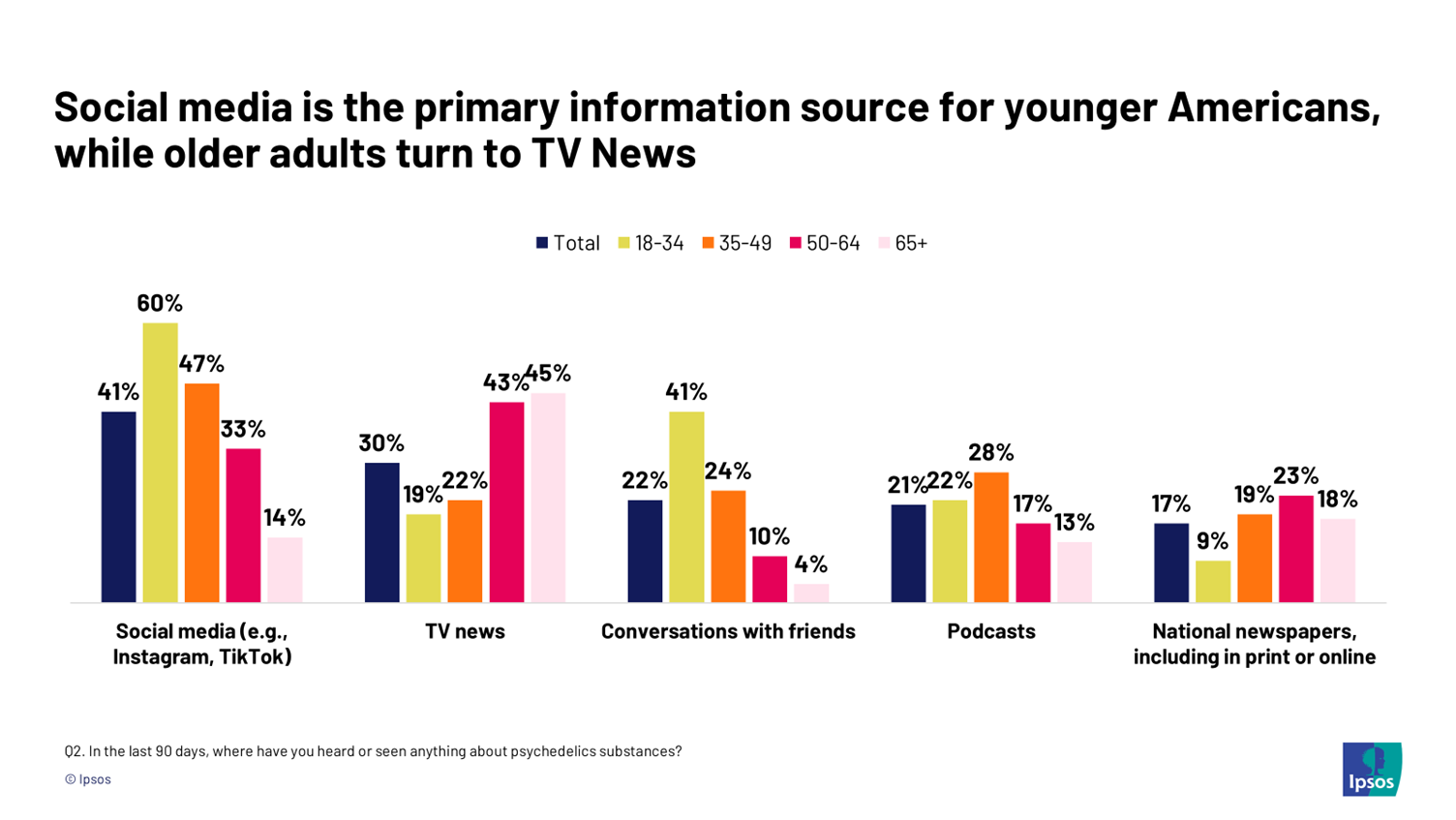
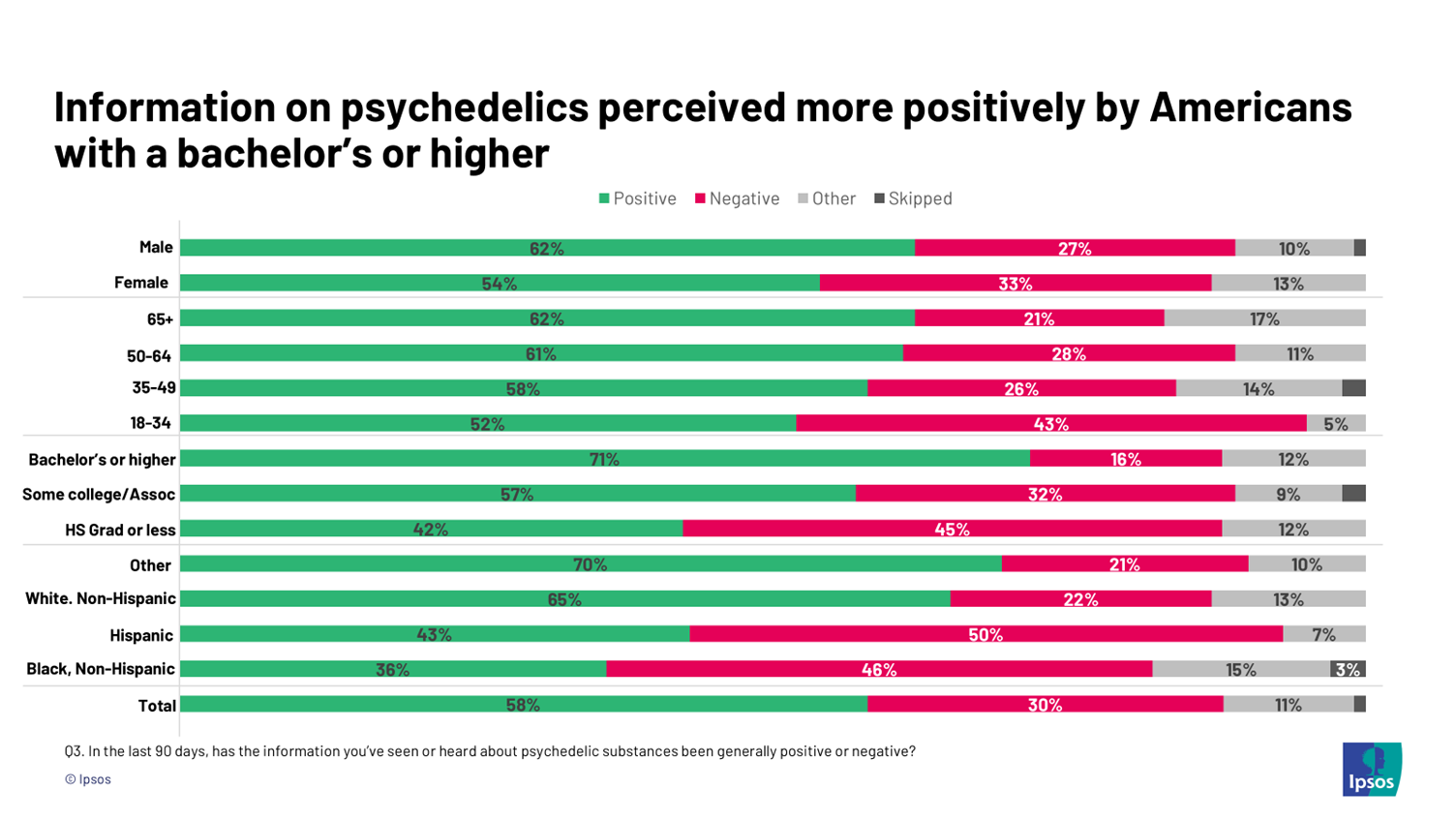
Exposure to information about psychedelics remains limited in the United States. Seven in ten respondents had not encountered any media coverage on the topic in the past 90 days. Among those who had, clear demographic patterns emerged: older adults were more likely to encounter information via TV news, while younger adults primarily came across psychedelics during conversations with friends or on social media—the most common channel overall—and were most likely to report exposure to negative content.
Where would Americans feel comfortable taking psychedelics?
As public interest in psychedelics continues to grow, understanding the contexts in which people feel comfortable taking psychedelics becomes increasingly important. Notably, 60% of respondents said they would not feel comfortable taking a psychedelic in any of the listed settings. This finding may not be attributable to opposition per se, as there is also a perceived lack of personal need, as indicated by earlier Ipsos polling (see responses to Question 5 in the topline from June 2025).
Medical settings were the most preferred option, though only marginally more so than taking psychedelics “at home, with my friends.” Men, younger respondents, and those with a bachelor's degree or higher level of education expressed greater comfort across a range of settings, whereas older adults and Black or Hispanic respondents reported lower comfort overall. Comfort with medical facility use increased with education level, possibly signaling broader links between education, trust in healthcare systems, and familiarity with emerging psychedelic research.
How are Americans’ attitudes to psychedelics changing?
Americans remained divided in their attitudes towards psychedelics in mental health care, with equal proportions of respondents expressing positive (28%) and negative (28%) views and 44% holding neutral or mixed opinions. Older adults were more likely to hold negative views, despite less exposure to negative media, and Black respondents felt more negatively than white respondents, though this aligned with their higher exposure to negative content. While most respondents said their views had remained stable over time, 21% reported becoming more positive and 10% more negative, indicating a net positive shift.
About the Study
This Ipsos poll was conducted from November 21-23, 2025, using the probability-based KnowledgePanel®. This poll is based on a nationally representative probability sample of 1,022 adults age 18 or older.
The survey was conducted using KnowledgePanel, the largest and most well-established online probability-based panel that is representative of the adult U.S. population. Our recruitment process employs a scientifically developed addressed-based sampling methodology using the latest Delivery Sequence File of the USPS – a database with full coverage of all delivery points in the U.S. Households invited to join the panel are randomly selected from all available households in the U.S. Persons in the sampled households are invited to join and participate in the panel. Those selected who do not already have internet access are provided a tablet and internet connection at no cost to the panel member. Those who join the panel and who are selected to participate in a survey are sent a unique password-protected log-in used to complete surveys online. As a result of our recruitment and sampling methodologies, samples from KnowledgePanel cover all households regardless of their phone or internet status and findings can be reported with a margin of sampling error and projected to the general population.
The data for the total sample were weighted to adjust for gender by age, race/ethnicity, education, Census region, metropolitan status, and household income. The demographic benchmarks came from the 2024 March Supplement of the Current Population Survey (CPS).
- Gender (Male, Female) by Age (18–29, 30–44, 45-59 and 60+)
- Race/Hispanic Ethnicity (White Non-Hispanic, Black Non-Hispanic, Other, Non-Hispanic, Hispanic, 2+ Races, Non-Hispanic)
- Education (Less than High School, High School, Some College, Bachelor’s degree, Master’s degree or higher)
- Census Region (Northeast, Midwest, South, West)
- Metropolitan status (Metro, non-Metro)
Household Income (Under $25,000, $25,000-$49,999, $50,000-$74,999, $75,000-$99,999, $100,000-$149,999, $150,000+)
The margin of sampling error is plus or minus 3.3 percentage points at the 95% confidence level, for results based on the entire sample of adults. The margin of sampling error takes into account the design effect, which was 1.14.
The margin of sampling error is higher and varies for results based on sub-samples. In our reporting of the findings, percentage points are rounded off to the nearest whole number. As a result, percentages in a given table column may total slightly higher or lower than 100%. In questions that permit multiple responses, columns may total substantially more than 100%, depending on the number of different responses offered by each respondent.
About Ipsos
Ipsos is one of the largest market research and polling companies globally, operating in 90 markets and employing nearly 20,000 people.
Our passionately curious research professionals, analysts and scientists have built unique multi-specialist capabilities that provide true understanding and powerful insights into the actions, opinions and motivations of citizens, consumers, patients, customers or employees. Our 75 business solutions are based on primary data from our surveys, social media monitoring, and qualitative or observational techniques.
“Game Changers” – our tagline – summarizes our ambition to help our 5,000 clients navigate with confidence our rapidly changing world.
Founded in France in 1975, Ipsos has been listed on the Euronext Paris since July 1, 1999. The company is part of the SBF 120, Mid-60 indices, and is eligible for the Deferred Settlement Service (SRD).
ISIN code FR0000073298, Reuters ISOS.PA, Bloomberg IPS:FP