Small Dollars Are Fueling the 2020 Election
Wine caves entered the political lexicon during an unexpected turn at the last Democratic debate in December, becoming a point of discussion and tension among the primary contenders.
Underlying that debate sideshow is a very real issue: the sources candidates are turning to for campaign funding.
Where campaign funding comes from has become a signal of candidates’ values. Despite all primary candidates swearing off PAC money, a divide still remains over how to handle big-money fundraising events, when all primary candidates have touted their low average donor numbers.
While political donations are under increased scrutiny this election cycle, this comes on the back of a larger trend in political fundraising. Collecting small-dollar donors was a winning strategy for Obama’s presidential campaigns and became an intense focus during the 2018 midterms.
The last midterm cycle saw an influx of grassroots and small-dollar support for many candidates, many of whom had never run for office before. Democrats outraised Republicans in some of the most competitive House races by more than $78 million. About 40% of that gap in fundraising came from small donations of $200 or less.
Democratic small-dollar fundraising is also showing historic strides during the 2020 election cycle as well. About 60% of Senator Sanders' $74 million campaign dollars came from small donors, while 53% of Senator Warren’s $60 million came from donors under $200, as of Q3 2019 reporting. Sanders’ campaign announced last week that the senator received more than 1.8 million donations in the last quarter of 2019, with an average donation of $18.53, a formidable demonstration of his grassroots appeal.
Among the moderate frontrunners, Mayor Buttigieg's breakdown of donors is split nearly down the middle, after raising over $76 million in 2019, with the average donation coming in at $33 for the last quarter of this past year. Former Vice President Joe Biden is the only major primary candidate whose support comes mostly from big donor dollars. As of the Q3 2019, about 65% of the roughly $38 million he raised came from large donors.
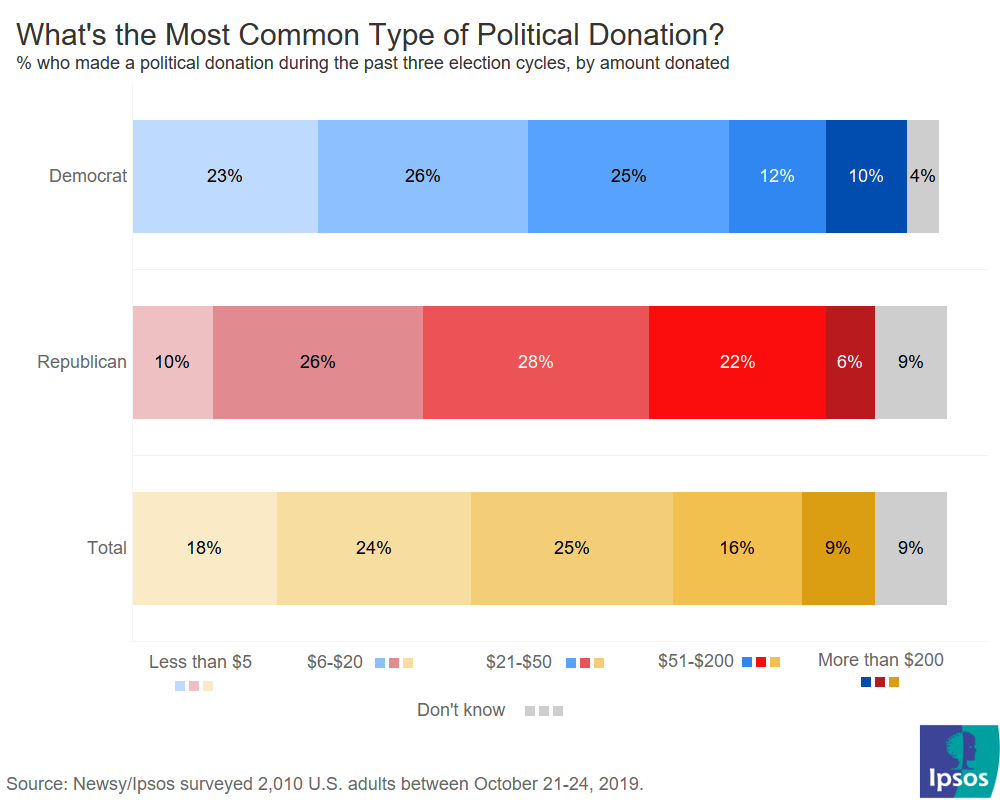
The strong numbers posted by these candidates align with the findings of this Ipsos/Newsy survey. About half of Democratic donors gave under $20 on average, while the majority of Republicans donors gave amounts of $20 or greater.
These small-dollar donations are not confined to the Democrats either – Republicans are also giving in small amounts. President Trump raised over $165 million for his reelection bid with about $79 million of that money coming from donations under $200, accounting for almost half of the campaign's total funding.
Advocates of strict campaign finance regulations and candidates looking to win grassroots support hope that these small-donor dollars will act as a counterweight to money funneled through PACs. While individuals have a spending limit of $2,800, the landmark 2010 Supreme Court’s Citizens United ruling allows PACs to raise unlimited amounts of money and pass it along to candidates and causes of their choosing.
While the bottom-line matters for candidates running at every level of government, renewed focus on small-dollar donations emphasizes a candidate’s grassroots appeal and support. It doesn’t fix money in politics, but it can act as a counterweight to the large coffers at a candidate’s disposal.