Women of Color Report Declining Trust in Government Amid Economic Pressures
Washington, D.C., March 26, 2026 – A new national survey from Intersections of Our Lives and Ipsos finds that more than half of women of color believe the traditional American dream is no longer accessible to them. The research reveals that women of color (defined as Black, Hispanic, and Asian American/Native Hawaiian/Pacific Islander women) are navigating significant economic pressures while reporting declining confidence in government institutions. In addition, most believe voting can create change, but far fewer feel their voice matters in the political process.
Detailed Findings:
- Most women of color believe that the country is headed in the wrong direction and report declining levels of trust in government.
- Women of color express significant concern about the state of the nation. Two-thirds (65%) say the country is on the wrong track, while only 9% believe it is moving in the right direction.
- When asked to describe how they feel about America today, the top emotions are uncertain (50%), frustrated (49%), exhausted (38%), and angry (28%). ‘Hopeful’ registered at just 14%. Black women report the highest levels of frustration (55%) and exhaustion (43%), and the lowest levels of hope (10% compared to 16 and 19%, respectively, among Hispanic and AANHPI women).
- Trust in government has eroded substantially. Nearly seven in ten respondents (68%) report that their confidence in federal institutions has declined over the past year alone.
- Economic conditions are leading women of color to delay major life decisions.
- Affordability and cost of living dominate current concerns, with nearly nine in ten respondents (89%) reporting worry about this issue—ranking it as their top concern. Healthcare also weighs heavily on people's minds, particularly around access and affordability. Seventy-nine percent express concern about access to affordable healthcare, while 77% worry about access to quality healthcare, and 75% are concerned about women's healthcare specifically.
- Specific financial strain is widespread. For example, 36% report their family finances worsened over the past year and another 24% describe their financial situation as tight, requiring them to carefully watch spending.
- These pressures have forced many to put important decisions on hold. Nearly two-thirds (64%) report delaying major life choices due to economic conditions, including 26% who delayed moving or relocating, 23% who report postponing buying a home and 21% who delayed healthcare or medical procedures. Separately, 41% report delaying saving or investing money.
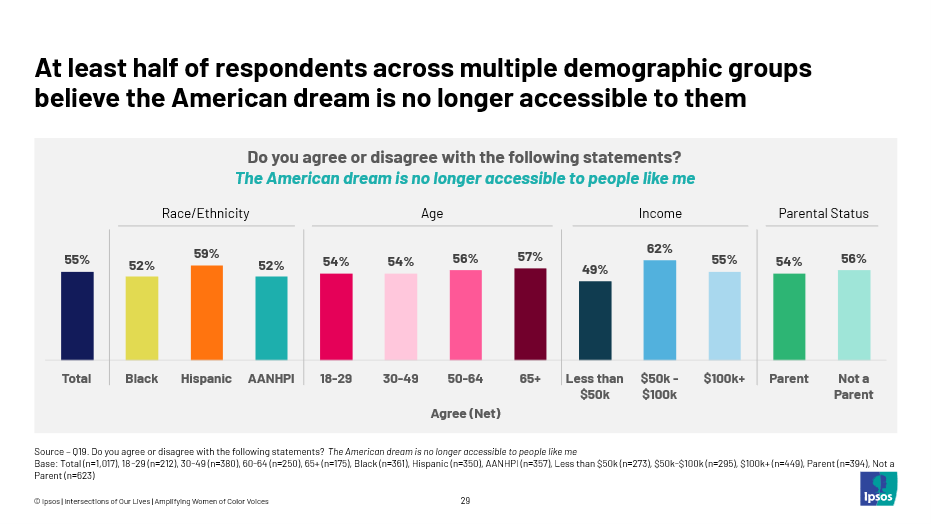
- The cumulative effect is evident: more than half of American women of color (55%) believe the traditional American dream is no longer accessible to people like them.
- Women of color connect reproductive autonomy to economic stability
- Respondents draw a clear connection between reproductive choice and economic security. Seventy percent believe that planning when to have children helps women succeed in their careers, while 64% say women are more likely to finish their education when they can choose if and when to have children. Additionally, 62% believe women's financial stability improves when they can make their own reproductive choices.
- However, respondents give government low marks on delivering these priorities. Fewer than one in five say the government is doing a good job ensuring people can choose whether to have children (18%) or creating safe communities to raise children (17%). Even fewer rate the government positively on providing access to reproductive healthcare (15%) or making it affordable to raise children (12%).
- Voting is seen as a pathway for change and civic engagement, but there is limited confidence in the political system to serve them.
- Most women of color still see voting as a path to change with 65% saying it is an important way to create the change they want to see. But belief in voting does not translate to confidence in the system, as 64% say traditional parties and politicians don’t care about people like them. Moreover, fewer (40%) feel their voice matters in the political process, Just one in five believe the political system works for people like them. Income correlates with notable differences in outlook.
- Women earning less than $50,000 annually are less likely to believe voting is an important way to create change in the country (54% compared to 75% of those earning more than $100,000) and less likely to feel their voice matters (32% compared to 46% of those earning more than $100,000).
About the Study
This National Asian Pacific American Women’s Forum/Ipsos poll was conducted in both English and Spanish from December 5 to 16, 2025, by Ipsos using the probability-based KnowledgePanel® and supplemented with additional interviews in six states (New Jersey, Georgia, Texas, Arizona, Nevada and California) using online (opt-in) panels, to maximize the overall sample size. Only Black, Hispanic, and Asian American and Native Hawaiian Pacific Islander (including mixed races) females 18 years or older were surveyed. In total, 1,017 women were surveyed using KnowledgePanel® for the national sample and a 1,475 were interviewed in the six states of interest across the KnowledgePanel® and supplemental sample.
The margin of sampling error for this study is plus or minus 3.49 percentage points at the 95% confidence level, for results based on the KnowledgePanel®. For the sample that focused on specific states and combined KnowledgePanel® and opt-in sample, the MOE was plus or minus 4.01%. The margin of sampling error takes into account the design effect, which was 1.29 for KnowledgePanel® only and 2.47 for the state specific sample. The margin of sampling error is higher and varies for results based on other sub-samples. In our reporting of the findings, percentage points are rounded off to the nearest whole number. As a result, percentages in a given table column may be slightly higher or lower than 100%. In questions that permit multiple responses, columns may be substantially more than 100%, depending on the number of different responses offered by each respondent.
The data for the KnowledgePanel® sample were weighted to adjust for age, race/ethnicity, education, Census region, metropolitan status, household income, language proficiency, Hispanic origin, and 2024 presidential vote choice. The demographic benchmarks came from the 2023 American Community Survey while the 2024 presidential vote choice benchmark was from KnowledgePanel. Additionally, four calibration variables with benchmark distributions derived from KnowledgePanel respondents were incorporated when weighting opt-in respondents and blending KnowledgePanel with opt-in respondents for the six states of interest. These additional variables helped to reduce biases known to be associated with opt-in samples that are not completely addressed with standard geodemographic weighting.
For more information on this news release, please contact:
Mallory Newall
Vice President, US
Public Affairs
[email protected]
About Ipsos
Ipsos is one of the largest market research and polling companies globally, operating in 90 markets and employing nearly 20,000 people.
Our passionately curious research professionals, analysts and scientists have built unique multi-specialist capabilities that provide true understanding and powerful insights into the actions, opinions and motivations of citizens, consumers, patients, customers or employees. Our 75 business solutions are based on primary data from our surveys, social media monitoring, and qualitative or observational techniques.
“Game Changers” – our tagline – summarizes our ambition to help our 5,000 clients navigate with confidence our rapidly changing world.
Founded in France in 1975, Ipsos has been listed on the Euronext Paris since July 1, 1999. The company is part of the SBF 120, Mid-60 indices, and is eligible for the Deferred Settlement Service (SRD).
ISIN code FR0000073298, Reuters ISOS.PA, Bloomberg IPS:FP www.ipsos.com