

AXA Future Risks Report 2026
AXA has published the 13th edition of the AXA Future Risks Report, in partnership with Ipsos. Each year, the report analyses changing perceptions of emerging risks among thousands of experts and members of the public worldwide.
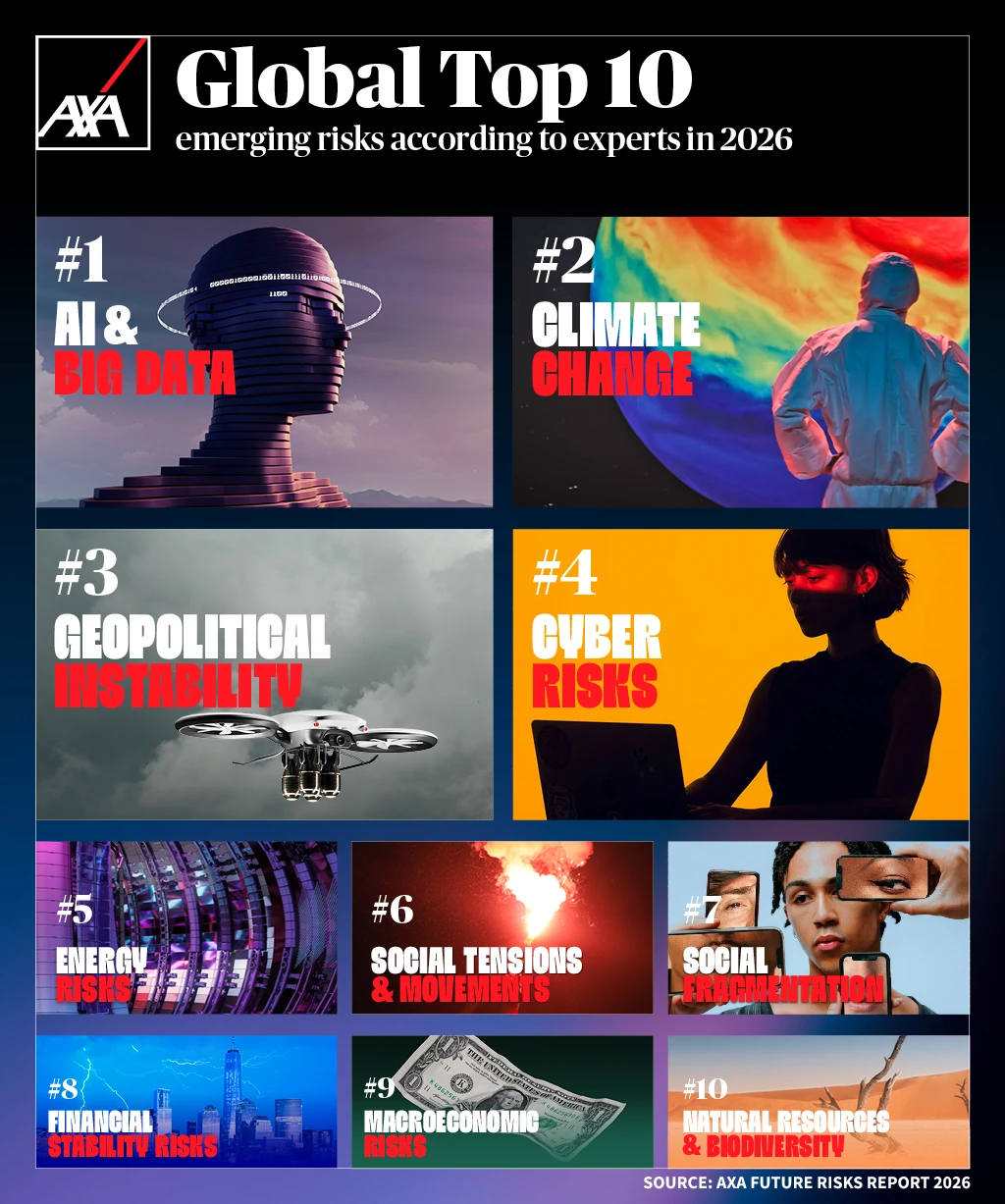
The 2026 edition marks a turning point: for the first time since the AXA Future Risks Report was launched, risks related to artificial intelligence and big data rank first among experts, ahead of climate change. AI ranked fourth in 2025.
This increase reflects the speed at which artificial intelligence is transforming economies and societies, as well as the uncertainty surrounding its impacts. Among experts ranking AI among their top risks, 54% consider it a rapidly emerging risk, while only 9% believe public authorities are well prepared to address it. This figure falls to 3% in Europe.
Climate change nevertheless remains a major concern. It continues to rank as the number one risk for the public and comes first across all age groups. Meanwhile, AI has risen to second place among the public, compared with seventh place in 2025.
Demographic Change: Anticipating a New Protection Economy
The report also highlights how demographic trends are progressively reshaping the needs societies must address: declining birth rates, ageing populations, longer life expectancy and changing family structures. In this context, protection needs are evolving as well.
For an insurer, these shifts call for a rethink of protection throughout people’s lives: supporting family transitions, health and loss of autonomy, savings, retirement and wealth transfer, while ensuring that insurance solutions remain accessible for populations with increasingly diverse life paths.

From Protection to Prevention
95% of experts and members of the public believe that the risks that concern them most can be at least partly prevented through prevention measures. A majority of the public also says it is willing to adopt behaviours that reduce its exposure to risk.
This expectation directly concerns the insurance sector. 68% of the public believe insurers have an important role to play in protecting society against emerging risks.
As risks evolve faster and become increasingly interconnected, the challenge for insurers is therefore twofold: to continue providing protection when risks materialize, while contributing more actively to anticipating and reducing them.

Access the full report
For the past 13 years, AXA's Future Risks Report has analysed the main emerging risks that are likely to transform our societies in the next five to ten years.
The 2026 edition is based on a survey conducted by Ipsos of 4,345 experts in 62 countries and regions, and 24,000 people representative of the general public in 19 countries. Participants rank 20 major risks based on their potential impact on society.
The Risk Radar, an interactive tool, allows you to visualize the risks, compare the perceptions of experts and the general public, and track the evolution of rankings over time and between regions or generations.
Key figures
46%
of the public consider relocating due to emerging risks such as climate change, insecurity, and health threats.
87%
of 18-35 year olds believe that strong preventive actions could help mitigate the risks they are most concerned about.
46%
of the public think that younger generations will have a lower quality of life than their own.


