Ipsos Health Service Report 2026
Key Research Findings:
Download the report below
Mental health remains the biggest health problem and is growing as a concern
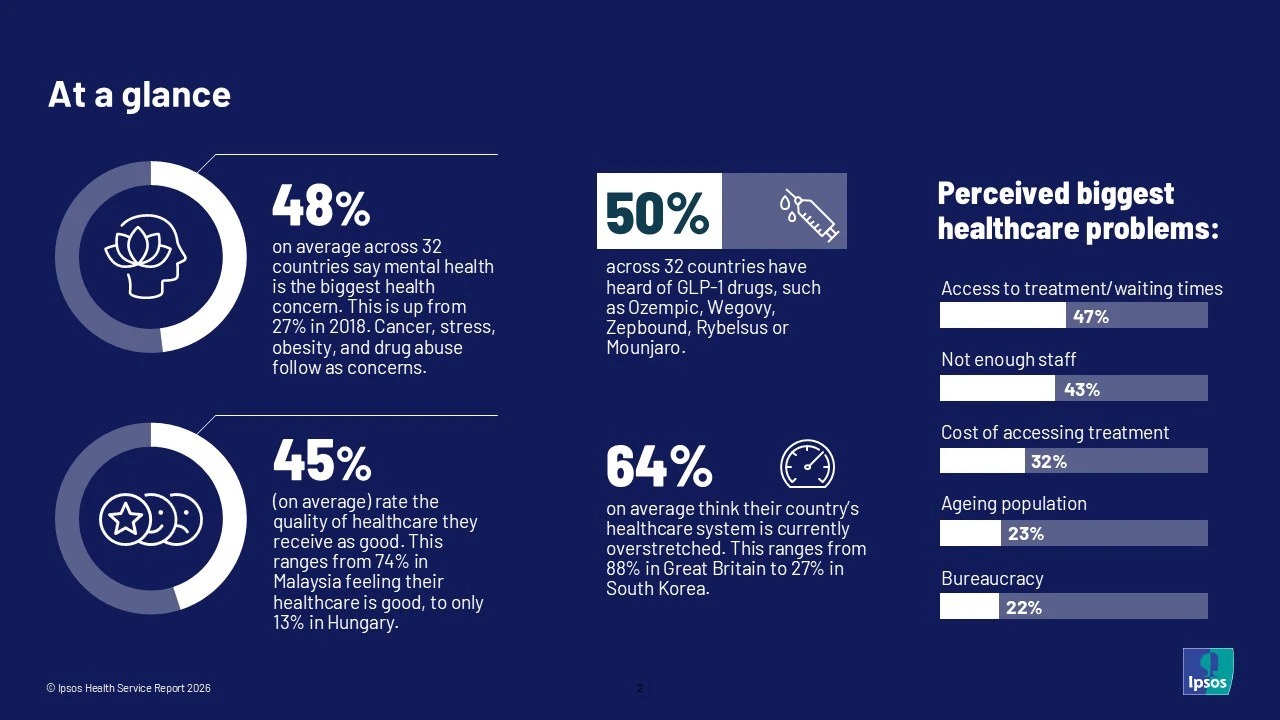
On average across 32 countries one in two (48%) see mental health as one of the biggest health problems in their country ahead of cancer (40%), stress (32%) and obesity (25%). Mental health has topped our list of worries since 2023 and despite many already seeing it as a problem 19 out of the 28 countries surveyed this year and last are more likely to see it as major issue in 2026.
Quality of care perceptions vary sharply around the world
Malaysia tops our quality of care perceptions index with a score of 72%. While Hungary records the lowest score (28%). The quality of care perceptions index looks at people’s satisfaction with their country’s healthcare system, trust in the system, ability to access a doctor and a pharmacy, and whether the system treats all people equally.
Healthcare systems reach a breaking point for many Europeans
A lack of capacity in health systems among countries in Europe is a growing worry. A majority see access to treatment and not enough staff as the biggest problems facing their healthcare systems (52% and 55% respectively). These figures are higher than the global averages (47% and 43%). They are much more likely (76%) to see their health services as overstretched than the global average (64%).
GLP-1s move from niche treatment to mainstream awareness
Across 32 countries, one in two (50%) say they have heard of GLP-1s. This figure is higher in some of the world’s most advanced economies like Great Britain, Canada, or the US. While awareness is lower in LATAM, all 29 countries surveyed in 2025 and this year are more likely to be aware of GLP-1s in 2026.
Contact
 Jamie StinsonIpsos Knowledge Centre