4 in 10 Britons want Northern Ireland to remain in the UK, but many are indifferent about its constitutional future
- Fewer than one in four Britons say they feel well informed about current events in Northern Ireland.
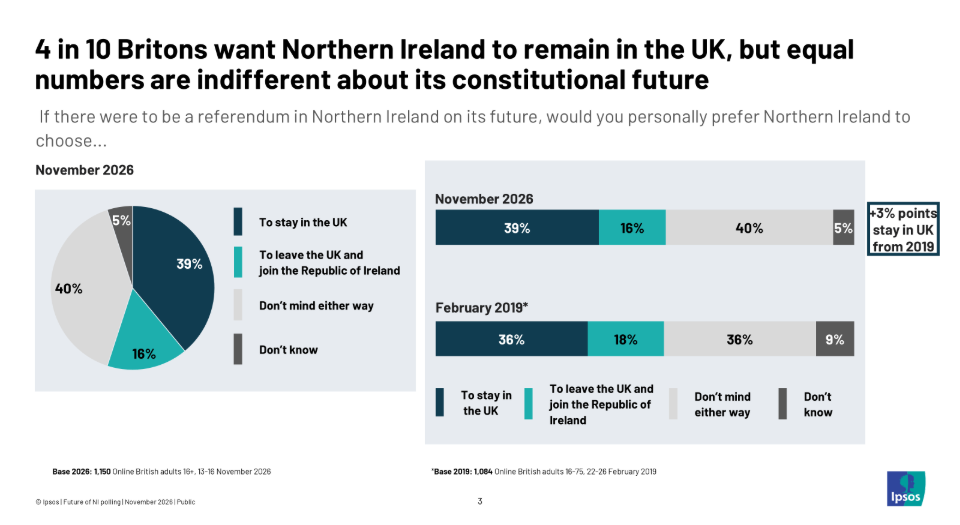
- 39% would prefer Northern Ireland to remain part of the UK in the event of a referendum, while 16% would prefer it to join a united Ireland. Four in ten (40%) say they do not mind either way.
- Britons are less certain about Northern Ireland's longer-term future than its status over the next five years.
What do Britons want for Northern Ireland?
If there were to be a referendum in Northern Ireland on its future, 39% of Britons say they would prefer Northern Ireland to remain part of the UK, compared with 16% who would prefer it to leave the UK and join the Republic of Ireland. However, four in ten (40%) say they do not mind either way, suggesting that many in Britain do not hold strong views on the constitutional question.
2024 Reform UK voters are most committed to Northern Ireland’ place in the UK (53%) but a plurality of 2024 Labour (43%) and Conservative voters (48%) also prefer Northern Ireland to remain part of the UK too. People in Scotland are the most supportive of a united Ireland (30%) but more Scots would still prefer Northern Ireland to remain in the UK.
The findings come alongside relatively low levels of engagement with Northern Irish affairs. Just 23% say they feel very or fairly well informed about current events and developments in Northern Ireland, making it one of the issues respondents feel least informed about.
What do Britons think will happen in the future?
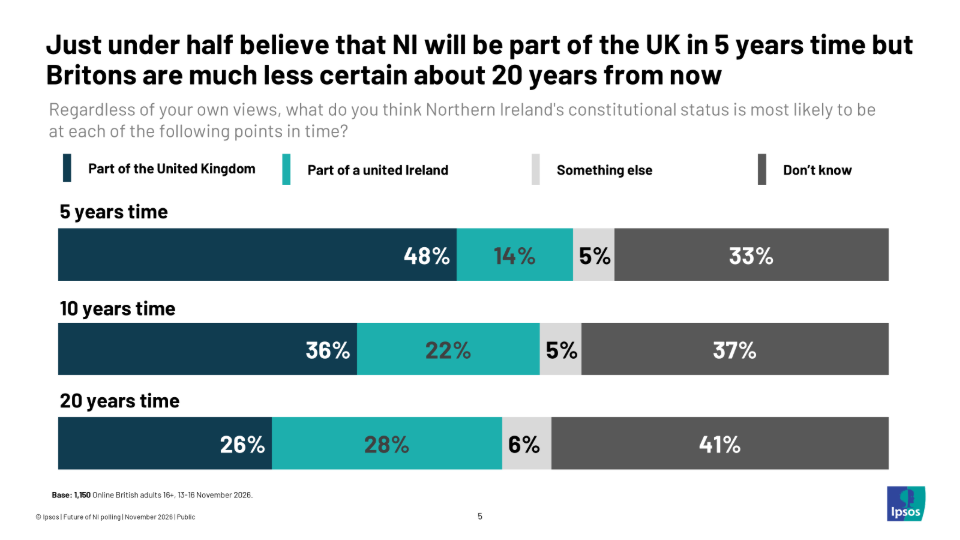
Looking ahead, almost half (48%) think Northern Ireland is likely to remain part of the UK in five years' time. However, views become more uncertain over longer time horizons. The proportion expecting Northern Ireland to remain in the UK falls to 36% when considering the next decade and 26% when considering the next twenty years. In fact, in 20 years Britons are as likely to expect Northern Ireland to be part of a united Ireland (although 4 in 10 say they don’t know).
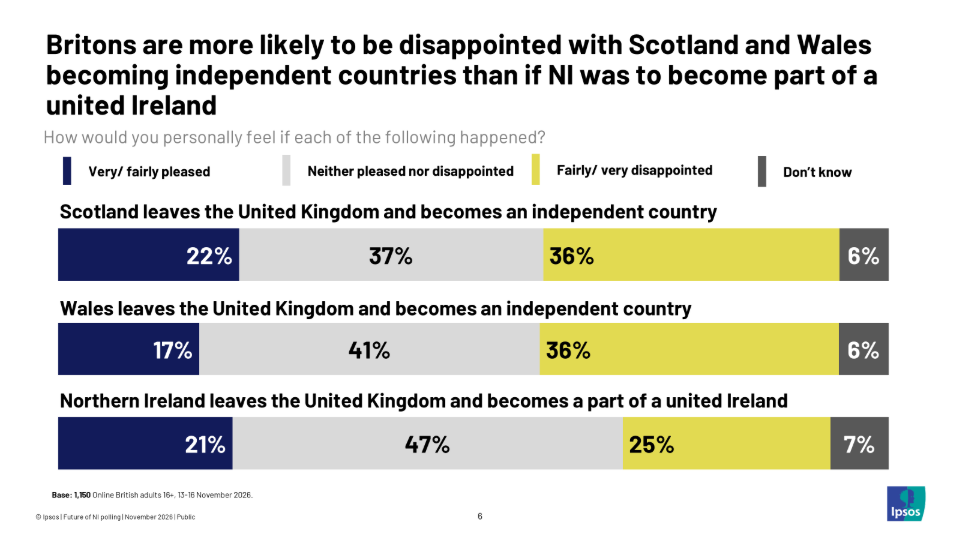
When asked how they would feel if Northern Ireland left the UK and became part of a united Ireland, respondents were more likely to say they would feel neither pleased nor disappointed (47%) than disappointed (25%) or pleased (21%). By comparison, Britons are more likely to express disappointment at the prospect of Scotland or Wales becoming independent countries.
Commenting on the findings, Managing Director of Ipsos Northern Ireland Caolan Ward said:
These findings suggest that while Britons are somewhat more inclined to favour Northern Ireland remaining part of the United Kingdom than joining a united Ireland, many do not hold strong views on the issue. Indeed, as many say they do not mind either way as actively favour Northern Ireland remaining in the UK. This points to a constitutional ambivalence whereby many neither follow the issue closely nor feel strongly about Northern Ireland's long-term constitutional future.
The data also points to relatively low levels of engagement with Northern Irish affairs among the wider British public. While many continue to expect Northern Ireland to remain part of the UK in the near term, there is considerably greater uncertainty about what its constitutional future may look like over the longer term.
Notes to Editors:
- For media queries, please contact the Ipsos in the UK Press Office at [email protected]
- For the full findings, please visit the Ipsos website.
- Ipsos interviewed a representative sample of 1.150 online British adults aged 18+. Polling was conducted online between 13-16 November 2026.
- Data are weighted to match the profile of the population. All polls are subject to a wide range of potential sources of error.
The author(s)
-

-

-
Adam McgleaveSenior Research Executive, Public Affairs, UK