
81% of Generation Y think it is harder for them to buy or rent a home to settle down in than it has been for others
New research by Ipsos for housing and homelessness charity Shelter finds 74% of people in younger Generations X and Y of the view that it is harder for them to get a home to settle down in – either as a homeowner or a renter – than it was for their parents’ generation. This compares to only 44% of people born in the Baby Boomer or Pre-War years.
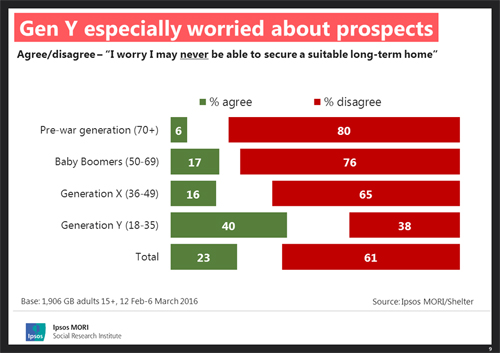
All generations expect the housing situation to get worse for future ones, but Generation Y are especially worried about their own prospects; 40% agree that ‘I worry I may never be able to secure a suitable long-term home’.
A large majority of people who don’t currently live in a long-term home (one suitable for the long-term i.e. 10 years or more) would like to, either now or in future, with most saying the key reason is to give them stability or to put down roots.
The research marks the launch of the Great Home Debate – the country’s biggest ever conversation about the meaning of home. In its 50th year of striving to end bad housing and homelessness, Shelter, with support from British Gas, is inviting the public to have a say on what makes a good home. It will use people’s views from the Great Home Debate to shape new standards for homes in the 21st century.
It also supplements recent Ipsos analysis of the British Social Attitudes survey, produced on behalf of the Guardian, which has shown that the proportion of Generation Y (adults born since 1980) who own their own home is significantly smaller than the proportion of Generation X (those born 1966-1979) homeowners when that generation was of a similar age.
Technical note
Ipsos interviewed 1,906 British adults between 12 February and 6 March 2016, with respondents interviewed in-home, face to-face. Data has been weighted to match the known population profile.

