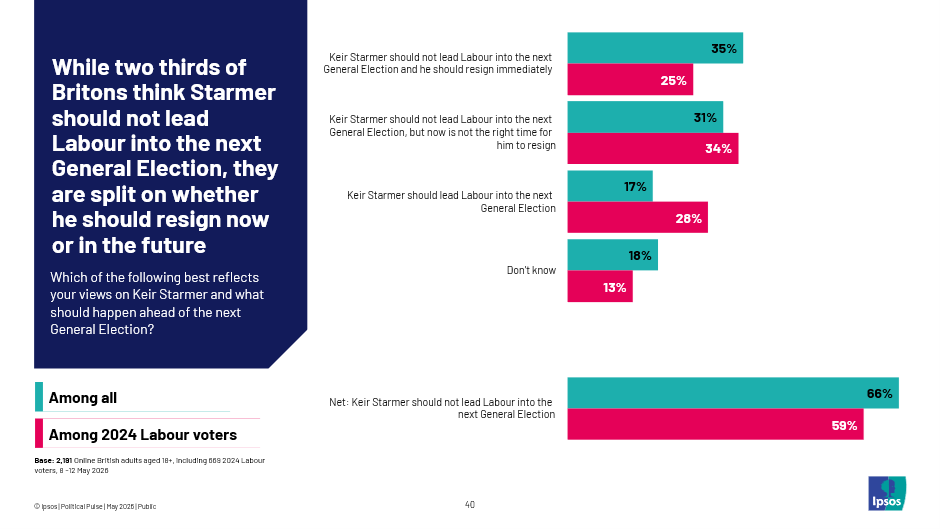
Two in three Britons (66%) think Starmer should not lead Labour into the next General Election but are divided on when he should go
- The public are divided as to whether he should resign immediately (35%) or sometime between now and the next GE (31%). 2024 Labour voters are more likely than the public overall to call for delay.
- But just 17% explicitly say he should lead Labour into the next GE. 18% don’t know.
- 2 in 5 (42%) think that the Labour party would perform better in the next GE with someone else as leader, with 74% of Britons now thinking it is unlikely that Starmer would win the next GE
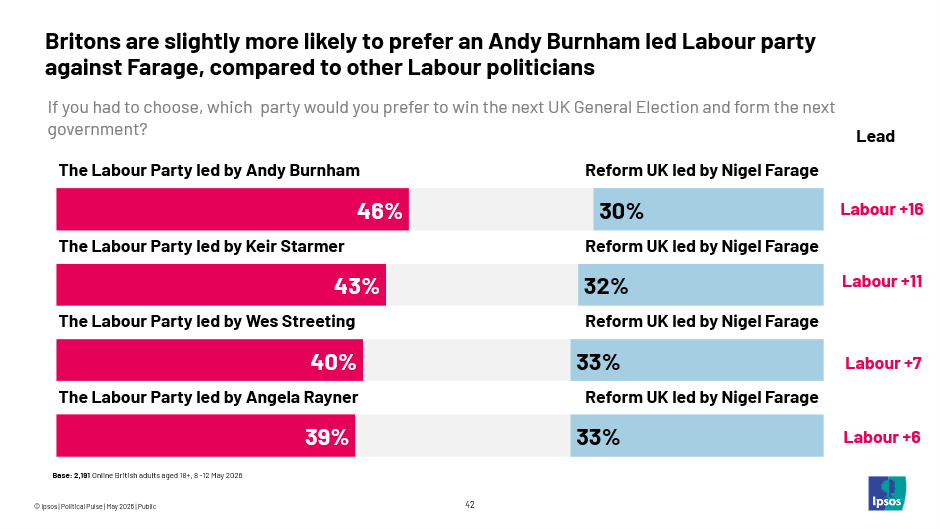
- Even so, in hypothetical head-to-heads against Reform UK led by Farage, A Starmer-led Labour government leads by +11 points, Andy Burnham leads by +16, Wes Streeting by 7 and Angela Rayner by 6.
2 in 3 think Starmer should resign before the next General Election
- Two in three Britons (66%) think Starmer should not lead Labour into the next General Election, including 59% of those who voted Labour in the 2024 General Election
- However, the public are divided as to whether he should resign immediately (35%) or sometime between now and the next GE (31%)
- More than 2 in 5 (42%) think that the Labour party would perform better in the next GE with someone else as leader, with 74% of Britons now thinking it is unlikely that he would win the next GE
- There has further been an increase in the share of Britons who think it’s likely that Nigel Farage will ever be prime minister, rising 10ppts to 50% as compared to April 2026
- Even so, in hypothetical head-to-heads against Reform UK led by Farage, each of Starmer, Burnham, Streeting, and Rayner comes out ahead. Though Andy Burnham and Keir Starmer lead by more than Wes Streeting and Angela Rayner.
Favourability ratings among Party leaders
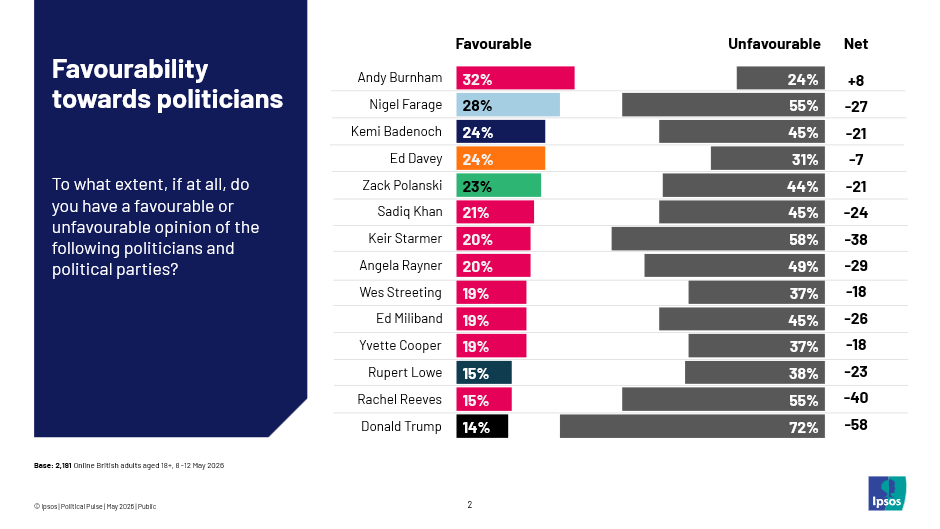
The survey highlights a significant "favourability gap" between senior Labour figures and regional leaders. Andy Burnham remains the most popular politician tracked, with a net favourability rating of +8 (32% favourable, 24% unfavourable). In contrast, Keir Starmer and Rachel Reeves are facing substantial public disapproval:
- Keir Starmer: The Prime Minister’s net favourability stands at -38, with 58% of the public viewing him unfavourably and only 20% favourably. Even among those who voted Labour in 2024, Keir Starmer’s net favourability is just +3, while Andy Burnham enjoys a net rating of +41 within the same group.
- Wes Streeting: Streeting’s net favourability is the second highest amongst the potential frontrunners to challenge Starmer in a leadership election, following Burnham. 19% of the public currently view him favourably, compared to 37% who view him unfavourably, giving him a net favourability of -18
- Angela Rayner: Rayner’s net favourability stands at -29 (20% favourable, 49% unfavourable)
- Rachel Reeves: The Chancellor’s ratings are even lower than the Prime Minister’s at net -40 (15% favourable, 55% unfavourable)
Among other party leaders:
- Ed Davey, leader of the Liberal Democrats, enjoys the highest net favourability other than Andy Burnham at -7 (24% favourable, 31% unfavourable)
- Kemi Badenoch, leader of the Conservative Party, has a net favourability of -21, with 24% favourable and 45% unfavourable
- Leader of the Green Party Zack Polanski also has a net favourability of -21, with 23% favourable and 44% unfavourable
- Nigel Farage, leader of Reform UK, has the lowest net favourability of any of the other party leaders, with 28% favourable and 55% unfavourable, making for a net favourability of -27. However, his favourable score of 28% is second only to Andy Burnham on 32%.
Party favourability ratings
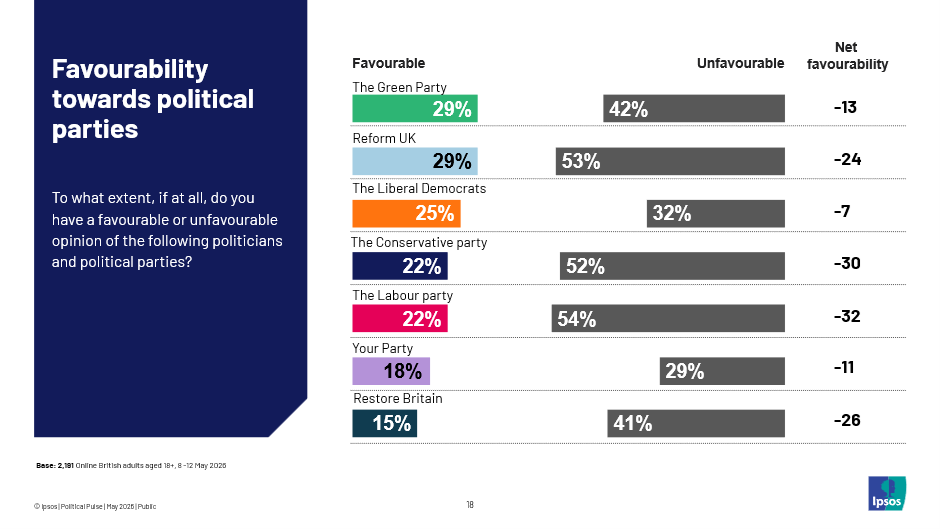
- The Green Party and Reform UK have the highest levels of favourability (29%)
- However, Reform UK has a higher level of unfavourability (52%), giving it a net favourability of -24
- The Labour Party (-32) and the Conservatives (-30) have the lowest net favourability
Direction of the country and key issues
The national mood remains pessimistic, with 68% of Britons believing the country is heading in the "wrong direction," compared to just 13% who think it is on the "right track".
More than 9 in 10 Britons think the country needs change, though they are divided as to whether that change should be radical (44%) or moderate (42%).
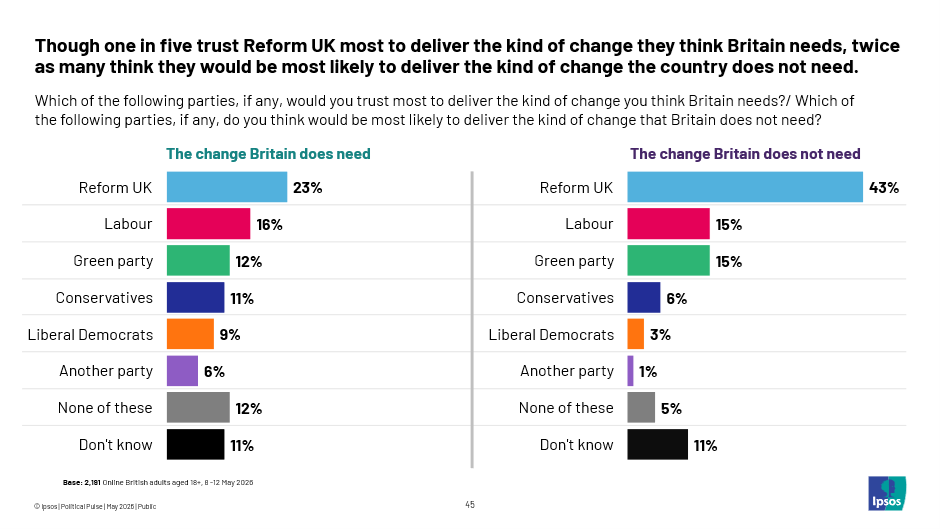
Reform UK leads as the party most likely to deliver the kind of change that Britain needs (23%), but also the most likely to deliver the kind of change that Britain does not need (43%).
Healthcare and the NHS remain the paramount issues for the electorate, with 66% of respondents citing it as very important in deciding their vote (+3ppts vs Apr ’26). This is followed closely by:
- Inflation / Cost of living: 63% (+7ppts vs Apr ’26)
- Immigration: 50% (no change vs Apr ’26)
- The economy: 46% (+4ppts vs Apr ’26)
Of the findings, Keiran Pedley, Director of UK Politics at Ipsos said:
Whilst public opinion appears clear that Keir Starmer would be unlikely to win a future General Election and he should not lead Labour into one, the public are less clear on how soon he should go. With 2024 Labour voters in particular more likely to say he should stay for now than leave immediately. Andy Burnham is the most popular candidate to replace him, with the highest net favourability rating overall and the biggest lead in hypothetical head to heads with Nigel Farage and Reform. However, he is not in parliament and it is not obvious that other potential leadership rivals who are would do better against Farage than Starmer himself.
Notes:
- Ipsos interviewed a representative sample of 2,191 adults aged 18+ across Great Britain. Polling was conducted online between 8-12 May 2026.
- Data are weighted to match the profile of the population. All polls are subject to a wide range of potential sources of error.