
Attitudes To Growing Older
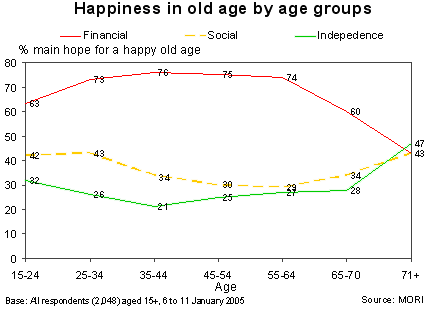
The importance of having family and friends around, and being able to live independently, increases with age according to new research from the MORI Social Research Institute. The project also shows that being financially comfortable becomes less important as one grows older.
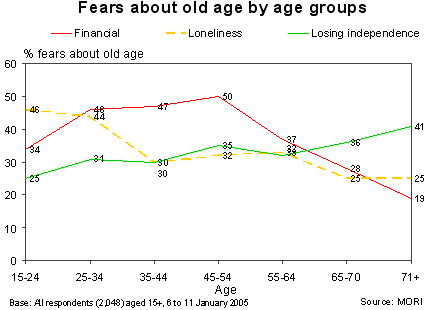
Similarly, financial concerns are replaced by fears about losing independence as respondents get older.
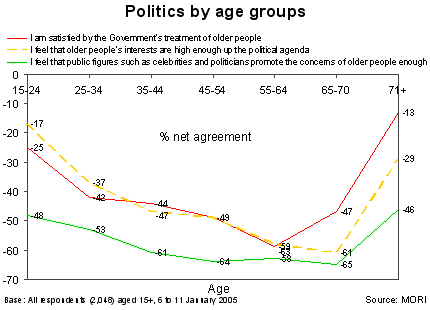
Two thirds of the population are not satisfied with the way the Government is treating older people. The level of net satisfaction with the government drops with age and reaches its lowest point amongst 55-64 years olds. However, after the age of 65, levels of satisfaction with the government start increasing, and reach their peak among those aged 71+.
Opinion on means testing is divided, with the same proportions of respondents (38%) citing only positive and only negative statement about it. Despite the fact that more money often felt needed is considered to help people remain independent, one in seven (14%) of those aged 65+ would not apply for social security benefits specifically to avoid going through means testing.
During the interview, the respondents were asked two sets of different questions depending on their age. Those aged 15-64 were asked to what extent they agreed with six statements, each exploring different aspects of family dynamics in old age. The same procedure was followed for those aged 65 or above, with six different statements exploring corresponding aspects but from those older peoples' perception.
Overall, those who are aged 65+ appear to expect less from their children than those aged 16-54 appear willing to give. Only after the age of 70 do respondents' expectations from their children increase slightly. However the support offered to the parents becomes less generous with age; the older the respondents are the less prepared they become to live with their parents or to pay for their care (despite in many cases being more able to do so than would younger people).
Older respondents are far less enthusiastic about living with their children in old age than are their children.
Technical details
The MORI study was conducted among the general public to explore public perceptions of old age. Interviews were conducted via MORI Omnibus, face-to-face, in home, from 6 to 11 January 2005 across Great Britain. The survey was commissioned by Keene PA on behalf of the Royal United Kingdom Beneficent Association (RUKBA) which is being re-launched as Independent Age.
Topline Results
- Results are based on 2,048 interviews conducted face-to-face in respondents' homes with a representative sample of the Great Britain
- Interviews were conducted between 6th-11th January 2005
- Data are weighted by age, gender, working status
- Where results do not sum to 100%, this may be due to multiple responses, computer rounding or the exclusion of 'don't know/not stated' response categories.
- Where there are small bases (less than 30 respondents) responses are given in absolute figures rather than percentage answers.
- Multiple responses mean that respondents can give more than one answer to a question; therefore results will total more than 100%, as percentages are based on the total number of responses given divided by the total number of people answering the question, e.g. Q5.
- The use of show cards indicates that responses to a question are prompted i.e. respondents are shown a list of responses from which they can choose.
- An asterisk (*) represents a value of less than half of one per cent, but not zero.
Q1 Everyone would say that they hope for good health in their old age. Apart from good health, what are your main hopes for a happy old age, if any? What else?
| 160 | First Mention | Total Mentions |
|---|---|---|
| 160 | % | % |
| Being financially comfortable | 50 | 67 |
| Having family/friends around | 10 | 32 |
| Being able to live independently | 9 | 21 |
| Leading a full and active life | 8 | 23 |
| Being able to stay in my home | 5 | 15 |
| Having more time for family and friends | 2 | 10 |
| Having more time for myself, hobbies and interests | 2 | 9 |
| Happiness/contentment/peace* | 2 | 4 |
| Seeing family grow/happy* | 2 | 2 |
| Not having to work | 1 | 3 |
| Safety* | 1 | 3 |
| Working part-time | * | 2 |
| Other | 1 | 3 |
| Net: Independence | 14 | 36 |
| Net: Social | 13 | 42 |
| Net: Financial | 50 | 68 |
| None/Don't have any | 4 | * |
| Don't know | 3 | 7* |
Q2 Similarly, everyone would say that they would fear having poor health in their old age. What things, if anything, apart from poor health do you fear about old age? What else?
| 160 | First Mention | Total Mentions |
|---|---|---|
| 160 | % | % |
| Loneliness | 20 | 32 |
| Not having enough money | 18 | 31 |
| Having to depend on others | 10 | 20 |
| Going into a care home | 7 | 14 |
| My saving or pensions won't be enough | 6 | 12 |
| Having to leave my home | 3 | 9 |
| Crime/safety* | 3 | 4 |
| Being excluded from the local community | 2 | 4 |
| Not having enough/ anything to do | 1 | 4 |
| Other | 7 | 10 |
| Net: Financial | 25 | 39 |
| Net: Independence | 20 | 32 |
| Net: Loneliness | 22 | 35 |
| Don't know | 7 | 24 |
Q3 What, if anything, do you think you will miss /are missing out on in old age? What else?
| 160 | % |
|---|---|
| Social life/ active social life | 23 |
| My independence | 16 |
| Being active* | 9 |
| Playing sport | 9 |
| Going to work | 7 |
| Holidays | 6 |
| Seeing the family | 6 |
| Physical relationship (e.g. regular sex) | 4 |
| New experiences | 3 |
| Going to concerts/cinema/theatre | 2 |
| Keeping up with technology | 2 |
| Money* | 2 |
| Dating/ romance (meeting members of the opposite sex) | 1 |
| Youth | 1 |
| Friends/companions | 1 |
| Other | 3 |
| Nothing | 25 |
| Don't know | 11 |
Q4 To what extent do you agree or disagree with each of the following statements?
| 160 | Strongly agree | Tend to agree | Neither agree nor disagree | Tend to disagree | Strongly disagree | Don't know |
|---|---|---|---|---|---|---|
| 160 | % | % | % | % | % | % |
| I am satisfied by the Government's treatment of older people | 2 | 19 | 12 | 32 | 29 | 5 |
| I feel that older people's interests are high enough up the political agenda | 2 | 19 | 12 | 35 | 26 | 5 |
| I feel that public figures such as celebrities and politicians promote the concerns of older people enough | 1 | 11 | 13 | 41 | 28 | 6 |
Q5 Could you name any public figures who you think promote the concerns of older people? Who else? Base: 248
| 160 | % |
|---|---|
| Tony Blair | 3 |
| June Whitfield | 2 |
| Gordon Brown | 1 |
| Local MP | 1 |
| Christopher Timothy | 1 |
| Jack Jones | 1 |
| Andrew Carter | 1 |
| Government | 1 |
| Henry Cooper | * |
| No one/ Don't Know | 79 |
Q6 To what extent do you agree or disagree with each of the following statements? Base: All aged 15-64 (1,559)
| 160 | Strongly agree | Tend to agree | Neither agree nor disagree | Tend to disagree | Strongly disagree | Don't know | No opinion | N/A |
|---|---|---|---|---|---|---|---|---|
| 160 | % | % | % | % | % | % | % | % |
| I will be better off financially in my retirement than my parents | 14 | 27 | 10 | 19 | 12 | 9 | 2 | 6 |
| I expect my parents to live with me when they can no longer cope with living on their own | 9 | 23 | 8 | 17 | 19 | 3 | 2 | 18 |
| I expect to care for my parents in their old age | 18 | 36 | 6 | 10 | 8 | 2 | 2 | 18 |
| I want my parents to live with me in their old age | 8 | 16 | 11 | 20 | 22 | 2 | 2 | 19 |
| I expect my parents to leave me money when they die | 6 | 17 | 10 | 18 | 26 | 3 | 3 | 17 |
| I want to pay for my parents' care | 8 | 28 | 10 | 16 | 15 | 2 | 3 | 18 |
Q7 To what extent do you agree or disagree with each of the following statements? Base: All aged 65+ (489)
| 160 | Strongly agree | Tend to agree | Neither agree nor disagree | Tend to disagree | Strongly disagree | Don't know | No opinion | N/A |
|---|---|---|---|---|---|---|---|---|
| 160 | % | % | % | % | % | % | % | % |
| I am better off financially in my retirement than my children will be in theirs | 9 | 27 | 9 | 18 | 12 | 13 | 4 | 9 |
| I expect to live with my children when I can no longer live on my own | 3 | 9 | 7 | 22 | 45 | 4 | 1 | 8 |
| I expect my children to care for me in my old age | 4 | 21 | 9 | 19 | 34 | 3 | 1 | 9 |
| I want to live with my children in my old age | 3 | 8 | 6 | 23 | 50 | 1 | 1 | 9 |
| I expect to leave money behind for my children when I die | 25 | 37 | 8 | 9 | 8 | 3 | 1 | 9 |
| I want to pay for my own care in old age | 11 | 33 | 13 | 17 | 18 | 2 | 2 | 4 |
Q8 Which two or three of these, if any do you feel you would most need to allow you to remain living where you are in your old age? Base: All aged 65+ (489)
| 160 | % |
|---|---|
| Support from relatives | 30 |
| Greater support from local social services | 28 |
| Help in caring for yourself | 27 |
| Help with household chores | 27 |
| More money | 26 |
| Help getting out and about | 25 |
| Aids and adaptations | 21 |
| Support from neighbours | 16 |
| Community alarm system | 12 |
| Help with financial affairs | 11 |
| Nothing | 8 |
| Don't know | 4 |
Q9 I would like to ask a question about means testing. Means testing is where your financial status is assessed by people to decide whether or not you qualify for some of the social security benefits. Which of these phrases, if any, do you think apply to means testing? Base: All aged 65+ (489)
| 160 | % |
|---|---|
| It is demeaning | 32 |
| It means that money goes to the people who need it most | 30 |
| It is unfair | 25 |
| It cuts down on benefit fraud | 24 |
| It is necessary | 24 |
| It costs more money than it saves | 18 |
| It is fair | 17 |
| It is unnecessary | 14 |
| It will put me off applying for social security benefits (e.g. Pension Credit) | 14 |


