
Reform UK holds 7-point lead over Labour, Greens up 5 points
Ipsos’ latest Political Monitor is now released, with fieldwork carried out 5-11 March 2026.
- Reform UK still hold a clear lead over Labour. This lead is 7 points today – one point down from January and 8 points down from their 15-point lead in November.
- The Greens are the big movers in this poll. Their vote share increasing 5 percentage points since January, following the Gorton and Denton by-election.
- Andy Burnham and Nigel Farage are seen as most likely to ‘have what it takes to be a good PM’. Though Keir Starmer’s figures comparable to Farage’s and stronger than Zack Polanksi of the Greens and other potential internal Labour Party rivals.
- Expectations of the government are low. Only around one in five think the government’s policies will improve the economy or public services in the long run.
Voting intention
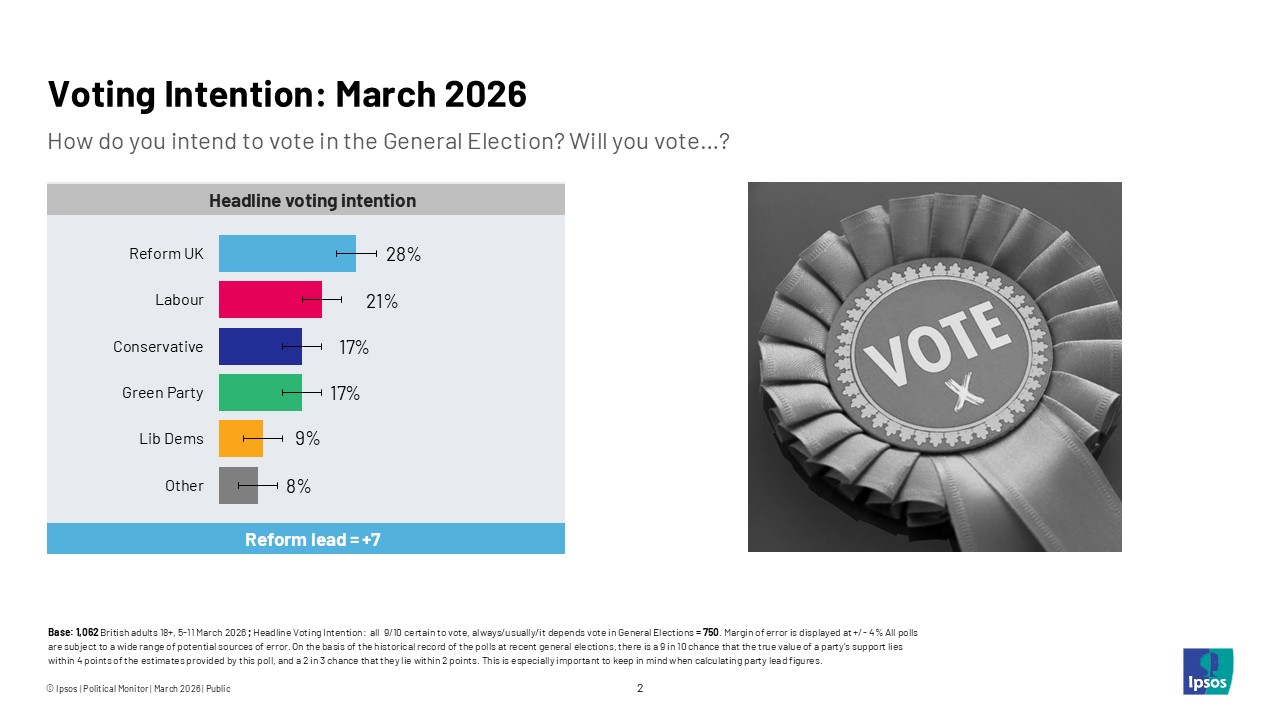
This month Reform are on 28% in terms of voter preferences (-2 from January), Labour 21% (-1), Conservative 17% (-2), Greens 17% (+5), Lib Dems 9% (-3), Others 8% (+3)
Satisfaction ratings
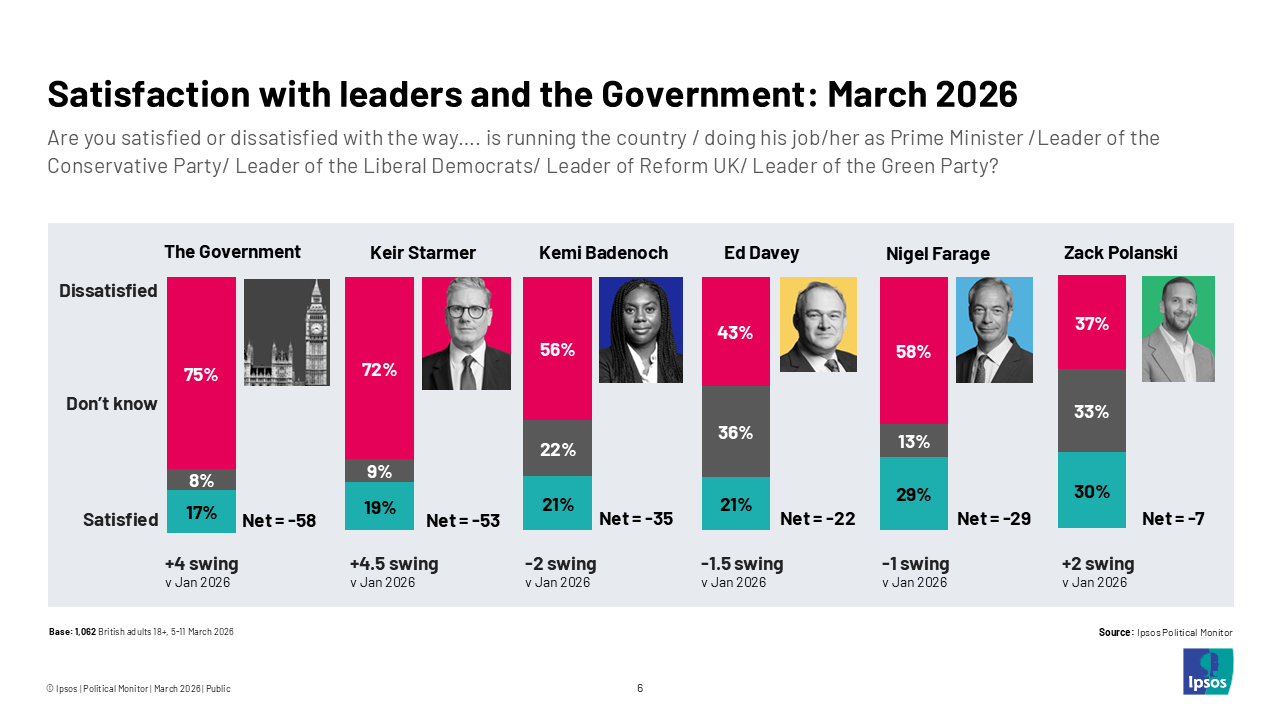
Each month Ipsos ask the public whether they are satisfied or dissatisfied with how the government are running the country and how various politicians are doing their jobs; Keir Starmer as Prime Minister, Rachel Reeves as Chancellor and various other politicians as leaders of their respective parties. Here is a summary of this month’s scores:
- Government: 17% satisfied (+4 from January), 75% dissatisfied (-4). Net satisfaction -58
- Keir Starmer: 19% satisfied (+4), 72% dissatisfied (-5). Net satisfaction -53. This reflects an increase in net satisfaction from -62 last month.
- Kemi Badenoch: 21% satisfied (-1), 56% dissatisfied (+3). Net satisfaction -35.
- Nigel Farage: 29% satisfied (+1), 58% dissatisfied (+3). Net satisfaction -29.
- Ed Davey: 21% satisfied (nc), 43% dissatisfied (+3). Net -22.
- Zack Polanski: 30% satisfied (+8), 37% dissatisfied (+4). Net -7 (up from -11 last month)
- Rachel Reeves: 13% satisfied (+1), 70% dissatisfied (-3)
Most capable PM
- Keir Starmer 22% (+4)
- Nigel Farage 19% (-2)
- Kemi Badenoch 11% (-1)
- None/no difference 29% (-2)
Has what it takes to be a good Prime Minister
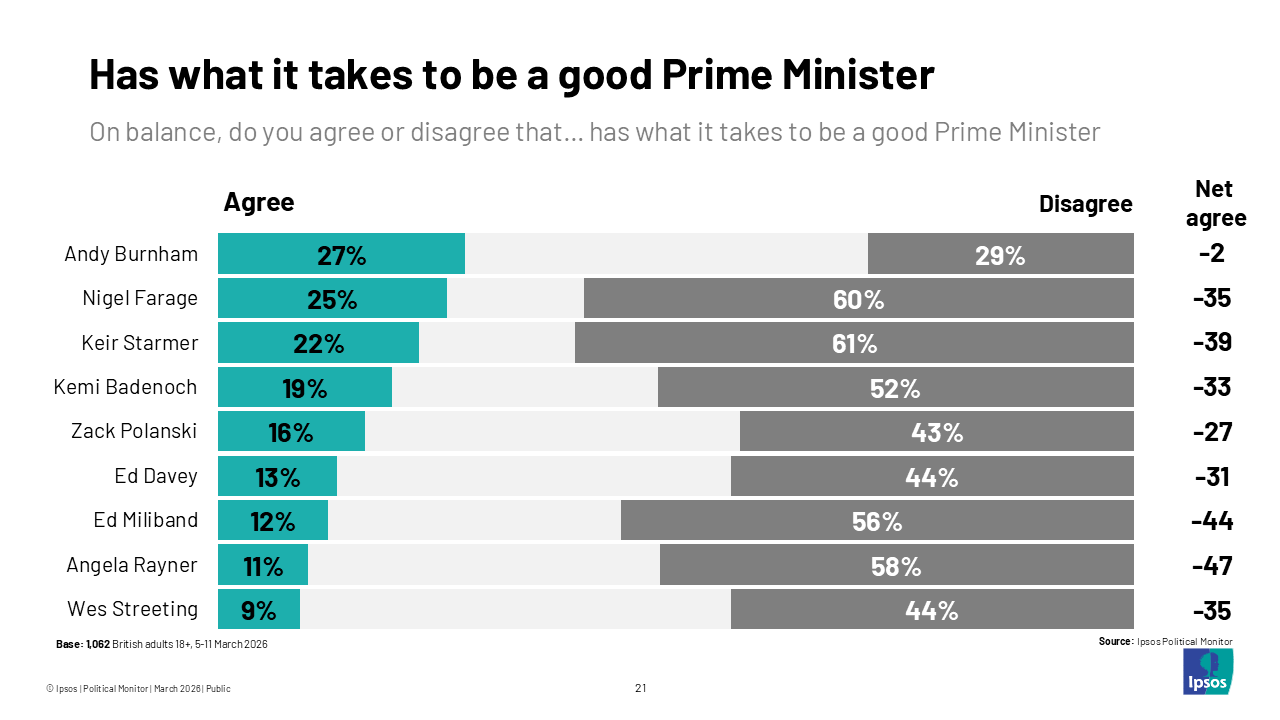
- In our list of politicians, Andy Burnham (27%) and Nigel Farage (25%) are most likely to be seen as having what it takes to be a good Prime Minister.
- However, Burnham’s net rating (-2) is stronger than Farage’s (-35) as fewer disagree (29% vs 60%).
- Elsewhere, whilst the Greens have gained 5 points in voting intention this month – and Zack Polanski’s leader satisfaction ratings have also improved – just 16% think he has what it takes to be a good Prime Minister. Which is less than say the same about Keir Starmer.
- Meanwhile, Keir Starmer’s ratings on this measure have fallen sharply since we last asked this question in September 2024. 22% agree he has what it takes to be a good PM (-18) and 61% disagree (+18). His ratings today are similar to Boris Johnson’s at his lowest scores in January 2022 (23% agree, 64% disagree).
- However, outside of Andy Burnham, the public appear unconvinced by several touted alternatives to Starmer. Just 12% think Ed Miliband has what it takes whilst 11% and 9% say the same about Angela Rayner and Wes Streeting respectively.
Party image
- Reform UK are most likely to be see as best representing the change that Britain needs. 25% choose Reform UK, 17% the Greens and 16% Labour.
- Reform UK are also seen as most likely to be clear and united about what their policies should be. 24% Reform UK, 19% Greens. They hold a similar advantage over being seen as ‘would be best at looking after the interests of people like you’ – Reform UK 22%, Greens 17%, Labour 16%.
- However, when it comes to having the best team of leaders to deal with the country’s problems Reform UK and Labour are neck and neck (20% vs 19%) with the Greens back at 11% (with the Conservatives on 10%).
- Similarly on having the best policies for the country as a whole 21% choose Reform UK, 18% Labour and 14% the Greens.
- On most measures though, as many if not more say “none of the above” or don’t know as choose any one party.
Economy and public services
- 21% agree that in the long term the government’s policies will improve the state of the British economy 64% disagree. In November 17% agreed and 66% disagreed.
- Meanwhile 24% agree “In the long term, this government's policies will improve the state of Britain's public services”. 62% disagree. In November 18% agreed and 65% disagreed.
Ipsos Director of Politics, Keiran Pedley, said:
These findings are clearly poor for the Prime Minister, which reflects public dissatisfaction with how the government is managing the economy and public services. However, his numbers are comparable to Nigel Farage and better than Zack Polanksi and most of his potential internal Labour Party rivals. The only exception perhaps being Andy Burnham who is not in parliament. So Starmer’s position can be described as unpopular, precarious but ultimately salvageable; if he can find a political formula to turn things around.
Technical note:
- Ipsos interviewed a representative probability sample of 1,062 British adults aged 18+, via the Ipsos UK KnowledgePanel. Data was collected between the 5th -11th March 2026. Panel members are recruited via random probability sampling, by sending letters to randomly selected addresses, which invites them to join an online panel. This approach means every household in the UK had a known and non-zero chance of being selected to join the KnowledgePanel. Those who are digitally excluded are provided with a tablet and free, restricted data connection. A sample of 2,226 adults aged 18+ were invited to take part in the survey. The sample was stratified by nation, age, qualifications and vote at the 2024 general election (as collected immediately after the election). The achieved sample was weighted in two stages:
- Design weights were applied to correct for the unequal probabilities of a person being selected for a survey, notably residents in smaller households have a higher chance of being selected.
- Calibration weights were applied through rim weighting to correct for differential non-response. Data was weighted to the adult population profile on age and gender, Government Office region, ethnicity, qualifications, work status and work sector (public sector/other), social grade (office coded), number of cars in household, constituency type, and newspaper readership (print and digital). Population targets were obtained from the 2021/22 Census, ONS population estimates and other large-scale probability surveys.
- All polls are subject to a wide range of potential sources of error. On the basis of the historical record of the polls at recent general elections, there is a 9 in 10 chance that the true value of a party’s support lies within 4 points of the estimates provided by this poll, and a 2 in 3 chance that they lie within 2 points. This is especially important to keep in mind when calculating party lead figures.
Note that this is a new methodology implemented since June 2025. It involves a new form of data collection (online random probability panel instead of quota telephone survey), an updated voting intention (which involves prompting for Reform UK), and an updated weighting scheme. This is based on our learnings during and since the 2024 General Election. This means that comparisons with previous waves need to be made with caution.


