Britons’ belief in the special relationship shows slight recovery following King Charles III’s state visit to US
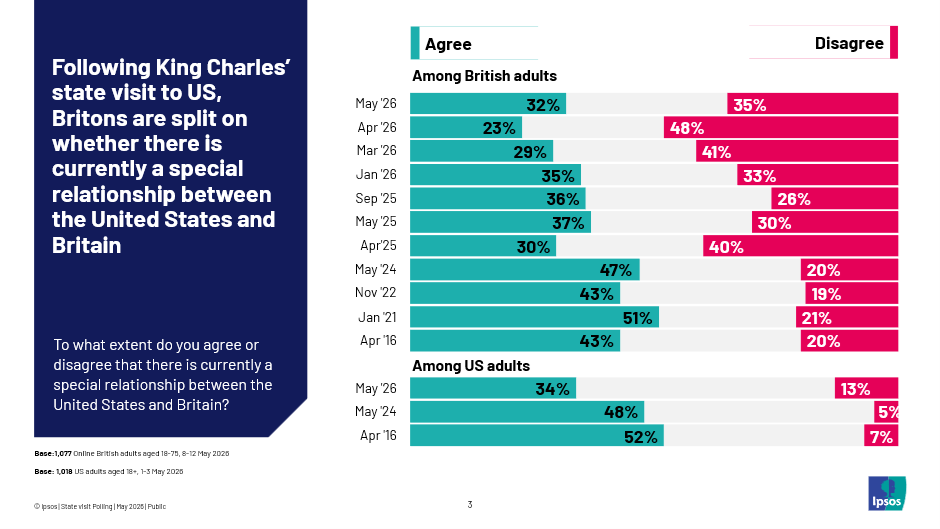
- 1 in 3 Britons (32%) agree there is currently a special relationship between the United States and Britain following King Charles III’s state visit
- This marks an increase of 9ppts as compared to the week before the state visit, which was seen as a success by 58% of the public
- However, a roughly equal share (35%) disagree that there is a special relationship between the two countries, and belief in the special relationship is still lower than it has been in previous years
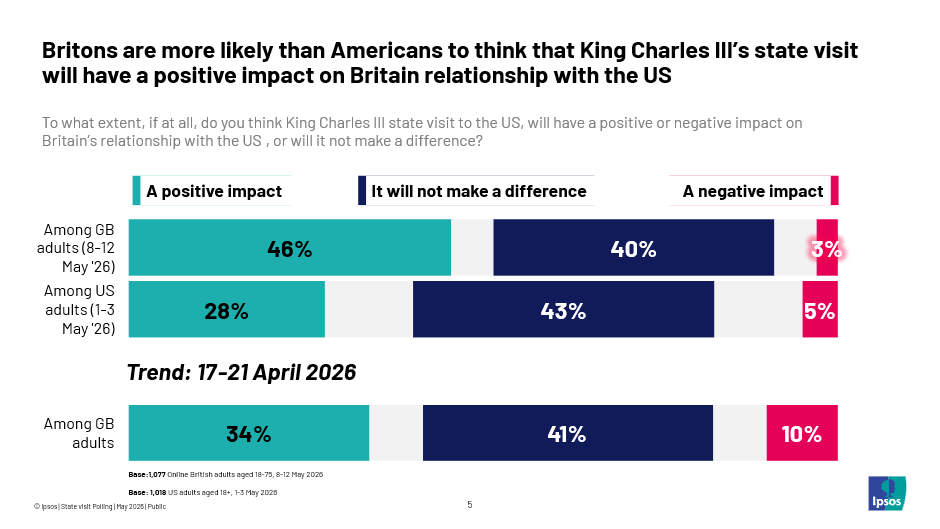
- More than 4 in 10 Britons (46%) think the state visit will have had a positive impact on Britain’s relationship with the US, compared to 28% of Americans who say the same
Attitudes towards the special relationship
- 1 in 3 Britons (32%) now agree there is a special relationship between the United States and Britain, following King Charles III’s state visit to the United States
- This marks an increase of 9ppts compared to the week before the state visit
- However, a roughly equal share (35%) disagree that there is a special relationship between the two countries, and belief in the strength of the special relationship is lower than it has been in previous years
- Over the last two years, belief in the strength of the special relationship has also declined among the American public. In Ipsos US research carried out immediately after the visit, 34% of US adults agreed there was a special relationship between the two countries, down from 48% in May 2024. This means that Britons and Americans are now both equally likely to believe there is currently a special relationship, but Britons are almost three times as likely as American to believe there isn’t one (35% vs 13%).
Impact of the state visit
- Around 6 in 10 (58%) Britons think the state visit was successful, compared to fewer than 1 in 10 (6%) who think it was unsuccessful
- Following the visit, more than 4 in 10 (46%) think that the state visit will have a positive impact on Britain’s relationship with the US, compared to 34% who thought the same prior to the visit (17-21 April). However almost as many (40%) think it will not make a difference.
- Americans are less optimistic about the impact of the state visit, with fewer than 3 in 10 (28%) thinking it will have a positive impact on the relationship between the two countries, 18ppts fewer than the share of Britons who said the same. Again, around 4 in 10 Americans (43%) think the visit will make little difference to US-UK relations.
Commenting on the findings, Gideon Skinner, Senior Director of UK Politics at Ipsos said:
Following a period of considerable uncertainty that has damaged public perceptions towards the transatlantic relationship, King Charles III’s state visit appears to have provided a welcome sense of stability, at least in the short term. Most Britons think the visit was a success, and nearly half are hopeful that it will have a positive impact on US-UK relations in the future, which is higher than pre-visit expectations.
However, the question remains whether this will be a sustained improvement or a temporary recovery. While belief in the special relationship has clearly recovered from April’s historic low, Britons are still split on it overall, and attitudes remain more ambivalent than we have seen in previous years. This is mirrored across the pond, where Ipsos US research shows that Americans’ belief in the special relationship is also lower than it was two years ago. It now falls onto the two governments to build on the optimism that has been created by King Charles’ visit to move towards a more settled chapter in UK-US relations.
Technical notes:
- Ipsos interviewed a representative sample of 1,077 adults aged 18-75 across Great Britain. Polling was conducted online between 8-12 May 2026.
- Data are weighted to match the profile of the population. All polls are subject to a wide range of potential sources of error.