
Britons Predict 2026: less than half think Starmer will still be PM at the end of next year as expectations for the economy remain gloomy
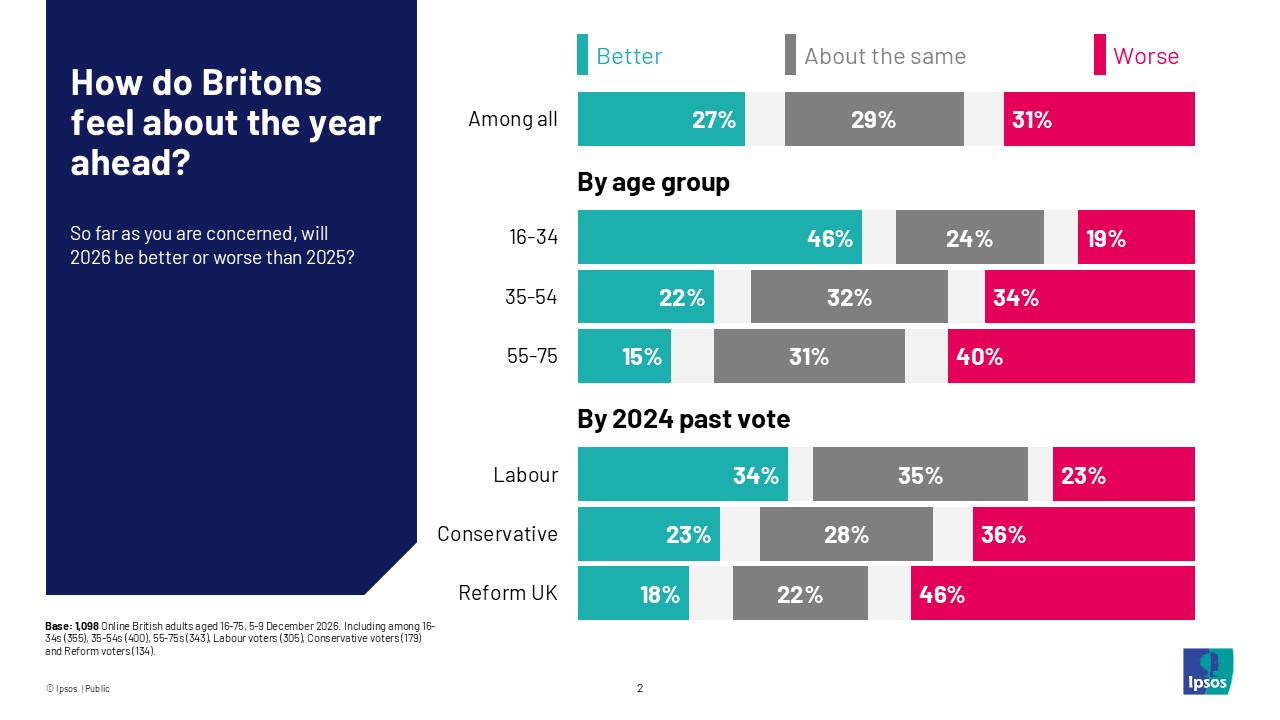
Ipsos has looked at what Britons expect from 2026. The public remains divided on their outlook for the new year, with 27% feeling optimistic about 2026 being a better year than the one just gone, while 31% believe it will be worse than 2025. Age plays a significant role in outlook, as younger Britons (aged 16-34) are more optimistic (46%) compared to older age groups.
Politics
- Digital ID: 45% think it likely that it will become mandatory to have a government issued Digital ID (35% unlikely).
- Political futures: When asked what 2026 may hold for a number of Britain’s leading politicians:
- 43% think that Keir Starmer will still be Prime Minister at the end of the year (37% unlikely). Belief in his staying power has dropped notably since 2024, when 61% predicted (correctly) he would still be PM by the end of this year.
- The same proportion (43%) think that Kemi Badenoch will still be Leader of the Conservatives at the end of 2026 (down from 49% in 2024 who predicted she would still be leader at the end of 2025). 29% think it unlikely.
- Just 27% think that Rachel Reeves will still be Chancellor at the end of the year, with half (47%) believing it’s likely that she is ousted
- 37% think that Andy Burnham will become an MP again by winning a by-election (26% unlikely, 37% don’t know).
- 29% believe that there will be a snap UK General Election (46% unlikely)
- 19% think that the Conservative party and Reform UK will merge (59% unlikely). The proportion who expect this to happen is unchanged from last year, though there is a slight fall in those thinking it unlikely from 64% to 59%.
- 36% believe that Reform UK will win the most seats in the Welsh Senedd elections (34% unlikely).
- Around two in ten (19%) believe that Donald Trump will win a Nobel Peace Prize (63% unlikely).
- The same proportion (19%) think that the war between Russia and Ukraine will end (62% unlikely).
Economy
- Recession fears: Half (51%) of Britons expect the UK economy to enter a recession in 2026, down from 57% last year.
- Income tax rises expected: Just over six in ten (63%) believe that the Government will raise the rate of income tax.
- Personal finance optimism tempered: 35% of Britons believe their financial situation will improve, slightly down from 39% last year. Almost half (48%) remain pessimistic.
- Inflation target doubts: Six in ten (60%) do not expect the UK's inflation rate to fall below 2%, an increase in pessimism from 53% last year.
- AI fears: 35% of those in work believe that AI will cause significant job losses within their sector (45% unlikely).
- House prices: Two in ten (20%) believe that average house prices will fall in their area, while 58% think this is unlikely.
- Working from home: Almost half (46%) believe that British workers will spend more time working from the office than from home in 2026, while a third (33%) think this is unlikely.
Pop culture and sport
- Eurovision pessimism: Just over half (55%) think that the UK will get 0 points in Eurovision.
- Taylor Swift records? 35% think Taylor Swift will start her own record label (24% unlikely, 41% don’t know).
- The popstar and the former PM: A quarter (24%) think that former Canadian Prime Minister Justin Trudeau will pop the question to his pop star partner Katy Perry in 2026 (35% unlikely, 41% don’t know).
- World cup pessimism: Just two in ten (20%) think that the Lions will be victorious in the men’s FIFA World Cup (58% unlikely). 10% think it’s likely that Scotland will take home the trophy (65% unlikely).
- The end of Ant and Dec? Two in ten (20%) think that Ant and Dec will quit hosting I’m a Celebrity Get Me Out of Here (52% unlikely).
- Sir Alan Carr? 18% think that Celebrity Traitors winner Alan Carr will be given a knighthood (54% unlikely).
Gideon Skinner, Senior Director of UK Political Research at Ipsos, said:
Britons are split over the prospects for 2026, reflecting the challenges they have faced in 2025. There is not a great deal of optimism about the economy, with many expecting more tax rises and inflation to remain above the 2% target, leaving only 1 in 3 hopeful that their personal finances will improve, and half worried the economy as a whole will slip into recession.
These concerns are echoed in their views towards the country’s political leadership. While more do think Keir Starmer and Kemi Badenoch will still be PM and leader of the Conservatives respectively at the end of 2026 than expect them to leave, belief in Keir Starmer’s longevity in particular has fallen significantly over the last 12 months. Given the public’s predictions on the economy, there is even less confidence that Rachel Reeves will last the year, with nearly half expecting her to be replaced as Chancellor. Views are more split over whether Reform will continue to set the pace in British politics and win the most seats in the Welsh Senedd elections in May, though regardless most do not think they will merge with the Conservatives.
There is not a lot of optimism for Britain in other aspects of life either, with many believing another nul points for the UK in Eurovision is on the cards, and few thinking that either England or Scotland will win the men’s football World Cup. More hopefully, there is still some truth in the maxim of the optimism of youth, with younger Britons much more likely than middle-aged or older people to think that 2026 will be a better year than 2025, including for their own personal finances.
Technical note:
- Ipsos interviewed a representative sample of 1,098 online British adults aged 16-75. Interviews were conducted between the 5th to 9th of December 2025.
- Data are weighted to match the profile of the population. All polls are subject to a wide range of potential sources of error.


