
SNP maintain polling lead in Scotland but four in ten say they may change their minds
- SNP lead constituency voting intentions on 36% (+1 from early December).
- Labour are up 4 points to 20%, while Reform are on 16% (-2 points).
- Four in ten say they may change their mind before polling day.
- Healthcare/the NHS remains the top issue for Scotland’s voters.
Voting intention
Our headline estimate of Holyrood constituency voting intention is:
- SNP: 36% (+1 point compared with Ipsos’ previous poll taken 27th November – 3rd December)
- Labour: 20% (+4)
- Reform UK: 16% (-2 points)
- Liberal Democrats: 10% (+1)
- Conservatives: 9% (-2)
- Scottish Green Party: 7% (-2)
- Other: 2% (no change)
Our headline estimate of Holyrood regional list voting intention is:
- SNP: 26% (-2 points)
- Labour: 19% (+1)
- Scottish Green Party: 16% (-1)
- Reform UK: 14% (-3)
- Conservatives: 11% (-1)
- Liberal Democrats: 10% (+3)
- Other: 3% (+2)
The SNP maintain a comfortable lead over Labour according to the latest Ipsos Scottish Political Monitor. The poll shows the SNP on 36% of the constituency vote – although if replicated on polling day, this would be a weaker performance than at the last Holyrood election in 2021, when the party won 48% of the constituency vote.
Labour are on 20% - a rise of 4 points compared with Ipsos’ previous poll in December 2025 – ahead of Reform UK on 16%. Fieldwork for this poll took place from 19th to 25th February – after Cabinet members publicly declared support for Keir Starmer (following Anas Sarwar’s speech on 9th February calling for the Prime Minister’s resignation), but before the Gorton and Denton by-election on 26th February.
Our headline estimate of General Election voting intention is:
- SNP: 33% (unchanged)
- Labour: 21% (+4)
- Reform UK: 17% (-3)
- Conservatives: 10% (-1)
- Liberal Democrats: 10% (+2)
- Scottish Green Party: 8% (-3)
- Other: 2% (+1)
A large majority (85%) of the public say it is important to them personally who wins the Scottish Parliament election, with just 10% saying it’s not important to them. However, four in ten (40%) say they may change their mind about which party they’ll cast their constituency vote for. This is higher than in February 2021, when 31% said they might change their mind.
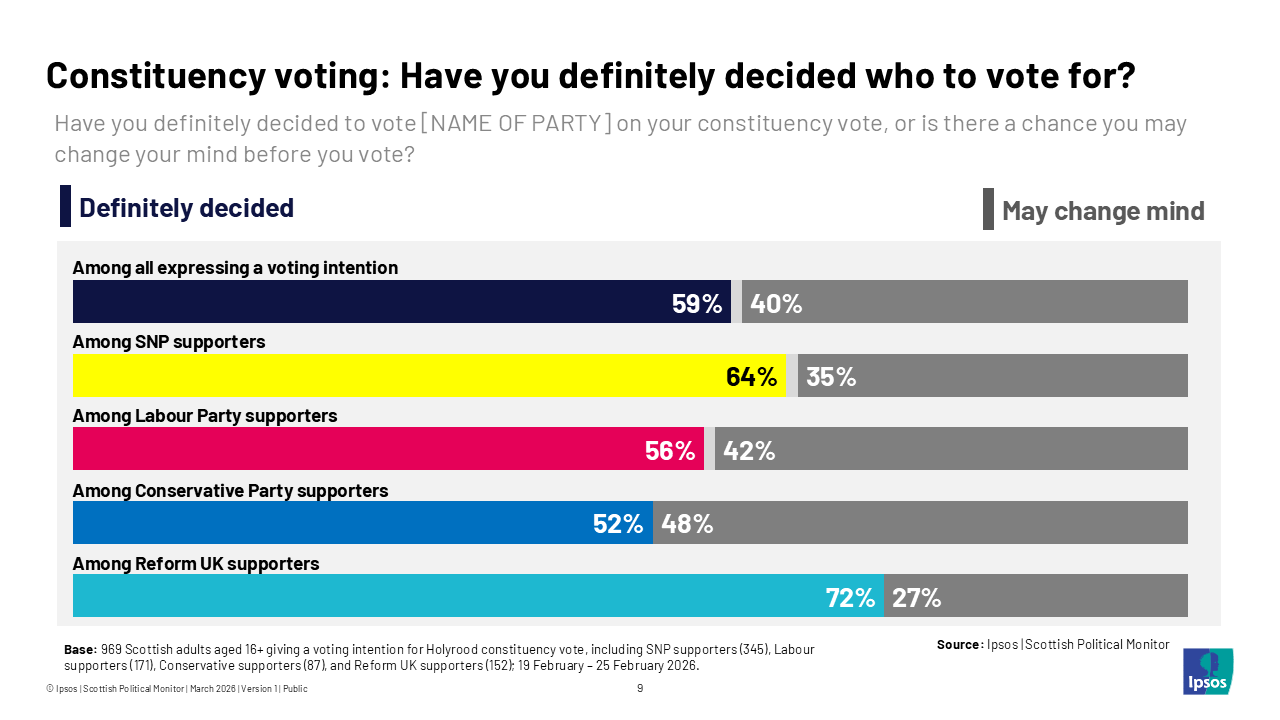
- Those who currently say they’ll vote Reform UK or SNP are surer of their vote than those currently planning to vote Labour, Conservative or Liberal Democrat.
- Labour voters who may change their mind are most likely to consider the Liberal Democrats, SNP or Scottish Greens, while SNP voters who may change their mind are most likely to consider the Scottish Greens or (to a lesser extent) Scottish Labour.
- On the evidence of this poll, the Scottish Greens and Liberal Democrats are the parties that may be set to benefit most if voters do change their minds. Among those who may change their mind, 24% are considering the Scottish Green Party, 21% the Liberal Democrats, 16% Scottish Labour and 14% the SNP, with 11% considering an independent candidate, 8% the Scottish Conservatives and 7% Reform UK.
Key issues for voters
Healthcare/the NHS is seen as the top issue helping voters decide which party they’ll vote for (56%). This is followed by inflation/the rising cost of living (35% - down 6 points compared with Ipsos’ previous poll in December), the economy (27%), immigration (25% - down 5 points), and Scottish independence/devolution (24%). Immigration is particularly important to Reform UK supporters (74%) and to a lesser extent, to Conservative supporters (34%), while Scottish independence is particularly important to SNP supporters (51%).
The SNP is seen as the most trusted party to manage the NHS in Scotland (28%), grow Scotland’s economy (27%), manage education and schools (27%), have the right policies on taxation (24%) and tackle the cost of living crisis (23%). 23% of the public trust the SNP most to have the right stance on immigration, while 21% trust Reform UK most on this issue. Almost three in ten (29%) say they do not trust any of the political parties to act with honesty and integrity.
Views of political leaders
None of the party leaders asked about in the poll is rated positively overall by the public. As in Ipsos’ previous poll, First Minister John Swinney is the least poorly rated, with 35% of the public saying they are satisfied with his performance and 51% that they are dissatisfied – a ‘net’ satisfaction rating of -16. Scottish Labour’s Anas Sarwar’s approval ratings are at a similar level to three months ago, with 24% of the public satisfied with him and 53% dissatisfied - a net satisfaction rating of -29. Meanwhile, around one in three Scots don’t know enough to rate Reform UK Scotland leader Malcolm Offord, Scottish Green co-leaders Gillian Mackay and Ross Greer, or the Conservatives’ Russell Findlay.
Prime Minister Keir Starmer’s approval ratings, although still very low, have rallied a little this wave. Just under three quarters of the Scottish public (73%) are dissatisfied with him and 18% satisfied – giving a net satisfaction rating of -55, compared with -63 in Ipsos’ previous poll in December. As in December, almost three times as many Scots are dissatisfied (62%) as are satisfied (21%) with Reform UK’s Nigel Farage, giving a net rating for him of -41.
Views on Scottish independence
The Scottish public remain divided on the constitutional question, with 51% of those likely to vote either Yes or No in an immediate referendum saying they would vote Yes and 49% that they would vote No.
Emily Gray, Managing Director of Ipsos in Scotland, commented:
The SNP have most reason to be pleased with these new results, which show them maintaining their polling lead two months out from the Holyrood election. While Scottish Labour’s constituency vote share has increased slightly compared with three months ago, Labour also look more vulnerable than either the SNP or Reform UK to their voters switching to support other parties. With four in ten voters saying they may change their minds, much may still shift once the parties begin their election campaigns later this month.
Notes to Editor:
- For further information, please contact Jordana Moser on [email protected]
- For the full findings of the poll please visit the Ipsos website: www.ipsos.com
- Ipsos interviewed a representative probability sample of 1,096 adults aged 16+ across Scotland, via the Ipsos UK KnowledgePanel. Data was collected online between 19th and 25th February 2026.
- Panel members are recruited via random probability sampling, by sending letters to randomly selected addresses, which invites them to join an online panel. This approach means every household in the UK had a known and non-zero chance of being selected to join the KnowledgePanel. Those who are digitally excluded are provided with a tablet and free, restricted data connection. A sample of 2,128 panellists aged 16+ in Scotland were invited to take part in the survey. The sample was stratified by age, qualifications and vote at the 2024 general election. The achieved sample was weighted in two stages:
- Design weights were applied to correct for the unequal probabilities of a person being selected for a survey, notably residents in smaller households have a higher chance of being selected.
- Calibration weights were applied through rim weighting to correct for differential non-response. Data was weighted to the adult population profile on age and gender, Scottish Parliament region, ethnicity, qualifications, work status and work sector (public sector/other), social grade, area deprivation, number of cars in household, and newspaper readership (print and digital). Population targets were obtained from the 2022 Census, ONS population estimates and other large-scale probability surveys.
- As the election approaches we are continuing to keep our methodology under review so that this gives results that are as accurate as possible. While Ipsos’ polling was overall highly accurate at the 2021 Scottish Parliament election, our final poll slightly overestimated the Scottish Greens on the regional list vote. As an experiment, in this survey half the sample was prompted with the Scottish Green Party on the regional list voting intention question as previously, while half the sample was not. Our initial findings suggest that prompting for the Scottish Green Party on the regional list makes little difference (around 1 percentage point) to the published Green figure, and we will carry out further analysis on this ahead of our next poll.
- All polls are subject to a wide range of potential sources of error. On the basis of the historical record of the polls at recent general elections, there is a 9 in 10 chance that the true value of a party’s support lies within 4 points of the estimates provided by this poll, and a 2 in 3 chance that they lie within 2 points. This is especially important to keep in mind when calculating party lead figures.
- Where results do not sum to 100%, this may be due to computer rounding, multiple responses, or the exclusion of “don’t know” categories.


