“Cost of Living” the top concern driving voters to the polls in English Local elections
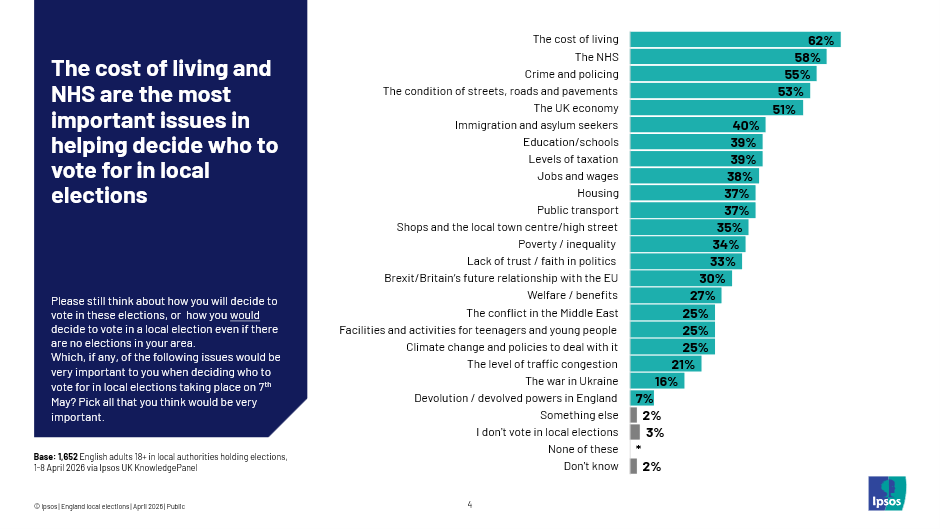
- Public voting on a range of national and local issues but 62% say cost of living the top issue deciding their vote.
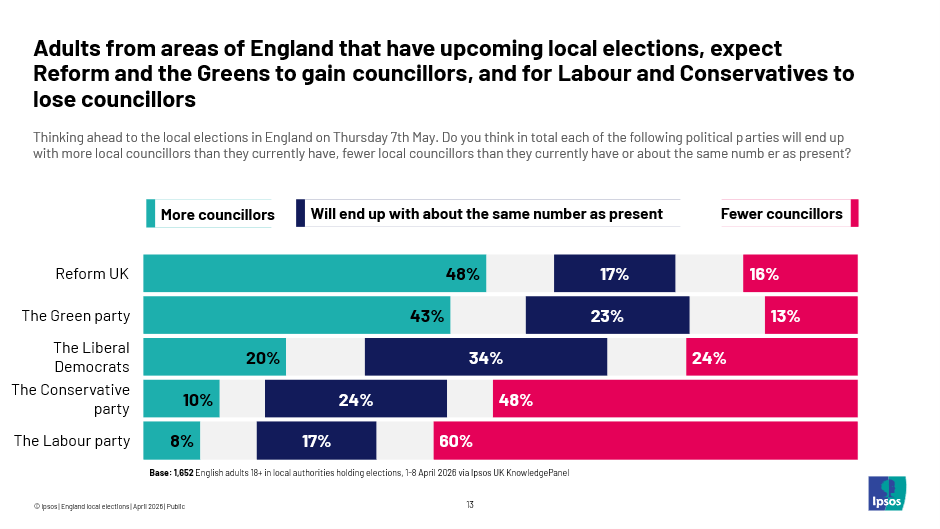
- Voters expect Reform (48%), Greens (43%) to increase number of councillors held in England next month.
- In London, 51 % of voters think the Green party will have more councillors after May, and 57% saying they expect Labour to have less.
Driving voters’ decisions in local areas with elections in England
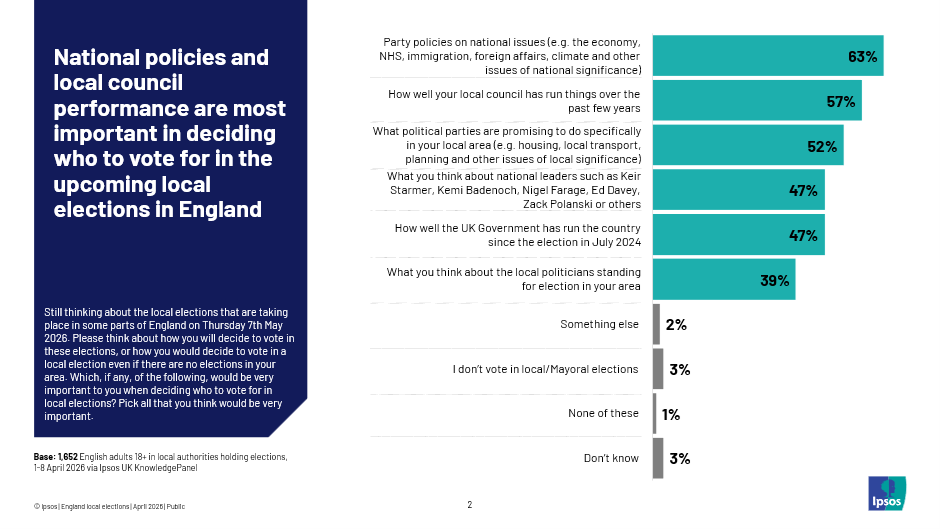
The cost of living (62%) is cited as the top factor in their mind when casting their vote in England’s local elections in May, followed by the NHS (58%), alongside crime and policing (55%).
That comes as the public in England say it is a mix of national and local factors guiding their vote at the upcoming local elections. The public say policies on national issues (63%) are important in deciding their vote, as well as how well their local council is run (57%).
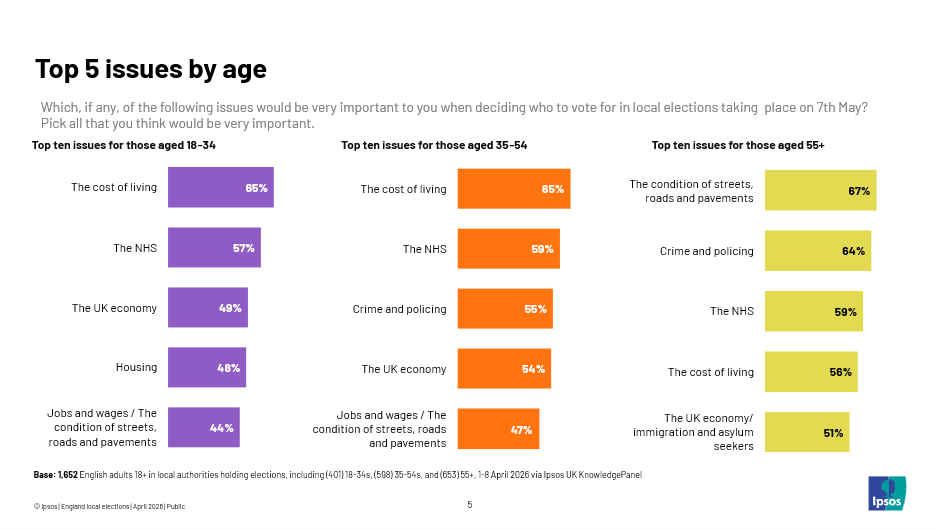
Voter priorities vary by age. Those aged under 35 prioritise the cost of living, NHS, economy and housing whereas those aged 55+ are more concerned with the condition of streets, roads and pavements, crime and policing. Though the NHS and cost of living are important for this group too.
State of public services
- 73% of adults in England where local elections are taking place think public services in England overall have got worse in the past 5 years. 9% say they have got better.
- Meanwhile, 55% think services in their local area have got worse in the past 5 years and 12% say they have got better.
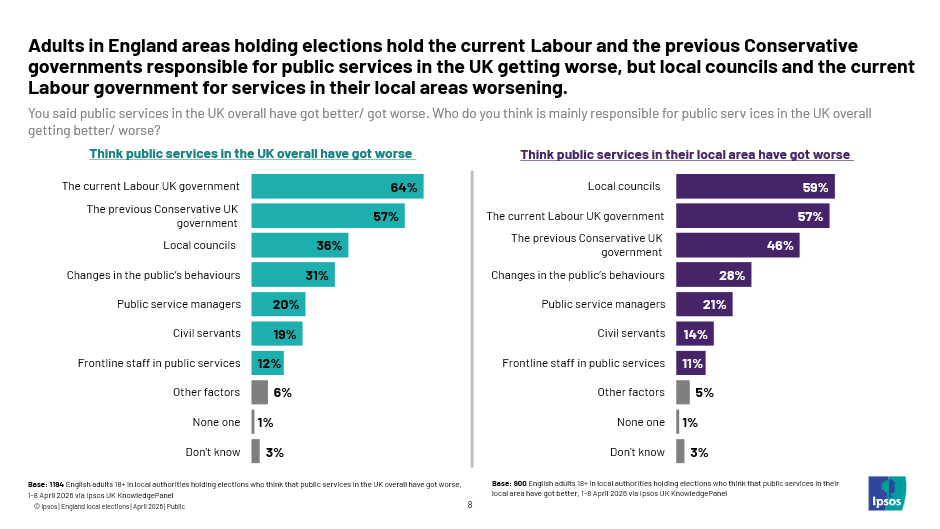
- For those who feel their public services have worsened both nationally and locally, the current Labour Government and previous Conservative government attain a significant proportion of the blame, but when it comes to local areas services worsening – incumbent Councils come out top as to blame (59%) alongside the current Labour government (57%).
Greens and Reform
That presents an opportunity for smaller parties, including the Greens and Reform – where the public continue to expect them to gain councillors. 48% expect Reform UK to gain councillors in May and 43% expect the Greens to gain too. Meanwhile, 6 in 10 expect Labour to have fewer councillors after these elections and 48% say the same about the Conservatives.
In London, we find that the Greens are being considered by almost over half (49%) of voters in the capital, where Labour potentially faces a significant challenge in its natural base.
Of the findings, Keiran Pedley, Director of Politics at Ipsos in the UK said:
This is shaping up to be a “Cost of Living” election poll in May, with the NHS and policing top of local voter’s concerns. Although the performance of their local council matters to voters too.
“The traditional big two of Labour and the Conservatives are both unpopular and widely blamed for the state of public services in England today – which most think have got worse in the past five years.This provides an opportunity when it comes to local battles for both the Greens and Reform who the public already expect to increase the number of local councillors.
That is especially in London where we have found almost half of the capitals voters considering voting for the Greens in a city which has long been a Labour stronghold.”
Technical note
- For media queries, please contact Owen Evans at [email protected] or 07814211915.
- For the full findings, please visit the Ipsos website.
Ipsos interviewed a representative probability sample of 1,652 English adults aged 18+ in local authorities where there are local elections in England in May. Interviews took place online via the Ipsos UK KnowledgePanel. Data was collected between the 2nd and 8th April 2026.
Panel members are recruited via random probability sampling, by sending letters to randomly selected addresses, which invites them to join an online panel. This approach means every household in the UK had a known and non-zero chance of being selected to join the KnowledgePanel.
Those who are digitally excluded are provided with a tablet and free, restricted data connection. A sample of 3,701 adults aged 18+ in English local authorities having elections in May were invited to take part in the survey. The sample was stratified and weighted to population figures on age and gender, Government Office region, ethnicity, qualifications, IMD quintile, the number of adults in the household and 2024 General Election vote. Population targets were obtained from the 2021/22 Census, ONS population estimates and other large-scale probability surveys.