
Glasgow Citizens’ Assembly Report on the Climate Emergency
Glasgow City Council declared a climate and ecological emergency in May 2019, with a target to become a net zero city by 2030. As hosts of the UN Climate Change Conference known as COP26, Glasgow has the opportunity to showcase its commitment to reaching net zero on a global stage and catalyse efforts towards this ambitious target. To succeed, Glasgow will need everyone’s participation. The city council commissioned Ipsos to design and facilitate a Citizens’ Assembly to hear from people living across the city and understand how the city can work together to become a net zero city in a way that is inclusive, fair, and respectful to everyone.
We brought together a diverse and representative group of 50 Glasgow residents to learn, deliberate and discuss how the city can make a ‘just transition’ to net zero by 2030 through a mix of expert presentations, question and answer sessions, and small group discussions. By the end of the process, members produced 15 recommendations for the city council.
The recommendations
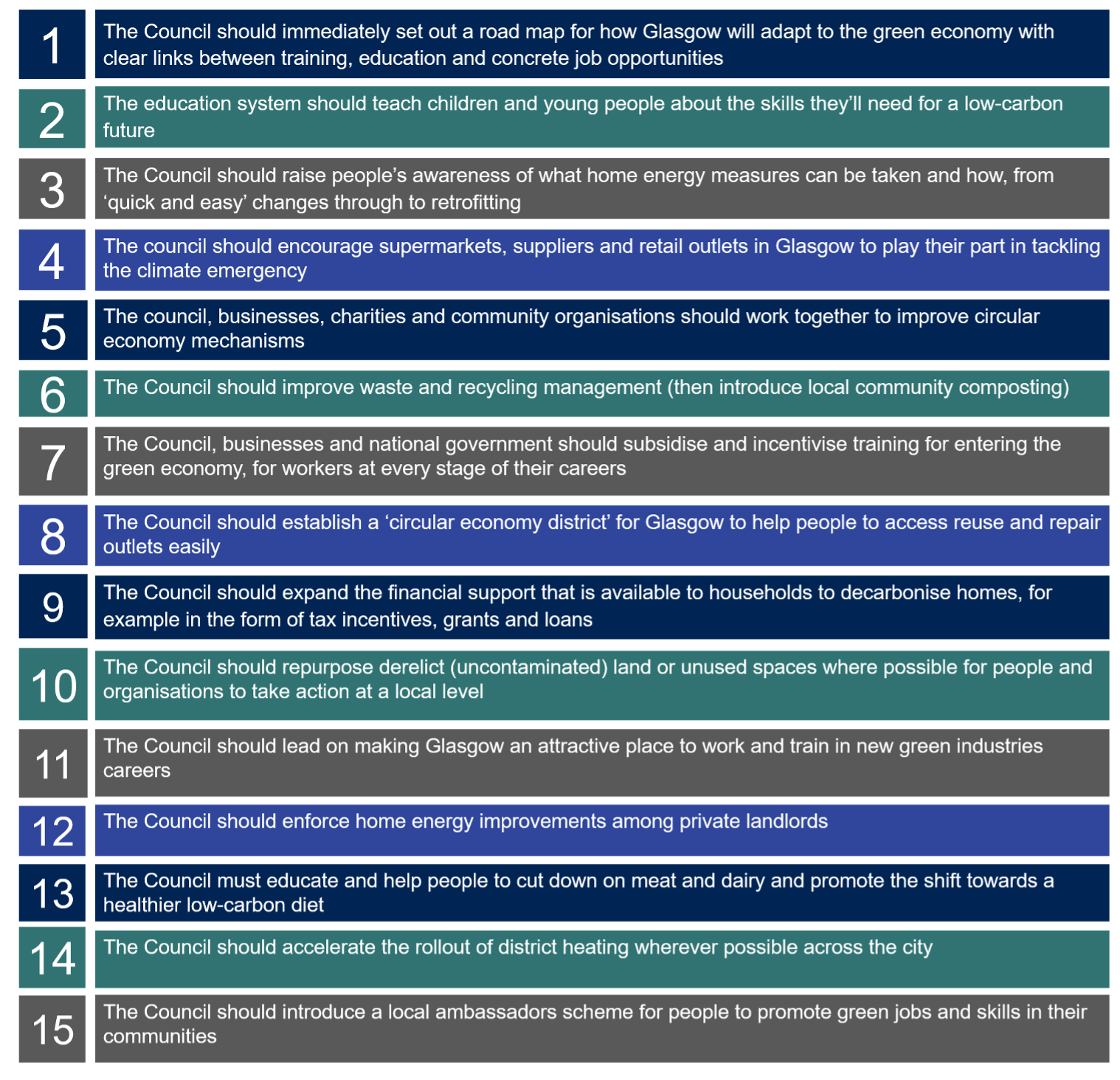
The assembly’s 15 recommendations focused on the four topic areas of the assembly, which were: the circular economy; green economy, jobs and skills; home energy; and food and diet. The assembly’s 15 key recommendations, ranked in the assembly’s own order of priority, are shown below. Please note that the rankings should be seen as a guide to the relative importance of each recommendation, but all were seen as important and necessary by the assembly to help Glasgow make a ‘just transition’ to net zero by 2030:
Reflections on the recommendations
Accompanying each recommendation were a series of assumptions, ideas and conditions that the assembly felt should be considered. Members also gave each recommendation a score to represent the level of impact they thought each would have towards reducing the city’s emissions. The supporting text and average impact scores can be found in the summary report. It is important to note that, while the recommendations above are listed in order of preference as agreed by the assembly collectively, individual priorities were diverse, with some recommendations - such as the reduction of meat and dairy or the introduction of local ambassadors - drawing mixed views and sparking deliberation over how they could be implemented in practice. However, the assembly as a whole considered these to be relevant and impactful interventions towards Glasgow’s net zero ambitions.
Technical note
- The assembly was held online. The sessions each lasted 3 hours and were scheduled on a mixture of weekday evenings and weekends. All five sessions took place in August 2021. Additional measures were put in place to support members as required to ensure they could participate fully in the process. This included one-to-one zoom sessions prior to the sessions, provision of laptops and/or dongles, and language support.
- The final two sessions made up the deliberation and recommendation-forming stage of the assembly. Members were given the opportunity to reflect on what they had learned, and finally to deliberate, develop and rank their final recommendations.
- At the beginning of each session, assembly members gathered in plenary for introductions and expert presentations. They subsequently moved between the main plenary session and smaller breakout discussion groups of 5-7 assembly members a number of times during each session. Discussions within the breakout groups were facilitated by experienced moderators from Ipsos. Professional note-takers were also assigned to each group to transcribe the discussions.
- Recruitment was conducted by the Sortition Foundation, which specialises in bringing together randomly selected, representative groups of people. In line with best practice, assembly members were recruited through a stratified random process, creating a group of 50 people reflecting the demographics of the city’s population. A range of selection criteria were applied including gender; age; ethnicity; long-term illness or disability; area of the city; and attitudes towards climate change. A more detailed breakdown of Assembly demographics can be found in the summary report.
- A full technical report can be accessed at the bottom of this page.


