Half of Britons deem nation 'ungovernable' but hold politicians more responsible than the public
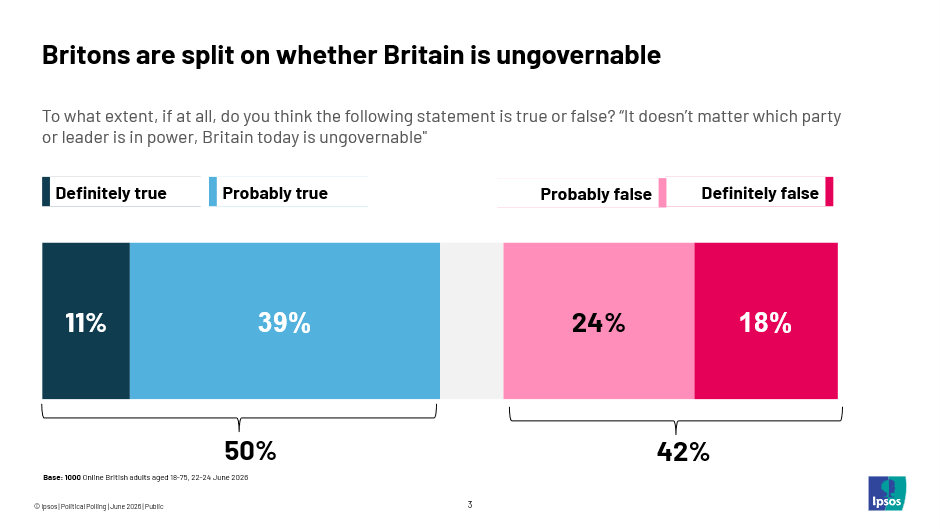
• Britons are split on whether the country today is ungovernable, regardless of which political party or leader is in power, with half (50%) agreeing and 2 in 5 (42%) disagreeing.
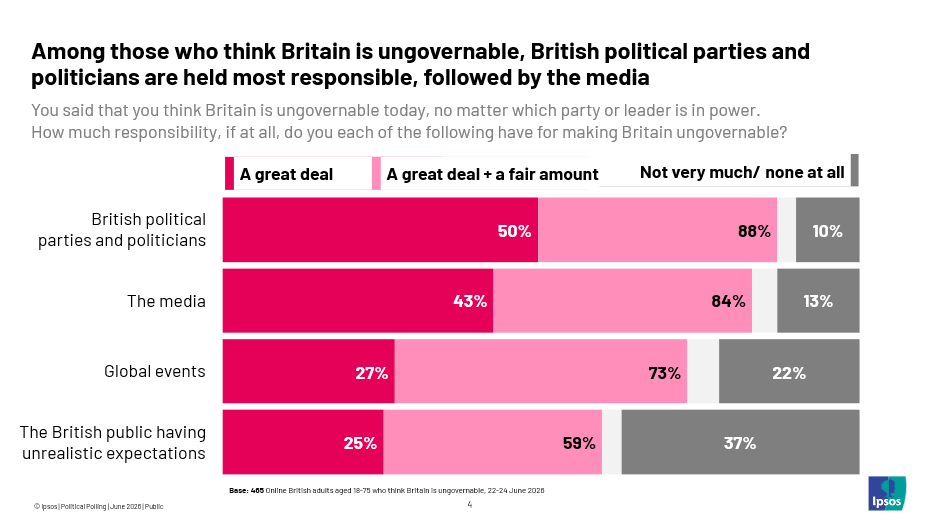
• Among those who think Britain is ungovernable, 88% think political parties and politicians hold responsibility, followed by 84% mentioning the media; 59% say unrealistic expectations on the part of the public are also responsible
• Over half of the public (55%) support introducing a law that would mandate an immediate General Election if the governing party changes its leader during a parliament.
• Many anticipate that a new Labour Prime Minister will make no difference to their life personally (52%) or their local area (56%)
Is Britain ungovernable - and who is to blame?
• 50% of Britons state that the sentiment "it doesn't matter which party or leader is in power, Britain today is ungovernable" is true, compared to 42% who believe it is false.
• Among those who view the country as ungovernable, nearly 9 in 10 (88%) place a great deal or a fair amount of the responsibility on British political parties and politicians.
- Broad blame is also directed at external and cultural forces, with 84% holding the media responsible, 73% pointing to global events, and 59% blaming the British public's own unrealistic expectations.
- With the Labour party embarking on an internal selection process to choose the UK's next Prime Minister, some have suggested legislation to build in constitutional guardrails for this situation.
- Just over half (55%) would support a law that requires a General Election to be called automatically if the party in power switches its leader during a parliamentary term. Levels of support vary from 45% of Labour 2024 voters to 76% of Conservatives and 83% of 2024 Reform UK voters
- Conversely, 1 in 5 people (18%) would oppose such legislation, with an equal share 20% remaining neutral.
Cynicism clouds the outlook for a new Prime Minister
The public mood surrounding the impending transition of power inside Downing Street is characterised by apathy rather than optimism.
• 45% of the public believe a new Labour Prime Minister will make no difference to the quality of British public services, with the remainder divided between expecting a positive impact (24%) and a negative one (22%).
• 38% state a change in leader will make no difference to the overall state of the country, with the rest split between positive (23%) and negative (28%) expectations. This feeling is further mirrored in the 37% who think a change in leader will make no difference to the economy.
• Personal expectations are even flatter, with 52% expecting no personal impact on their life, and 56% predicting little change to their local area.
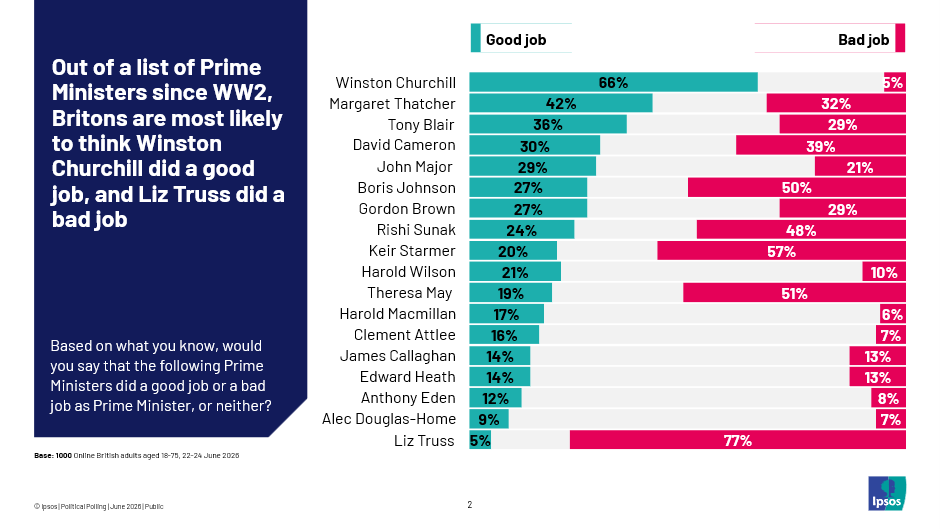
• This low-bar expectation matches the public appraisal of Keir Starmer's legacy; just 20% of Britons state that Starmer did a "good job" as Prime Minister, compared to 57% who brand his tenure a "bad job". For context out of post-WW2 leaders, Winston Churchill tops the list at 66% "good job", while Liz Truss sits at the bottom with a 77% "bad job" rating.
Commenting on the findings, Gideon Skinner, Senior Director of Politics at Ipsos in the UK said:
Keir Starmer's sudden departure highlights the public’s fatigue with the way Britain’s system of government is working. Many years of frustration with the state of the country is leading to a crisis of faith in the political machinery itself, regardless of who sits in Downing Street. Britons think this is a home-grown issue just as much if not more than being purely the result of external, global forces, with most of the blame laid at the actions of domestic political parties and politicians of all stripes, followed by the media. However, there is also some limited recognition of the role of unrealistic expectations from the public themselves – which suggests some awareness of the need to engage voters in the trade-offs the country now faces.
While Keir Starmer’s legacy as PM is viewed negatively, the immediate public reaction has not been a surge of optimism for a fresh start. Rather the mood is more reserved, with many expecting a new leader to deliver little tangible difference to their bank accounts, their local streets, or the state of public services.
This sets a tough challenge for the incoming Labour leader. Their task goes much further than Westminster, with the need to deliver real, tangible improvements to the economy and public services, all while finding a way to fundamentally rebuild public trust and prove to a weary electorate that the country can, in fact, be governed successfully.
Notes:
• Ipsos interviewed a representative sample of 1,000 online British adults aged 18–75. Polling was conducted online between 22–24 June 2026.
• Data are weighted to match the profile of the population. All polls are subject to a wide range of potential sources of error.