Labour leads Reform UK by three points
- Andy Burnham preferred to Nigel Farage and Kemi Badenoch as PM.
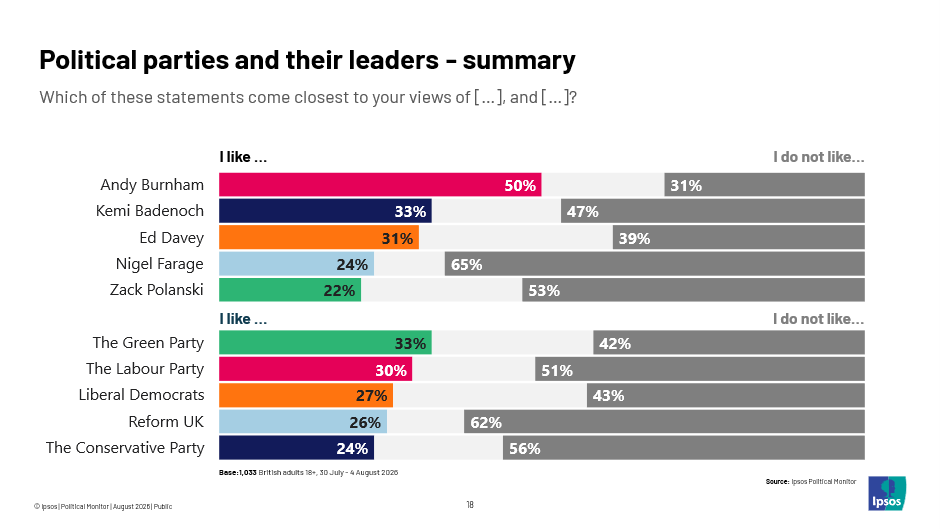
- Burnham better liked than opposition party leaders and the Labour Party.
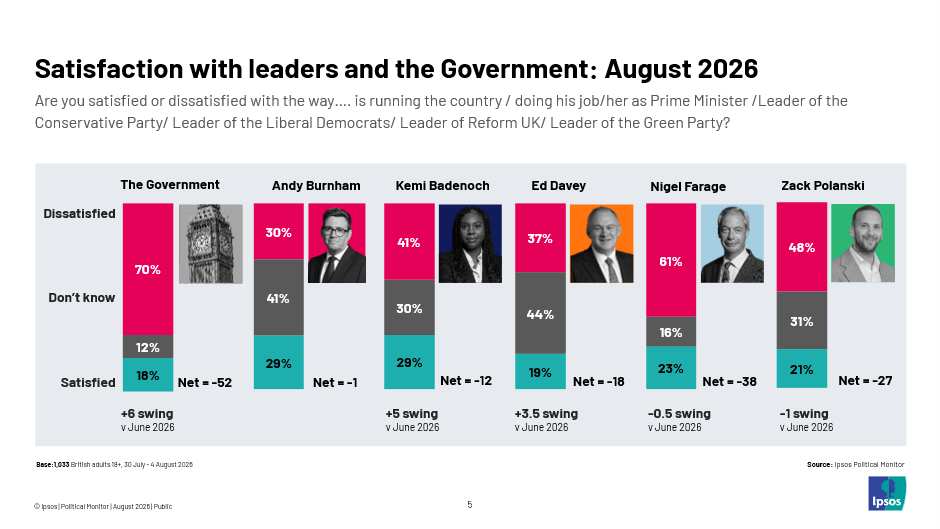
- Yet 7 in 10 remain dissatisfied with how government is running the country and 4 in 10 don’t have a view on how Burnham is performing as PM.
New polling data from Ipsos in the UK, conducted 30th July – 4th August 2026, shows Labour taking a three-point lead over Reform UK (albeit still within the margin of error). Andy Burnham is preferred as Prime Minister to Nigel Farage and Kemi Badenoch and is more liked than both opposition leaders and the Labour Party itself. Meanwhile, clear majorities disagree that Reform UK and the Conservatives are ready for government. Yet with 7 in 10 dissatisfied with the way the government is running the country and 4 in 10 saying they don’t have an opinion on how Andy Burnham is doing as Prime Minister, how public opinion may evolve in the near future remains to be seen.
Labour takes the lead
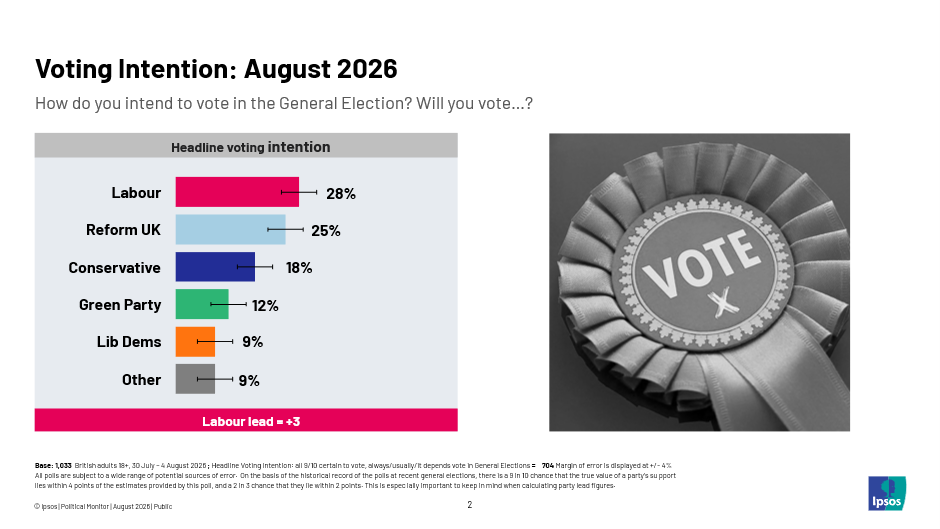
- 28% say they will vote Labour at the next General Election (+4 from June), 25% say Reform (-1). 18% say the Conservatives (no change), 12% say the Greens (-1) and 9% say the Lib Dems (-2).
This is Labour’s best position in Ipsos polling for over a year.
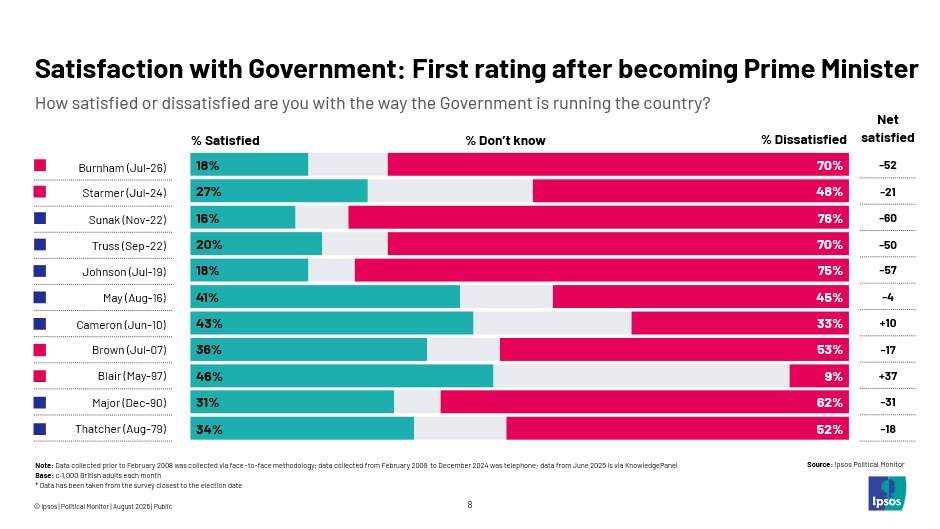
- However, 7 in 10 are dissatisfied with how the government is running the country (-8ppts since last month). Just 18% are satisfied (+4ppts). This is a more negative public starting point than the average for new governments in Ipsos records (for example, 27% were satisfied in Keir Starmer’s first month after winning the 2024 election). In fact, it is very similar to the position when Liz Truss become PM in September 2022, and only slightly worse than when Rishi Sunak and Boris Johnson became PMs in November 2022 and July 2019.
- Furthermore, 52% disagree that the current government is competent. This has fallen 11 points from a month ago. However there has been no increase in the 19% who agree it is competent– opinion is moving to a more undecided position.
Burnham compared to past PMs
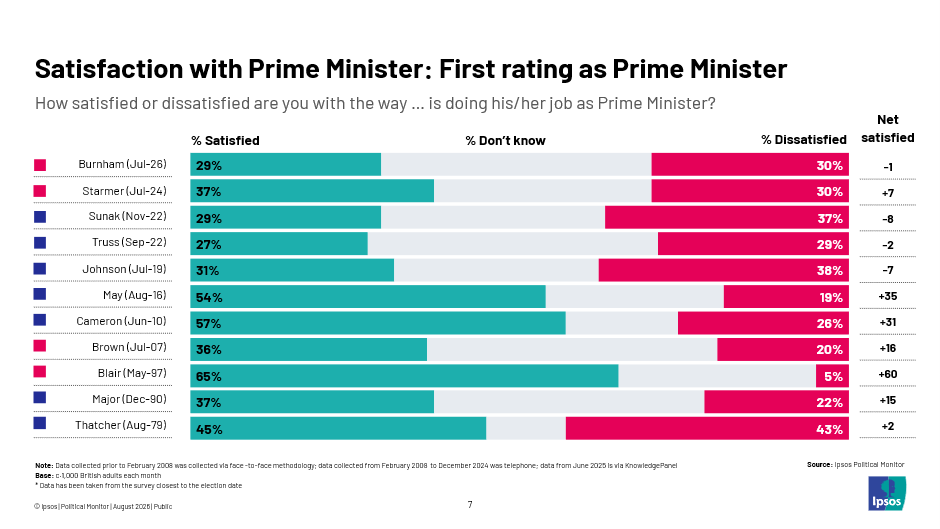
Andy Burnham’s first satisfaction rating with Ipsos is lukewarm compared to past PMs. The 29% satisfied with the way he is doing his job is actually less than Keir Starmer in his first month (37%) and the same as Rishi Sunak. Theresa May (54%), David Cameron (57%) and Tony Blair (65%) all had clear majorities satisfied when they began. With Andy Burnham 41% say they don’t know how they feel, 30% are dissatisfied.
Opposition parties fail to capitalise as dissatisfaction rises
While the government faces continued public criticism, opposition parties have yet to secure a definitive breakthrough with the British electorate.
- Kemi Badenoch does register a sharp fall in dissatisfaction (but not an increase in satisfaction). 29% are satisfied with the job she is doing as Conservative leader (+1) but 41% are dissatisfied (-9).
- Nigel Farage is the most unpopular opposition leader. 23% are satisfied with the job he is doing (-3) and 61% are dissatisfied (-2).
Meanwhile 19% are satisfied with the job Ed Davey is doing as leader of the Lib Dems (37% are dissatisfied) and 21% are satisfied with the job Zack Polanski is doing as leader of the Greens (48% are dissatisfied).
- The public is sceptical of how ready the opposition parties are for government. Only 1 in 5 British adults (21%) believe Reform UK is ready to form the next government —a drop from 25% in January and 29% last September. 64% currently disagree Reform UK are ready (little changed over the month but +11 points from September).
- Similarly, just 16% agree that the Conservative Party is ready for government, 57% disagree but this is down from 64% in September.
- Meanwhile, 48% disagree Kemi Badenoch is ready to be PM (21% think she is). 65% disagree Nigel Farage is ready to be PM and 21% think he is. Figures for both are little changed over the month, though Badenoch’s position has improved by 5ppts since January.
Andy Burnham leads preferences for Prime Minister and is seen as more likeable than counterparts in other parties
- In a forced choice on who would make the most capable Prime Minister, 36% say Andy Burnham (+6 from June), more than double the 15% who choose Nigel Farage or the 13% who select Kemi Badenoch.
- Overall, 50% like Andy Burnham and 30% like the Labour Party. Burnham is therefore more liked than opposition leaders Badenoch (33%), Davey (31%), Nigel Farage (24%) and Zack Polanksi (22%) as well as the Labour Party itself. It also makes him as liked as Keir Starmer was when he took over as Labour leader in 2020, but the party itself is still much less liked (-20ppts since September 2020).
- Kemi Badenoch is more liked than in January (+6ppts), and more than her party (33% vs 24%) whereas the leaders of Reform and the Liberal Democrats and their parties have similar levels of likeability to each other. For example, 24% like Nigel Farage and 65% do not compared to 26% and 62% respectively for Reform UK as a party. Zack Polanski is now notably less liked than the Green Party, at 22% vs 33% - 14% say they like the party but not its leader, more than the figure for any other party and its leader.
Commenting on the findings, Gideon Skinner, Senior Director of Politics at Ipsos in the UK said:
These findings confirm Labour are benefiting from changing their leader, with their best position in Ipsos polling for over a year. However, while Andy Burnham is clearly much more personally liked than his predecessor was at the end of his term (and more than the opposition party leaders, who typically the public don’t yet see as ready to replace him), at the moment his position can be seen as part benefit of the doubt and part jury is still out.
Although Labour has received a boost in voting intentions (partly thanks to more of their 2024 base returning to the fold), many of the underlying issues remain. The Labour party itself is still less liked than it has been for most of the last 20 years, and 7 in 10 are still dissatisfied how the country is being run overall - the ongoing pessimism of recent times has dampened public enthusiasm that a new PM will be able to quickly turn around the direction of the country. For the moment we are seeing evidence of Andy Burnham’s personal popularity, but for this to continue in the longer term the public will be looking for tangible evidence of improvements in their day-to-day lives.
Technical note
- For media queries, please contact the Ipsos in the UK Press Office at [email protected]
- For the full findings, please visit the Ipsos website.
Ipsos interviewed a representative sample of 1,033 British adults aged 18+ via the Ipsos UK Knowledge Panel. Polling was conducted online between 30 July – 4 August 2026. Panel members are recruited via random probability sampling, by sending letters to randomly selected addresses, which invites them to join an online panel. This approach means every household in the UK had a known and non-zero chance of being selected to join the KnowledgePanel. Those who are digitally excluded are provided with a tablet and free, restricted data connection. A sample of 2,207 adults aged 18+ were invited to take part in the survey. The sample was stratified by nation, age, qualifications and vote at the 2024 general election (as collected immediately after the election). The achieved sample was weighted in two stages:
- Design weights were applied to correct for the unequal probabilities of a person being selected for a survey, notably residents in smaller households have a higher chance of being selected.
- Calibration weights were applied through rim weighting to correct for differential non-response. Data was weighted to the adult population profile on age and gender, Government Office region, ethnicity, qualifications, work status and work sector (public sector/other), social grade (office coded), number of cars in household, constituency type, and newspaper readership (print and digital). Population targets were obtained from the 2021/22 Census, ONS population estimates and other large-scale probability surveys.
- All polls are subject to a wide range of potential sources of error. On the basis of the historical record of the polls at recent general elections, there is a 9 in 10 chance that the true value of a party’s support lies within 4 points of the estimates provided by this poll, and a 2 in 3 chance that they lie within 2 points. This is especially important to keep in mind when calculating party lead figures.
- Note that this is a new methodology implemented since June 2025. It involves a new form of data collection (online random probability panel instead of quota telephone survey), an updated voting intention (which involves prompting for Reform UK), and an updated weighting scheme. This is based on our learnings during and since the 2024 General Election. This means that comparisons with previous waves need to be made with caution.