
How to improve trust in business? Look beyond profits

Business leaders are now almost as distrusted as estate agents according to Ipsos’s Veracity Index. Only a third (34%) of the general public would trust business leaders to tell the truth, while more than half (57%) would not. Only a quarter (24%) would trust estate agents while politicians rank lowest on the scale, trusted by less than one in five (18%) of the public. In contrast, the top ranked are doctors, who would be trusted to tell the truth by around nine in ten (89%) British adults.
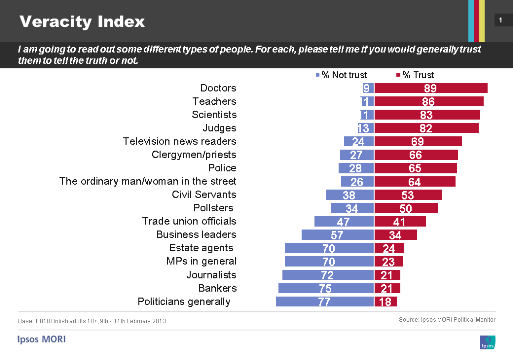
Yet, distrust appears to stretch beyond individuals and leaders to the wider corporate world. According to Ipsos’s annual Sustainable Business Monitor, seven in ten adults (70%) agree that both industry and commerce have lost the trust of the general public. And, company behaviour is still tarnished by the aftermath of the recession. More than half (56%) agree that they ‘generally trust large businesses less after the financial sector crisis’.
In addition to the on-going impact of the financial crisis, company profits appear to be driving further levels of distrust. When asked which issues most need addressing by companies, corporate tax avoidance (35%) and executive pay (34%) come top. Executive pay appears to be of greatest concern among over 55s, rising to almost half (46%) who cite it as an issue that needs addressing, compared to just three in ten (30%) 16 to 34 year olds.
These concerns have remained remarkably consistent over time, too. Concerns of both tax avoidance and executive pay have ranked top since they were first measured in 2008, suggesting that companies’ efforts to address these issues have had little impact on public perceptions. Whistleblowing also ranks third as an area to be addressed (20%), suggesting public scepticism that companies are committed to act when employees speak out about corporate wrong-doing.
Men and in particular, the Baby Boomers generation appear most cynical about business behaviour. Around one in three (29%) men strongly agrees that industry and commerce have lost the trust of the general public, compared to one in five (20%) women. Looking at generational differences, around three in four (76%) Baby Boomers agree that industry and commerce have lost the trust of the general public compared to just over half (55%) of 16 to 24 year olds among the Y generation. Baby Boomers are also more likely to harbour cynicism towards business, with around two in three (64%) in agreement that after the financial sector crisis, they generally trust large businesses less, compared to half (49%) of 16 to 34 year olds.
And, for a significant majority of the public, this distrust also extends to organisations’ corporate responsibility behaviour. Around seven in ten (68%) believe that large companies only invest in the environment and community initiatives to make themselves look better; the so-called ‘greenwash’ argument.
This is a risky tactic for businesses, as corporate responsibility is now an expectation for business among the public, who believe that profit should not be pursued at the expense of behaving responsibly. Men and those over 45 years old are in most agreement about this. Almost half of men (45%) strongly agree that it is possible for a company to both make a profit and behave responsibly, compared to around a third (36%) of women. And, around nine in ten (91%) 45 to 75 year olds agree that it is possible for a company to both make a profit and behave responsibly, compared to four in five (79%) 16 to 34 year olds.
In future, in order to be considered more trustworthy than the much-maligned estate agents and politicians and to reach levels of trust enjoyed by doctors in Britain, companies need to be seen to look beyond profits and demonstrate that their behaviour has changed since the financial crisis, that they are living up to expectations of financial responsibility and that their corporate responsibility activities are sincere.
Ipsos’s Sustainable Business Monitor runs annually.
Fieldwork was conducted in two parts:
- Online: 1,008 interviews among GB adults 16-75 were conducted online using our online Omnibus. Fieldwork dates were 13 to 18 August 2014. Data has been weighted to reflect the profile of the adult population (16-75) in terms of age, sex, social grade, region and work status.
- Face to face: An additional set of questions asked were conducted face to face for trend purposes. This was split into two surveys:
- 1011 interviews were conducted face to face via CAPIbus among GB adults 16+.
- 997 interviews were conducted face to face via CAPIbus among GB adults 16+.


