How worried are the public?
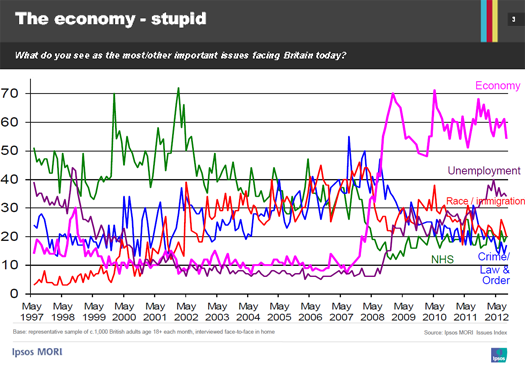
You worry about the NHS. I worry about the NHS. But most of the public don’t. Instead the general public is very clear on what the key challenge is facing Britain right now. The economy has been number one in the Ipsos Issues Index for 50 consecutive months and over the same period concern about unemployment has increased threefold. In contrast, despite plenty of excitement in the media, among the unions and professions and political parties, general anxiety about the NHS remains much lower than in the recent past.
In fact, in our tracking research, we have found that even at the height of the furore over the reforms last year, only 29% of the public claimed to know much about them. The figure under Labour was 26%. It’s true that those that claim to know something tend to think the reforms will make things worse rather than better, but satisfaction with the NHS as a whole remains high, although drifting down. Yet when you ask people to focus on the future, there is real anxiety.
A challenge for the government – indeed any government – is that the public are split over whether cuts to public services are necessary to reduce the deficit. They know there is a problem, but half are still not willing to countenance some of the measures needed to deal with it. And the proportion who are willing to cut the NHS (as opposed to the Aid budget) is very small. This is the difficulty for those trying to solve the Nicholson challenge. The NHS is a public service apart, one invested with more emotion and cultural significance than any other. It is something that politicians tamper with at their peril – they avoided closing effectively bankrupt and even dangerous local hospitals when money was more available.
So the concept of changing the way the NHS is funded, however it is done, is something people are very resistant to. This is something we are finding in the deliberative programme we are currently running with the King’s Fund looking at future funding options for the NHS (results to be published in early 2013). How do you start to communicate with the public about concepts as unpalatable as rationing, paying for more services or changing how we fund the NHS?
Recent data suggests that perhaps the public is becoming more realistic on NHS funding. Our latest wave of the Public Perceptions of the NHS, conducted for DH, shows that 58% of people agree that there should be limits on what is spent in the NHS, up from 44% in 2006. So there may be signs that we no longer see NHS funding as the bottomless pit that we once did. But, and it is a sizeable but, there is no indication that the full scale of the funding challenge is understood.
Given that the NHS is seen as one of the very best things about Britain by the public (ahead of everything except our heritage), it will take a very brave politician to start a public funding debate. But in a few years the debate will have to take place when the situation is worse than it is now: it may be that a moment of “crisis” will force the public to confront difficult choices – or it may just make them very cross indeed.