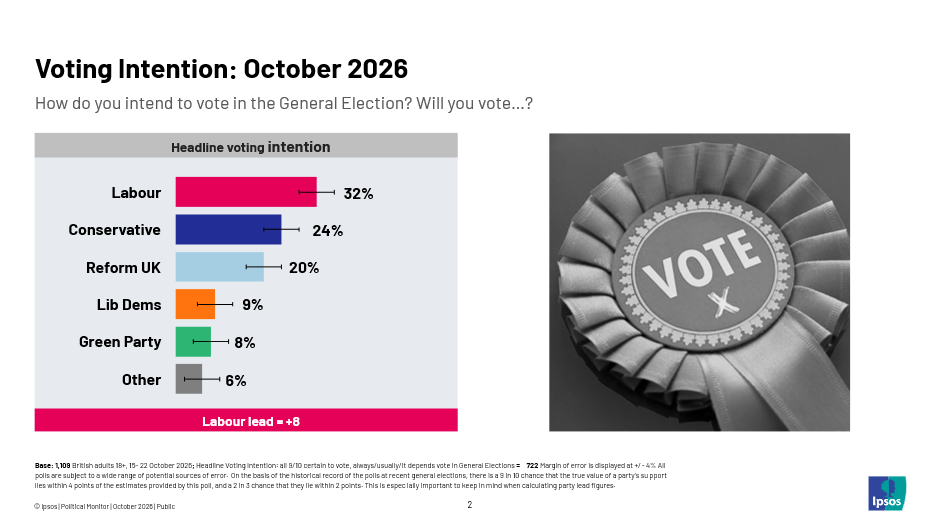
Labour now lead by 8 points with the Conservatives in second place in latest voting intention polling
- Labour on 32% – up 5 points from last month. Conservatives second on 24% (up 3 points). Reform UK down 3 points and Greens down 5.
- Largest Labour lead with Ipsos - and first time we have seen the Conservatives in second place - since June 2025
New polling data from Ipsos in the UK, conducted 15-22nd October 2026, shows Labour taking a 8-point lead over their nearest rival. This time that is the Conservatives rather than Reform UK. Elsewhere in the poll we explore whether the Conservatives and Reform UK are seen by the public as ready for government, whether the Labour government is seen to deserve re-election and which party is trusted on key issues.
Voting intention – Labour lead up to 9
- 32% say they will vote Labour at the next General Election (+5 from September), 24% say the Conservatives (+3), 20% say Reform (-3). 9% say the Lib Dems (+1) and 8% say the Greens (-5).
- Part of the reason the Conservative and Labour’s position is improving is because they are losing fewer voters to Reform and the Greens. The Conservatives are losing 16% of their 2024 vote to Reform versus 22% last month and Labour are losing 5% to the Greens versus 12% last month. Reform are losing 15% to the Conservatives versus 6% last month.
- 23% are satisfied with how the government is running the country (+5) and 66% are dissatisfied (down 4 points). The net satisfaction score of -43 is the highest recorded since Boris Johnson was Prime Minister (2022).
- 30% think the government deserves to be re-elected (+2 from Sept) and 47% disagree (+3). This is the highest level of agreement a government deserves to be re-elected since Boris Johnson was PM.
Leader satisfaction ratings
- 35% are satisfied with the job Andy Burnham is doing as Prime Minister (+4 from September), 45% are dissatisfied (-1).
- 35% are satisfied with the job Kemi Badenoch is doing as leader of the Conservative Party (+7), 39% are dissatisfied (-7). This is Badenoch’s highest satisfaction rating with Ipsos since becoming Leader of the Opposition.
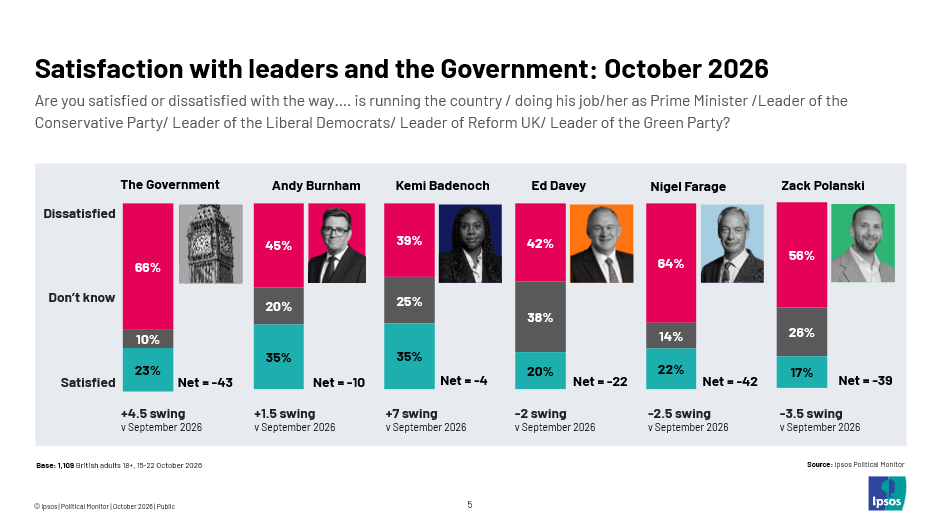
- Zack Polanski has seen a significant worsening of his satisfaction ratings. 17% are satisfied with the job Polanski is doing (-1 from Sept), 56% are dissatisfied (+6). This is the highest level of dissatisfaction since Polanski became leader.
- 22% are satisfied with the job Nigel Farage is doing as Reform UK leader (-2) and 64% are dissatisfied (+3).
- 20% are satisfied with the job Ed Davey is doing as leader of the Liberal Democrats (-3) and 42% are dissatisfied (+2).
Public remain sceptical other parties are ready for government – though the Conservative position is improving
- The public is sceptical of how ready the opposition parties are for government. Only 1 in 5 British adults (19%) believe Reform UK is ready to form the next government —a drop from 22% last month and 29% last September. 62% currently disagree Reform UK are ready (up 2 points from last months).
- 24% think the Conservatives are ready for government. This is up 4 points from last month and 8 points from August. 50% disagree. However, this number is down 4 points from last month, 8 points from June and 15 points from January.
Best party on key issues
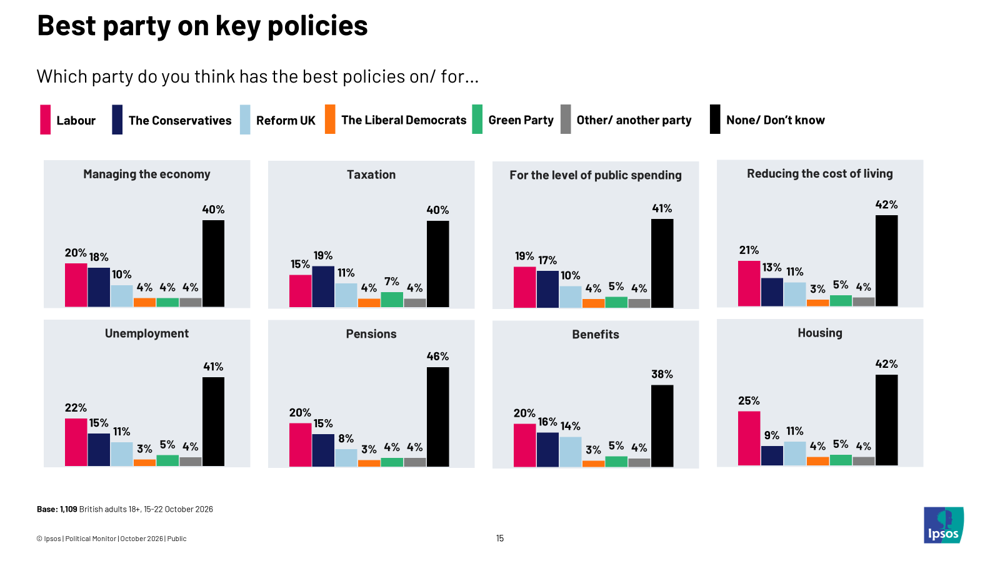
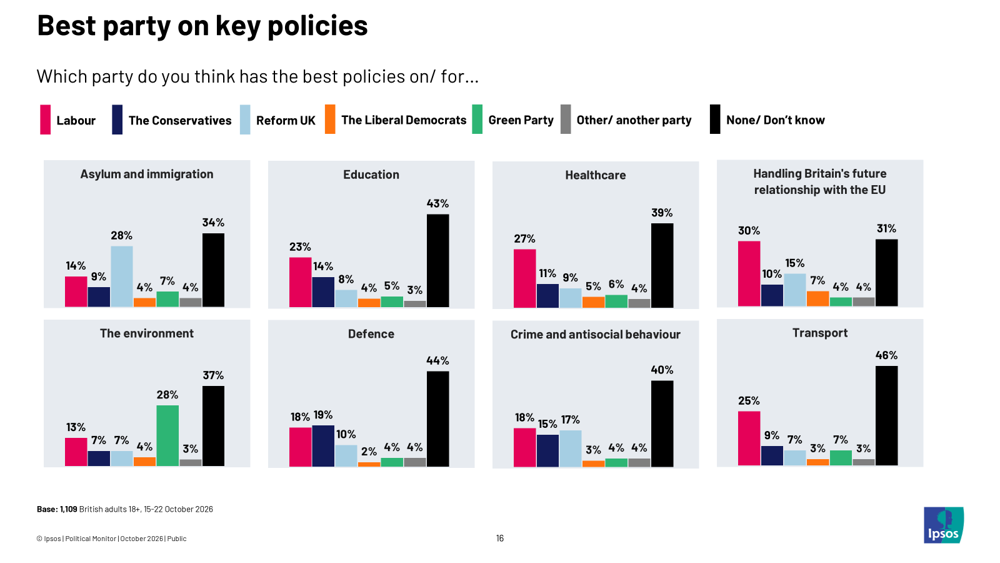
- Ipsos asked the public which party has the best policies on a range of issues. There were 16 in total.
- Our most recent Ipsos Issues index shows asylum and immigration, the economy, cost of living, healthcare and defence as the most important issues facing the country in the minds of voters.
- On asylum and immigration Reform UK leads Labour by 14 points (28% to 14%). Though last November Reform was on 35% and all other parties in single digits.
- On the economy Labour and the Conservatives are neck and neck (20% vs 18%) with Reform UK back at 10%. This position is markedly different to November 2025 where the Tories were on 17%, Reform 16% and Labour 10%.
- Labour leads on reducing the cost of living by 8 points. Labour on 21%, Conservatives on 13%, Reform UK on 11%. Labour also leads on healthcare by 16 points over the Conservatives (27% to 11%). Last November, Labour were in 4th place on the cost of living (Reform led Conservatives and Greens 18% to 10%) and were neck and neck with Reform on healthcare (14% vs 16%).
- On Defence the Conservatives and Labour are neck and neck with the Conservatives on 19% and Labour on 18% Reform are on 10%. Last November Reform were on 16%, the Conservatives 15% and Labour in 3rd on 12.
Commenting on the findings, Keiran Pedley, Director of Politics at Ipsos in the UK said:
Whilst the headline figures do show a striking change, they confirm a pattern we have been seeing in the underlying data for some time. The Labour Party under Andy Burnham is resurgent, consolidating voters on the left behind them. On the right, the tectonic plates have been shifting recently and now this is reflected in the Conservatives – not Reform UK – being in a clear second place. However, we should be mindful against overreacting to one poll. The Government faces a challenging budget this coming week and the lesson of the last year is the British politics is volatile. The picture today is very different to six months ago and it could be different again in six months time too.
Technical note
- For media queries, please contact the Ipsos in the UK Press Office at [email protected]
Ipsos interviewed a representative sample of 1,109 British adults aged 18+ via the Ipsos UK Knowledge Panel. Polling was conducted online between 15-22 October 2026. Panel members are recruited via random probability sampling, by sending letters to randomly selected addresses, which invites them to join an online panel. This approach means every household in the UK had a known and non-zero chance of being selected to join the KnowledgePanel. Those who are digitally excluded are provided with a tablet and free, restricted data connection. A sample of 2,316 adults aged 18+ were invited to take part in the survey. The sample was stratified by nation, age, qualifications and vote at the 2024 general election (as collected immediately after the election). The achieved sample was weighted in two stages:
- Design weights were applied to correct for the unequal probabilities of a person being selected for a survey, notably residents in smaller households have a higher chance of being selected.
- Calibration weights were applied through rim weighting to correct for differential non-response. Data was weighted to the adult population profile on age and gender, Government Office region, ethnicity, qualifications, work status and work sector (public sector/other), social grade (office coded), number of cars in household, constituency type, and newspaper readership (print and digital). Population targets were obtained from the 2021/22 Census, ONS population estimates and other large-scale probability surveys.
A two-part voting intention question is used with prompting on main parties (Conservative, Labour, Reform UK, Liberal Democrats, SNP in Scotland and Plaid Cymru in Wales). If a respondent indicates they will vote for ‘another party’ they see a second screen where they are prompted with the Greens, Restore Britain or another party that they write in. A follow-up ‘squeeze’ question is asked of those who are undecided or refuse the first question. Here all parties mentioned above are prompted on the same screen. A turnout filter is used based on two questions: current stated likelihood to vote (at least 9 out of 10 certain to vote) and previous voting behaviour (if they say they “always” or “usually” vote in general elections or that “it depends”).
All polls are subject to a wide range of potential sources of error. On the basis of the historical record of the polls at recent general elections, there is a 9 in 10 chance that the true value of a party’s support lies within 4 points of the estimates provided by this poll, and a 2 in 3 chance that they lie within 2 points. This is especially important to keep in mind when calculating party lead figures.
Note that this is a new methodology implemented since June 2025. It involves a new form of data collection (online random probability panel instead of quota telephone survey), an updated voting intention (which involves prompting for Reform UK), and an updated weighting scheme. This is based on our learnings during and since the 2024 General Election. This means that comparisons with previous waves need to be made with caution.