
Where did it all go wrong for Keir Starmer? And what lessons Andy Burnham should learn.
Keiran Pedley looks at Ipsos trend data to explore the two key stages in Starmer’s political demise with the public.
As Keir Starmer prepares to depart Downing Street, many are asking ‘how did it come to this’?
How did someone who won such a landslide majority in July 2024 end up being replaced two years later? How did it all go wrong so quickly?
Analysis of Ipsos data identifies two key time periods – the summer of 2024 and the autumn of 2025 – where Starmer’s fate was sealed.
More on that later. The first thing to acknowledge going in is that Keir Starmer did not enter office popular in the first place. This might seem counterintuitive given the scale of Labour’s victory in 2024, but when we look at Starmer’s leader satisfaction ratings with Ipsos before the 2024 election, we can see his net satisfaction rating then ( -19) was worse than other opposition leaders that had won General Elections and very similar to Ed Miliband’s -19 when he lost in 2015.
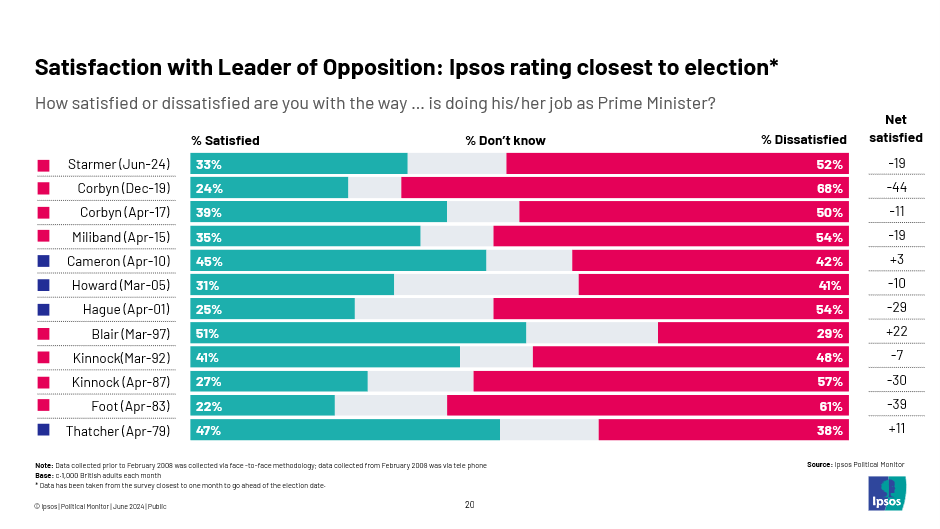
Starmer, of course, won when Miliband didn’t. He faced a much less popular government, in office in various forms since 2010 and a divided right. Though it should be acknowledged that he was able to persuade voters Labour was ready for government in 2024 in a way Miliband did not in 2015 and voters were much less hostile towards a Starmer led Labour government than they had been of one led by Jeremy Corbyn. To insinuate he somehow only won by default would be unfair.
And yet Starmer entered office not especially popular by historic standards with a public crying out for change and public trust in politics and the political process at a historic low. To keep a sceptical public on side he would have to start well.
Phase one: Honeymoon denied
This did not happen. Analysis of Ipsos Political Pulse data from July 2024 to the present day explores net favourability towards Keir Starmer and identifies two key stages where public opinion shifted decisively against him. The first was early in his premiership. Starmer started in July with a net favourability rating of +7 (40% favourable and 33% unfavourable). However, by October 2024 he’d fallen to -26 (26% favourable and 52% unfavourable).
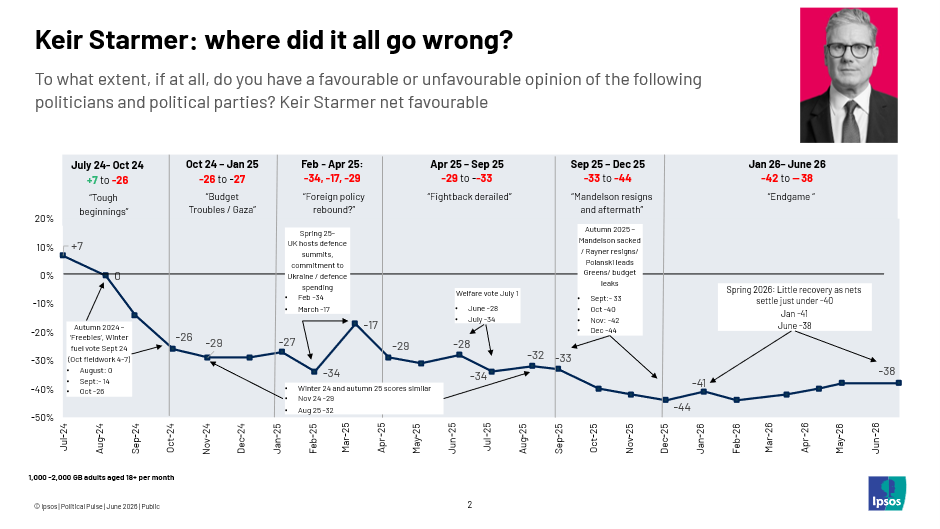
It is safe to say that Starmer’s government did not land well with the public.
The summer of 2024 gave way to riots, rows about the means testing of the winter fuel allowance, the so-called ‘freebies’ scandal and a general mood music out of the government that the UK’s public finances were in a worse state than expected.
Favourability towards Starmer fell fairly consistently across different voter groups.
Net favourability towards Starmer with 2024 Labour voters fell from +67 in July to +33 in October, net favourability with the ‘progressive bloc’ of 2024 Labour / Lib Dem / Green voters fell from +47 to +11 and net favourability with the ‘conservative bloc’ of 2024 Conservative and Reform voters – which had already started at -53 fell to -74.
Starmer’s overall net favourability rating in August 2025 of -32 (22% favourable and 54% unfavourable) was slightly worse but not hugely dissimilar to the -26 mentioned in October 2024. This despite significant controversy over his response to Israel’s war in Gaza – which would be a recurring problem for Starmer with younger progressives and Muslim voters – and economic policies such as the increase in NI contributions by employers.
Yet Starmer’s ratings went on a bit of a journey in that time nonetheless. Perceived Ukraine-related foreign policy successes in early 2025 saw his net rating increase to -17 in March, though if fell back soon after to -29 in April. There was a further dip in July to -34 (21% favourable, 55% unfavourable), which coincides with the Welfare vote earlier that month. Here net favourability was largely unchanged with progressives (+4 in June and +3 in July) but fell from -71 to -79 amongst the ‘conservative bloc’ of 2024 Conservative Reform voters. Starmer’s net rating with this bloc never recovered and stood at -77 in June 2026.
Phase two: 2025 the winter of Starmer’s discontent
It would be the autumn and winter of 2025 where Starmer’s ratings would take a further tumble. His net rating of -33 in September (21% favourable and 54% unfavourable) fell to -44 by the end of the year (17% favourable, 61% unfavourable). This fall would largely be driven by progressive voters deserting him rather than the conservative bloc that already had. Net favourability with 2024 Labour voters fell from +29 in August to -1 in December and fell from +10 to -11 with the broader progressive voter bloc of 2024 Labour, Lib Dem and Green voters in the same time.
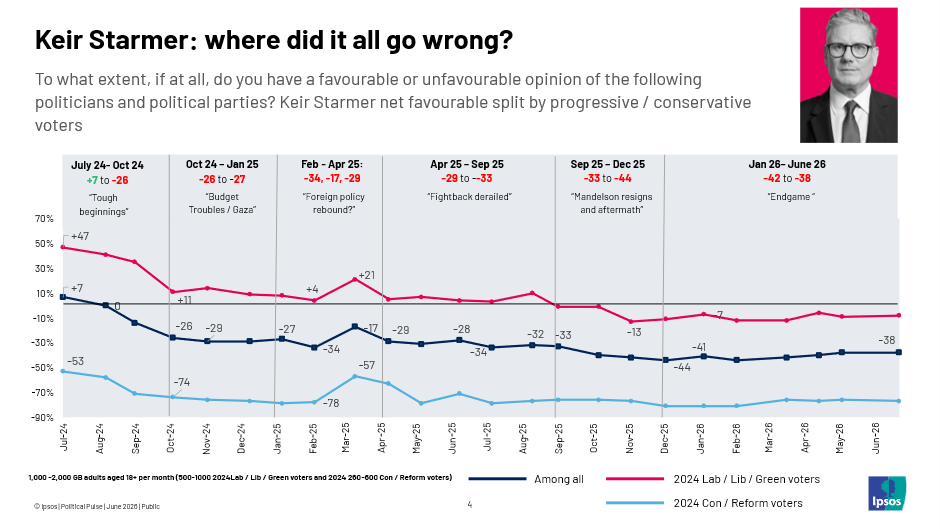
The period of August to December 2025 was clearly an intensely damaging one for Keir Starmer.
In September, Angela Rayner resigned, Peter Mandelson was sacked and Zack Polanski become leader of the Greens. The Labour Party looked inwards, with conference dominated by a Labour deputy leadership contest and Andy Burnham seemingly on manoeuvres. Persistent leaks ahead of the autumn statement in late November likely didn’t help.
All of which meant the political weather shifted markedly in the second half of 2025. Reform UK’s lead over Labour in our Ipsos political monitor grew from 9 points in June (34% to 25%) to 15 points in November (33% to 18%). The Greens share growing from 9% to 15% in that same period. Reform appeared to be consolidating support with immigration a growing concern in our monthly Ipsos Issues Index. Whilst the Greens under Polanski’s leadership were able to effectively tap into the disillusionment amongst more progressive voters at Labour’s expense. Something they would build on by winning the Gorton and Denton by-election this February and in a successful set of local elections in May.
End game and lessons for Burnham
In truth, Keir Starmer never really regained the political momentum from a disastrous second half to 2025. Labour’s position in the polls recovered somewhat – Reform’s lead was down to 7 in our May Ipsos Political Monitor (though more because their share has fallen to 27% rather than because Labour’s had risen at 20%). But Keir Starmer’s net favourability rating has only modestly improved at best. It was -41 in January and was -38 in June. The spectre of Mandelson, a disastrous set of elections in May and Andy Burnham’s success in Makerfield ultimately leading us to where we are today.
What lessons should Andy Burnham learn from Keir Starmer’s experience – other than perhaps not to hire Peter Manelson?
Well, the first is to start well and clearly demonstrate how his government will represent change. Starmer’s government was beset by scandals and policy challenges early on and never really regained the political initiative. The second is to pay close attention to the progressive flank. Starmer’s ratings fell to their lowest ebb when he fully lost progressives in the second half of last year. The electoral impact of which has been strongly felt this year. Burnham cannot afford to do the same.
None of which will be easy.
The public are crying out for change and trust in politics is at an all-time low. Fixing public priorities in key areas such as immigration, the economy, cost of living and public services is no easy task in a world where economic growth is stubbornly low. Andy Burnham will need properly articulate the journey he is taking voters on. Or else the pessimistic mood that ended up engulfing Starmer, like Sunak and others before him, may consume him too.
Keiran Pedley is Director of Politics at Ipsos.


