
Andy Burnham starts his premiership with public expectations for his leadership finely poised
- 3 in 10 Britons (29%) say Andy Burnham becoming Prime Minister makes them positive about the future, while the same proportion (29%) feel negative and 1 in 3 (33%) neutral about the nation's future under his leadership.
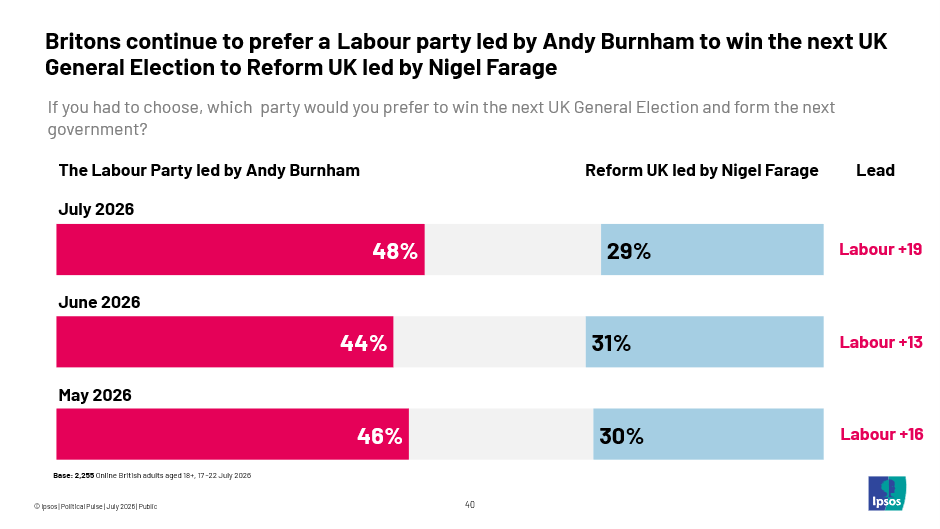
- Almost half of the public (48%) prefer a Labour Party led by Andy Burnham to win the next General Election, compared to 3 in 10 (29%) who prefer Reform UK led by Nigel Farage.
- This is despite 6 in 10 British adults (62%) saying Great Britain is heading in the wrong direction, and 44% giving the Labour Government a low score (0–3 out of 10) for running the country.
- Kemi Badenoch and Nigel Farage’s public favourability ratings are moving in opposite directions over the last year. Badenoch’s net favourability score has improved from -30 to -11 since last July, while Farage’s has fallen from -14 to -32.
- 59% cite healthcare and the NHS as the paramount issue determining their vote at the next General Election, followed by inflation (57%) and immigration (50%).
New polling data from Ipsos in the UK, conducted 17–22 July 2026 as Andy Burnham was preparing to assume office as Prime Minister, reveals public sentiment towards his incoming premiership and views of his political rivals.
Mixed public mood surrounding leadership transition but Andy Burnham and Labour see their favourability ratings increase
Public reaction to the leadership change reflects a divide across party lines, though Andy Burnham maintains the highest net favourability among senior political figures in Great Britain, and this brings an improvement in views towards the Labour party too.
- 1 in 3 British adults (32%) hold a favourable view of Andy Burnham (+6ppts since June), while the same proportion (31%) are unfavourable (net +1), placing him ahead of opposition figures such as Kemi Badenoch (29% favourable, 40% unfavourable) and Nigel Farage (25% favourable, 57% unfavourable).
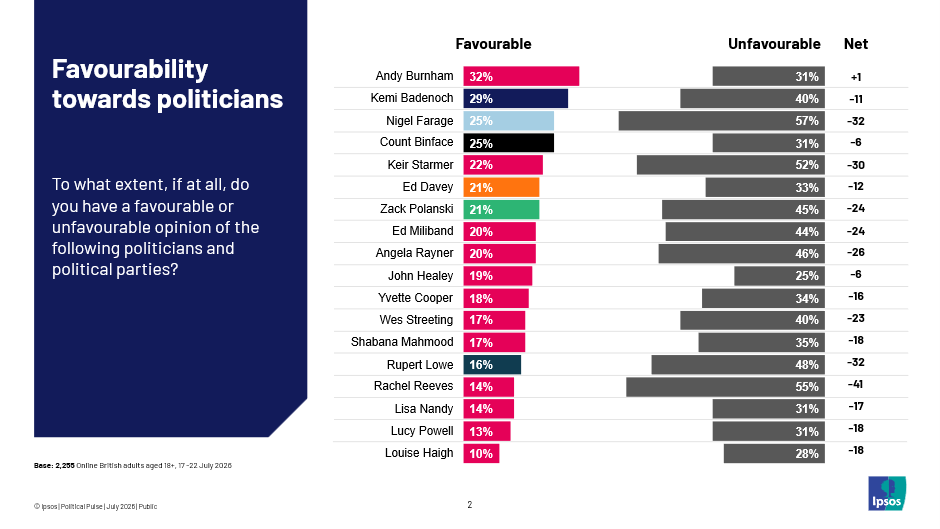
- 6 in 10 Labour 2024 voters (60%) view Burnham favourably, alongside 39% of LibDems. Green 2024 voters are split (28% favourable, 30% unfavourable), but 2024 Conservative and Reform UK voters are clearly negative (53% and 60% unfavourable respectively).
- Outgoing Prime Minister Keir Starmer leaves office with 22% favourability and 52% unfavourability (net -30), a notable decline from his initial +7 net rating upon taking office, but still better than the final favourability ratings for Rishi Sunak (-36 net favourable), Liz Truss (-66) or Boris Johnson (-42).
- While both Kemi Badenoch and Nigel Farage’s favourability ratings are little changed from last month, they are moving in opposite directions. Kemi Badenoch’s net rating of -11 has improved from her score of -30 last July, while Nigel Farage’s net of -32 has fallen from -14 over the same period.
National direction, party standings, and voting priorities
The Labour party itself also receives a small uplift in popularity this month as it changes its leader, but broader anxieties about the direction of the country and how it is being governed continue to weigh heavily on the electorate.
- 6 in 10 Britons (62%) state that things in Great Britain are heading in the wrong direction and just 14% in the right direction, leaving net direction sentiment at -48 (little changed from last month).
- Britons still only give Labour a mean score of 3.8 out of 10 for the job it is doing running the country, although this is marginally up from last month’s 3.4 out of 10.
Nevertheless, nearly 1 in 2 British adults (48%) prefer a Labour Party led by Andy Burnham to win the next General Election, while 29% select Reform UK led by Nigel Farage, a 19-point lead for Labour, up from 13 points in June 2026.
- On party favourability overall, Labour stands at 25% favourable to 47% unfavourable, giving it a negative net rating of -22, although this is better than last month’s rating of -32. Reform UK and the Conservatives’ net ratings are little changed over the last month at -27 and -21 respectively.
- 59% cite healthcare and the NHS as the key issue deciding their vote, followed by inflation and the cost of living (57%), immigration (50%), and economic management (46%), with the share of those citing managing the economy up by 5ppts since May 2026.
Whose interests would different parties look after?
The public holds distinct expectations regarding which societal and regional groups would benefit under different parties and their leaders.
- 59% of the public expect a Burnham-led Labour government to look after the interests of people in the North of England, compared to 26% for a Kemi Badenoch-led Conservative government and 29% for a Nigel Farage-led Reform UK government.
- Conversely, 54% of Britons believe a Badenoch-led government would look after people in the South of England, and 45% a Farage-led Reform government, compared to 34% under Burnham.
- Just over half of British adults expect Burnham to look after people on low incomes (54%) and benefits (55%), whereas around 6 in 10 expect Badenoch and Farage governments to look after big businesses (62% and 58% respectively) and people on high incomes (60% and 55%).
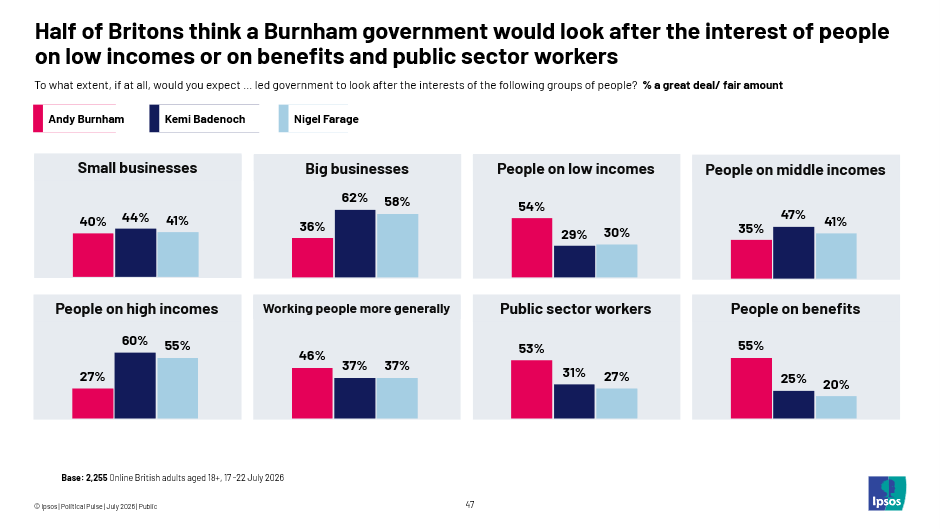
- Nearly half of Britons (46%) expect Burnham to look after renters and young people, compared to 31% who expect his government to look after homeowners.
Commenting on the findings, Gideon Skinner, Senior Research Director for UK politics at Ipsos, said:
The transition of power to Andy Burnham comes after a long period of deep public dissatisfaction with the direction of the country, yet it offers Labour some opportunity for a political lift. Public sentiment surrounding Burnham is split between hope and caution and voters’ enthusiasm should not be overstated – with Britons sceptical towards politicians after a long period of volatility they are reserving judgement for now. Nevertheless , his broader appeal among a wider coalition provides a distinct contrast to his predecessor, and for the moment at least is taking some of the reflex negativity towards Labour away.
However, while Labour is now gaining ground over Reform UK in potential head-to-head scenarios (although another story is Kemi Badenoch improving her favourability ratings over the last year as Nigel Farage’s have dropped), metrics of the national mood remain grounded in pessimism amidst anxieties over the economy and cost of living, state of public services and immigration. And while the public are broadly hopeful Andy Burnham will look after those in North and those on low incomes, young and working people, there is more scepticism he will look after those in the South, homeowners, and people on middle (and high) incomes.
The immediate challenge for the new Prime Minister will be converting this initial public benefit of the doubt into tangible delivery on healthcare, living standards, border control and economic investment.
Notes to Editors:
- For media queries, please contact the Ipsos in the UK Press Office at [email protected]
- For the full findings, please visit the Ipsos website.
- Ipsos interviewed a representative sample of 2,255 online British adults aged 18+. Polling was conducted online between 17–22 July 2026.
- Data are weighted to match the profile of the population. All polls are subject to a wide range of potential sources of error.


