
Scotland Public Opinion Monitor November 2010
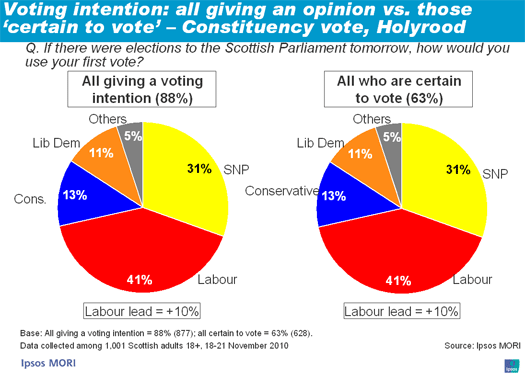
With five months to go until the Scottish Parliament elections, Labour has increased its lead over the SNP to 10 points in the latest poll from Ipsos Scotland. Among those certain to vote in May's election, Scottish Labour have 41% of the constituency vote, an increase of 4 percentage points since our last poll in August. The SNP are currently sitting on 31% (down 3 points), the Scottish Liberal Democrats are on 11% (down 2 points), while the Scottish Conservatives have increased their share by 2 points to 13%.
However, Labour's share of the Holyrood list vote is down from 38% in August to 36% today, while the SNP have increased their share of second votes since August from 29% to 32%. The Conservatives and Liberal Democrats hold 12% and 8% of the list vote respectively, while the Greens and other smaller parties share 10%.
Despite Labour's lead, Alex Salmond remains the most popular party leader, with a net satisfaction rating (the percentage satisfied minus the percentage dissatisfied) of +17%, compared to +5% for Iain Gray. Scottish Conservative leader Annabel Goldie has a net satisfaction rating of +1% and Scottish Liberal Democrat leader Tavish Scott has a net satisfaction rating of -4%.
Following last week's budget announcement by finance secretary John Swinney, Scots are more likely to think that it will be bad thing for both themselves and Scotland as a whole. Over a third of respondents (37%) thought the budget was bad for them personally (compared to 25% who thought it was a good thing), while the same proportion (37%) thought it was also a bad thing for Scotland as a whole (compared to 29% who thought it was a good thing).
However, the majority of Scots support many of the Scottish Government's key proposals in the budget. More than three quarters (78%) support the pledge to maintain the Council Tax freeze, while two thirds (66%) support the policy of maintaining NHS spending while reducing spending in other areas. In addition, 60% of Scots support freezing pay for public sector workers who earn 16321,000 or more and 59% support abolishing prescription charges.
Mark Diffley, Research Director at Ipsos said:
"As the Holyrood election looms ever closer, Labour has opened up a substantial lead in our latest poll. This represents a gradual shift in fortunes in the past 12 months which has seen the Labour's share of the vote increase from 32% to 41% since November 2009, while the SNP's share has fallen 36% to 31% over the same period. Labour also seems to be the main beneficiary from a fall in the popularity of the Liberal Democrats, who now stand at 11%, while the Conservatives stand at 13%. On a more positive note for the Government, the First Minister remains an asset to the party, with 54% expressing satisfaction in the job he is doing, higher than for the other party leaders. A week after the Finance Minister delivered the budget to Parliament, Scots are broadly supportive of the specific measures the Government is introducing, but divided over whether the budget is good one at a personal or national level."
- Download the topline (PDF)
- Download the full computer tables (PDF)
- Download the presentation slide pack (PDF)
Technical Note
- Results are based on a survey of 1,001 respondents160conducted by telephone between 18th November and 21st160 November 2010
- Data are weighted by age, sex and working status using census data, and tenure using SHS 2007-2008 data
- An asterisk (*) indicates a percentage of less than 0.5% but greater than 0.
- Where results do not sum to 100, this may be due to multiple responses or computer rounding
- Where the base size is less than 30 the number (N) rather than the percentage of respondents is given160
- Results are based on all respondents (1,001) unless otherwise stated.


