
What makes a global leader in Corporate Social Responsibility?

According to the global NGO community, leading companies in Corporate Social Responsibility (CSR) are those that successfully integrate Sustainable Behaviour throughout their businesses.
These leading companies demonstrate responsible concern for both the environment - with regards to sustainable sourcing of raw materials - and communities - including the safety and well-being of their employees - right through the supply chain. And, they make it relevant to the landscape within which their organisations operate.
Partnering up with an NGO to carry out campaign initiatives is also a reliable way to ensure they sit on the leader board.
So, which companies are in the lead?
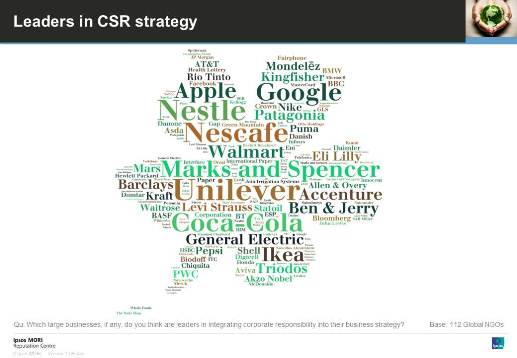
Unilever is by far the most highly regarded with a third (32%) of NGOs mentioning the organisation spontaneously as a leader in integrating corporate responsibility into its business strategy. Nestle ranks second best with 15% of unprompted mentions followed by Marks and Spencer, Coca-Cola and Google all with a 5% share of mentions.
The common element for all of these organisations is that their sustainability initiatives promote how they give back to the local communities on a global scale - with many relying on partnerships with highly regarded NGOs.
Unilever is often perceived as the biggest and the best when it comes to integrating its CSR into the business and their overall reputation. One NGO states that ‘Unilever has the Sustainable Living Plan whereby they look at all of their brands and generally see how they are operating in terms of a series of indicators; they have made those quite transparent. They have tied their reputation very heavily on their performance in terms of sustainability’.
Similarly, Marks and Spencer has Plan A - partnering with multiple NGOs including Oxfam, Shelter and WWF to reach their goals, while Coca-Cola has the Coca-Cola Foundation, a philanthropic organisation of its own making and prioritising women empowerment, water conservation and employee well-being.
Each of these organisations also focuses on the areas that relate most too how their businesses operate - whether that is the raw materials used in their products such as coffee beans or water or the communities they impact and the employees who work in their fields and factories.
Companies that focus on initiatives linked to their own business requirements are seen as more credible in their approaches. According to one NGO, ‘Nestlé and Unilever are leading in that they are taking a comprehensive look at their supply chain for raw materials through processing, trying to understand what impacts they have and how can they best medicate those or even eliminate them’.
But it’s not just about what these organisations do and who they partner with that make them leaders, it’s also about how successful they are in doing so; what they report back to their stakeholders. And, it is the same faces again that are thought to be leaders in reporting on their CSR success.
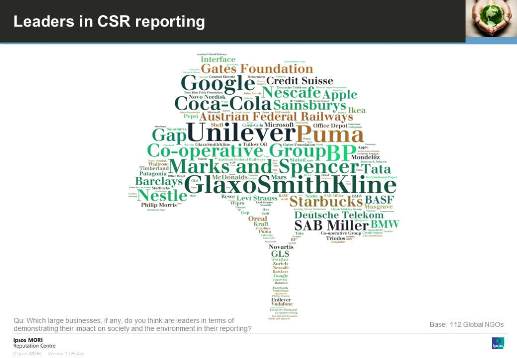
The top organisation once again is Unilever with 17% of spontaneous mentions followed by Marks and Spencer (4%), Coca-Cola (4%), Google (4%) and Nestle (4%). Also, top of the leader board this time is Puma, GlaxoSmithKline and BP – all also with a 4% share of unprompted mentions.
These organisations make the leader board due to the clarity of their reporting and the openness of their communications. They set ‘non-financial’ targets and goals from which to benchmark their progress and success; acknowledging that CSR cannot always be tied to financial success; ‘Marks & Spencer…have been very explicit about their Plan A and how they have met the specific criteria and [that] which they are still working on’.
Puma and BP make it on to the leader board for different reasons. They demonstrate innovative and distinct approaches to reporting their success.
‘Puma has pioneered the concept of environmental profit and loss reporting which has made a huge impact on how businesses see their impact, it is much more environmentally dominated than socially, but it is a real step change forward’.
BP gains credibility as it acknowledges the mistakes it has made and clearly reports its steps to address this. According to one NGO, ‘in response to the oil spill BP tried to green themselves, post oil spill they made a big attempt to do that’.
While some of these factors may seem like just good sense, companies need to consider a more distinct approach to CSR to raise perceptions as well as identifying opportunities to create or partner with not for profit organisations. These are the companies that are remembered by NGOs and that ultimately make it on to the leader board.
About this survey:
Ipsos conducted 112 telephone interviews between 29th September and 19th December 2014 with Global NGOs.
These Global NGOs participants consisted of CEOs, Directors and Heads of Policy and Programmes across 54 NGOs based in North America, Europe, Central and South America, Africa and Asia.


